AGS Formula 1 Team: The Full Story of France’s Smallest Constructor (1986-1991)
AGS was one of the smallest and most unlikely teams in Formula 1 history, born in a small French village and carried into the World Championship by sheer persistence. Between improvisation, talent, and financial limitations, the Gonfaron-based team left a unique mark on motorsport.
CLASSIC MOTORSPORT
6/19/202610 min read
The AGS Formula 1 team — Automobiles Gonfaronaises Sportives — stands as one of the most remarkable stories of independent ambition in the history of the World Championship. Born in the small French village of Gonfaron, a commune of fewer than 4,000 inhabitants located roughly 686 kilometers from Paris, the team was the creation of Henri Julien, a former racing driver with an exceptional mechanical aptitude who began hand-building racing cars in what was essentially an artisanal workshop in the late 1960s. The initials AGS proudly carried the name of its hometown: Automobiles Gonfaronaises Sportives.
From Village Workshop to Formula 2
Julien began by constructing cars for junior categories before setting his sights on the competitive European Formula 2 championship. In 1978, a season heavily dominated by March with BMW power, Julien debuted the JH15 chassis with French driver Richard Dallest at the wheel. The entry was modest, but it marked AGS's first serious steps in professional single-seater competition.
The team's finest Formula 2 hours came in 1980. In a season largely dominated by Toleman-Hart machinery, AGS managed a remarkable achievement: two race victories with Dallest still driving. The small French constructor won the Grand Prix de Pau in the Pyrenees region and a race at Zandvoort in the Netherlands. Dallest added a fourth place at one of the Hockenheim rounds and a fifth at Enna-Pergusa in Sicily, finishing the year with 23 points and sixth in the drivers' standings — a genuinely impressive result for such a tiny outfit.
AGS continued developing its Formula 2 program with care and dedication. Even without significant financial resources, the team produced some of the most aesthetically refined Formula 2 cars of the era. In 1982, Philippe Streiff joined Henri Julien's project and went on to write his name permanently into motorsport history: on September 23, 1984, driving the AGS JH19C at Brands Hatch, Streiff won the very last Formula 2 race ever held.
The Formula 3000 Bridge
With Formula 2 finished, Julien made the natural transition to Formula 3000, the new European feeder series created to replace it. In 1985, AGS entered a single car — the JH20 — for Streiff. Competition had intensified: Lola returned to European single-seater racing, and March dominated the championship with Christian Danner defeating Mike Thackwell's Ralt. The grid also included former Formula 1 cars from Williams, Tyrrell — one driven by Brazilian Roberto Moreno — and Arrows.
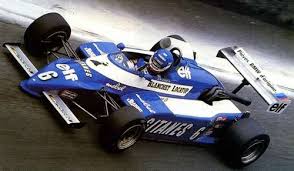
Streiff scored 12 points, finished eighth in the championship, and claimed a single podium at Zandvoort. His performance attracted Ligier, which recruited him to replace the inconsistent Andrea De Cesaris. Streiff also made a brief appearance for Tyrrell at the South African Grand Prix, filling in after Ligier declined to travel to Kyalami — respecting a request from President François Mitterrand in the context of South Africa's apartheid regime.
The AGS Formula 1 Team Is Born
It was the cost comparison between Formula 3000 and Formula 1 that triggered Julien's most audacious decision. The financial gap between the two categories was apparently smaller than expected. While the JH20B was still racing in the feeder series, Julien had already begun work on an F1 car for the 1986 season.
The challenge was enormous. The entire AGS operation numbered just nine people, including Julien himself. The Jolly Club team — which managed a semi-official Lancia entry in the World Rally Championship — lent personnel and resources. Yet it remained, by any objective measure, an extremely small outfit attempting something very large.
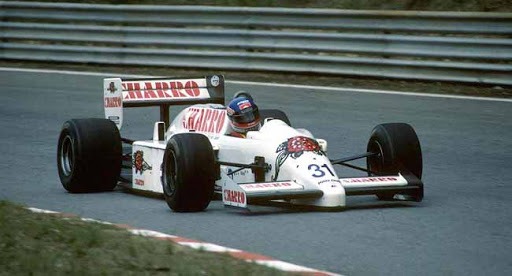
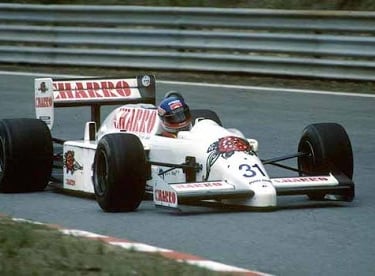
The resulting car, the JH21C, was designed by engineers Christian Vanderpleyn and Michel Costa. It was an unapologetic parts-bin special: the rear suspension and gearbox came from the Renault RE60 of 1985; the engine was a leased Motori Moderni V6 turbo; and several components were carried over from the team's last Formula 3000 car.
Ivan Capelli — who would go on to win the Formula 3000 championship in 1986 — was assigned to drive. On debut at the Italian Grand Prix, he qualified the JH21C ahead of the notoriously slow Osella entries before retiring on lap 31 with a puncture. At the Portuguese Grand Prix, Capelli again qualified 25th — ahead of Huub Rothengatter's Zakspeed and Allen Berg's Osella — before the gearbox failed on lap six.
AGS chose not to contest the final races of 1986. During this period, Julien invited Didier Pironi — absent from Formula 1 cockpits for four years after his catastrophic 1982 accident at Hockenheim — to test the JH21C at Paul Ricard. Pironi drove, offered diplomatic feedback, and encouraged Julien to continue. The test also appeared to confirm to Pironi himself that his future lay elsewhere. He subsequently pursued offshore powerboat racing and tragically died during the 1987 World Offshore Championship near the Isle of Wight when his boat was struck by a wave at high speed.
1987: The AGS Formula 1 Team's First Full Season
For 1987, the AGS Formula 1 team committed to a full campaign, still operating with nine people. The car was the JH22, again designed by Vanderpleyn. Financial constraints produced some unconventional solutions: the chassis was based on a Renault RE40 from 1983 — previously raced by Alain Prost and Eddie Cheever — and the underbody was constructed from plywood. One genuine technical contribution AGS did make was the revival of the periscope-style engine air intake, a design element used in Formula 1 between 1970 and 1976 before being regulated out.
Pascal Fabre, a French driver Julien knew from Formula 2, was contracted to drive. His mandate was simple: finish as many races as possible and collect points if circumstances allowed. AGS was grouped with Tyrrell, March, and Larrousse as Ford Cosworth DFZ-powered teams.
At the season opener in Brazil, Fabre qualified 13 seconds off Nigel Mansell's pole position. His race pace was over nine seconds per lap slower than Nelson Piquet's winning time — comparable to F1 standards from 1981 — yet he finished 12th. That result set the template for his season: invariably at the back but consistently reaching the finish line. Gaps to pole varied from seven seconds at Monaco to fifteen seconds at Spa-Francorchamps.
At both the French and British Grands Prix, Fabre achieved his best result of the season — ninth place — despite starting from the back of the grid. After that, reliability became increasingly problematic. Two consecutive disqualifications in Italy and Portugal prompted the team to seek outside help.
Roberto Moreno and the AGS Formula 1 Team's First Championship Point
Roberto Moreno, who had finished third in the 1987 Formula 3000 championship driving a Ralt-Honda, was brought in to provide technical feedback and help develop the JH22. Moreno was well known as a driver capable of maximizing whatever machinery he was given and articulating its problems clearly — exactly what a small team with limited testing resources required.
His contributions helped Fabre qualify for the Spanish Grand Prix at Jerez, though the race lasted only eleven laps before a clutch failure ended it. A further disqualification for Fabre in Mexico prompted the team to give Moreno race duties for the final two rounds.
At the Japanese Grand Prix, Moreno faced long odds: 27 cars competing for 26 grid slots. He qualified last, 10.170 seconds behind pole-sitter Gerhard Berger. In the race, he briefly ran ahead of Alain Prost — who had suffered a first-lap puncture — and ahead of René Arnoux's Ligier, before a fuel injection failure ended his race on lap 22 while running 18th.
At the Australian Grand Prix in Adelaide, Moreno delivered the most significant result in the AGS Formula 1 team's history. He qualified half a second ahead of Adrián Campos's Minardi, avoiding last place — a meaningful improvement by the team's standards. In the race, his fastest lap was only four seconds off Berger's best, and as attrition claimed car after car, Moreno climbed steadily through the field. He received the checkered flag three laps down in seventh place.
Hours after the race, the stewards announced that second-placed Ayrton Senna had been disqualified for an irregularity in the brake duct air inlets. Moreno was elevated to sixth — earning the AGS Formula 1 team its first-ever World Championship point. That single point was also critically important for a practical reason: it helped the team avoid the pre-qualifying system being reintroduced for 1988.
1988: The JH23 and Near-Misses
Encouraged by Adelaide, Henri Julien authorized Christian Vanderpleyn to design the JH23 — AGS's first genuinely purpose-built F1 car. Julien also unusually decided not to require Moreno to bring sponsorship money, believing commercial support would follow the team's growing reputation.
However, development funding dried up during construction. Unable to sustain Moreno without financial backing, Julien reluctantly parted ways with the Brazilian and signed Philippe Streiff, who arrived with personal sponsorship after losing his Tyrrell seat to a better-funded rival.
The JH23 represented a genuine step forward. At the Canadian Grand Prix in Montreal, Streiff qualified on the fifth row and set the fourth-fastest race lap, running as high as fifth and pressuring Nelson Piquet's troubled Lotus 100T before suspension failure on lap 42 denied him a likely points finish. At Detroit, starting 11th, Streiff passed Piquet and several others before the suspension again collapsed while he was running seventh.
In the second half of the year, Streiff started outside the top twenty in all but three races. His best result was eighth at the Japanese Grand Prix. AGS finished the season without points, though the performances in Canada and Detroit had demonstrated that the JH23 was capable of running with the midfield in the right conditions. Notably, the driver AGS had released — Roberto Moreno — won the 1988 Formula 3000 championship that same year.
1989: Tragedy and Decline
For 1989, the AGS Formula 1 team expanded to a two-car operation for the first time in a full season. Streiff remained as lead driver, joined by Joachim Winkelhock, younger brother of the late Manfred Winkelhock, who brought commercial sponsorship with him.
The season began in tragedy. During tire testing at Rio de Janeiro's Jacarepaguá circuit, Streiff suffered a severe accident at the fast Curva do Cheirinho when the rear suspension of his car broke. The roll hoop collapsed on impact, and emergency response was inadequate and slow. Streiff sustained neck fractures and spinal cord injuries, and as a direct consequence of the accident and delayed medical treatment, he was left permanently paraplegic, ending his racing career.
With Streiff's replacement unconfirmed, AGS entered Brazil with only Winkelhock, who failed pre-qualifying. For San Marino, the team signed Gabriele Tarquini, who had lost his intended seat at the First team after that operation collapsed due to internal disagreements and lack of funding.
While Winkelhock struggled to pass pre-qualifying throughout the year, Tarquini produced some noteworthy results: eighth in San Marino, a respectable 13th on the grid in Monaco, and sixth in Mexico — the last achieved by running minimal aerodynamic downforce to maximize straight-line speed in compensation for the Ford Cosworth DFR's power deficit.
After seven consecutive pre-qualifying eliminations, Winkelhock's patience was exhausted by Julien, who dismissed him despite his sponsorship and replaced him with Yannick Dalmas, recently released by Larrousse. The second half of the season was dismal: neither Tarquini nor Dalmas passed pre-qualifying for any remaining race. A costly administrative error in Portugal — the team incorrectly marked Dalmas's used tires, leading to disqualification in scrutineering — summed up the team's deteriorating fortunes.
Partway through the season, Henri Julien stepped away from the team. Cyril de Rouvre took over as owner, appointing François Guerre-Berthelot as sporting director. The change brought no improvement on track.
1990: Ted Lapidus and the JH25
Despite 1989's difficulties, De Rouvre committed to another season. Both Tarquini and Dalmas were retained. A sponsorship deal was secured with the Ted Lapidus fashion house, and Hughes de Chaunac — later prominent in endurance racing through Oreca — was named team principal.
The new car, the JH25, was designed by Michel Costa. It was by far the most professionally conceived car in AGS history, but underfunding continued to compromise it. Through the French Grand Prix, neither driver had managed to start a race from the regular qualifying sessions. Dalmas finally broke through at Paul Ricard, qualifying 17th. Tarquini subsequently started in Britain and Hungary, finishing 13th in the latter.
At the Spanish Grand Prix in Jerez, the AGS Formula 1 team achieved a historic milestone: both cars qualified for the same Grand Prix simultaneously, for the first time ever. Dalmas delivered the team's best result of the season — ninth place. Tarquini closed the year at the Australian Grand Prix, retiring with engine failure.
1991: The Final Chapter of the AGS Formula 1 Team
AGS returned for 1991 with the same JH25, repainted white after Ted Lapidus ended their sponsorship. Tarquini was joined by veteran Swedish driver Stefan Johansson, 34, whose experience at Ferrari and McLaren suggested he could provide useful technical direction. Without money, however, even experienced hands could not alter the trajectory.
Tarquini qualified at both Phoenix and Interlagos. In Arizona he finished eighth; in Brazil he was eliminated in a first-lap accident. Johansson failed to qualify for either race and subsequently moved to the Footwork team. From San Marino onwards, Italian Fabrizio Barbazza replaced him. By this point, De Rouvre had sold the team to Italian businessmen Gabriele Rafanelli and Patrizio Cantú, who maintained their countrymen in the cockpits.
At the Monaco Grand Prix, Tarquini qualified in 20th place and retired early with a gearbox problem. That would prove to be the last occasion an AGS car started a World Championship Grand Prix. For the latter part of the European season, the team introduced a revised livery and the JH25B, but results did not improve. From the German Grand Prix onwards, both drivers were required to compete in pre-qualifying, from which neither could advance. The team had only three engines available per race weekend, serviced on credit by Swiss rebuilder Heini Mader.
A final development project — the JH27, designed by Vanderpleyn with assistance from Mario Tolentino, formerly of Eurobrun — consumed the team's last resources. After failing to qualify at the Portuguese Grand Prix, Tarquini departed for Fondmetal. Olivier Grouillard, released by Fondmetal, took his place. The Spanish Grand Prix was the team's final paddock appearance. Neither Grouillard nor Barbazza advanced to the qualifying sessions. Rafanelli and Cantú recognized the situation was irretrievable and closed the operation.
Legacy of the AGS Formula 1 Team
Over its Formula 1 existence, the AGS Formula 1 team contested 47 World Championship Grands Prix and scored just two championship points in total — both earned by Roberto Moreno's drive at the 1987 Australian Grand Prix. The team never scored points under any other circumstance.
What the statistics cannot fully capture is the sheer improbability of the endeavor. A nine-person operation from a French village, building cars largely from second-hand components, competing at the highest level of motorsport against factory-backed giants — and occasionally troubling the midfield in the process. The AGS Formula 1 team's Formula 2 record was genuinely strong; its F1 journey was defined by ingenuity under severe constraint. Henri Julien built something from almost nothing, and while the final chapters were difficult, Automobiles Gonfaronaises Sportives remains one of the most remarkable stories of independent ambition in Formula 1 history.