Colin Chapman: The Genius Who Redefined Formula 1 — Innovation, Risk, and Controversy
There are engineers who build racing cars, and there are visionaries who rewrite what a racing car can be.
CLASSIC MOTORSPORT
4/13/202610 min read
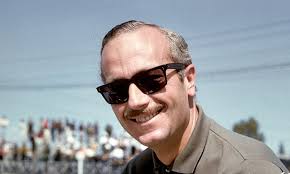
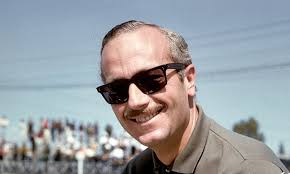
There are engineers who build racing cars, and there are visionaries who rewrite what a racing car can be. Colin Chapman was unquestionably the latter — a man who didn't just compete in Formula 1, but fundamentally changed its DNA. Yet behind every masterpiece, there was a shadow: a tolerance for risk that extended far beyond the racetrack. What happens when genius operates without limits for engineering creativity and business ideas?
Who Was Colin Chapman
Anthony Colin Bruce Chapman was born on May 19, 1928, in Richmond, Surrey. From an early age, he was drawn not just to speed but to the logic of speed — the mechanics behind why things moved, and how they could move faster . He studied structural engineering at University College London, served briefly in the RAF, and by his mid-twenties had already begun building cars in a lock-up garage with little more than ambition and borrowed money .
In 1952, he founded Lotus Cars with just £25 lent to him by his girlfriend — and future wife — Hazel Williams . The company's name itself became synonymous with a certain spirit: light, nimble, defiant. Chapman's engineering mindset was shaped by a radical question he seemed to ask himself constantly: what can I remove without losing performance? That question would go on to change everything.
He wasn't just building faster cars — he was rewriting the rules.
The Philosophy That Changed Everything
No phrase captures Colin Chapman's genius more cleanly than "simplify, then add lightness." While competitors at Ferrari, BRM, and Brabham were engineering power through mass — adding components, strengthening structures, reinforcing chassis — Chapman was moving in the opposite direction . Every gram removed from a car was, in his view, as valuable as any horsepower gained.
This philosophy gave Lotus a structural edge that was almost unfair. A lighter car brakes later, changes direction faster, and puts less stress on its tyres. In an era when teams were in an arms race of raw engine power, Chapman was playing a different game — one based on physics, not force . The ripple effects of this thinking can be traced through every lightweight carbon fibre chassis in Formula 1 today.
Innovations That Put Him Ahead of His Time
Monocoque Chassis Revolution
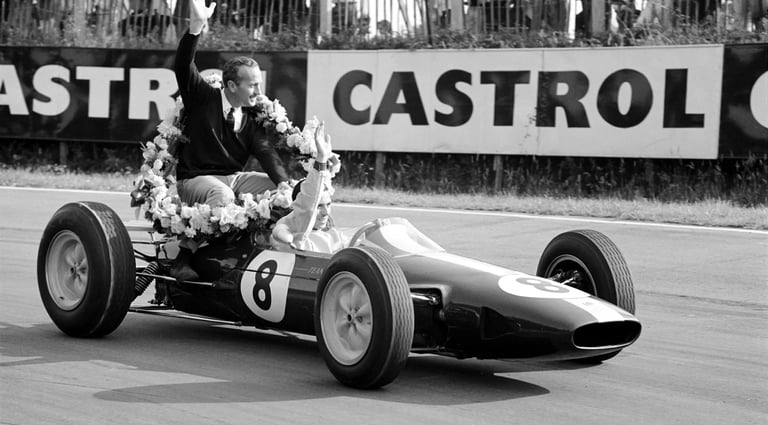
In 1962, Chapman unveiled the Lotus 25 at Zandvoort, and the paddock fell silent. Instead of a traditional space-frame of welded tubes, the car featured the first fully stressed monocoque chassis in Formula One history — a rigid aluminium shell in which the bodywork itself carried the structural loads . The 25 was three times stiffer than its predecessor, the Lotus 24, while its chassis weighed only half as much .
The effect on performance was immediate. In the hands of Jim Clark, the Lotus 25 took 14 World Championship Grand Prix victories . The original sketches, reportedly drawn on napkins during a dinner with aerodynamicist Frank Costin, became one of the most influential blueprints in motorsport history . When the car first appeared, John Cooper walked over to Chapman and asked where he had hidden the frame tubes — he simply could not believe what he was seeing.
Engine as a Structural Element
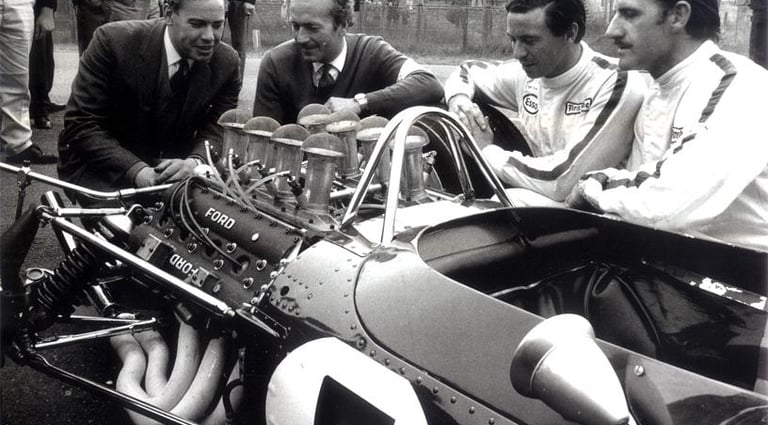
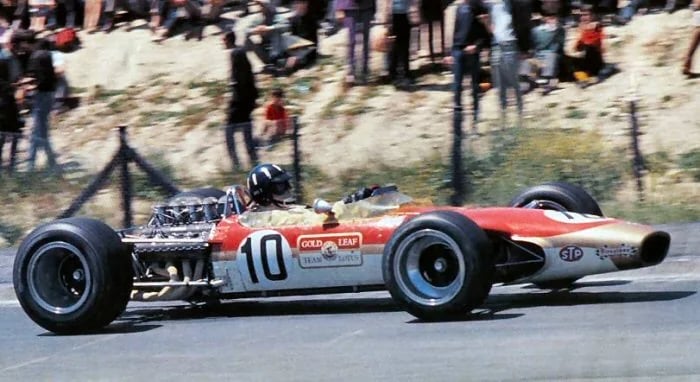
Chapman's next act of engineering audacity arrived in 1967 with the Lotus 49. Working with Maurice Philippe, he designed a car in which the Ford Cosworth DFV engine was not merely bolted to the chassis — it became part of the chassis, serving as a fully stressed structural member between the monocoque and the rear suspension . The concept had been explored in limited form before, notably by BRM, but the Lotus 49 executed it with a clarity that made the entire grid take notice .
Jim Clark won on the car's debut at Zandvoort in 1967 — an announcement that echoed through the sport . Graham Hill then used the 49B to win the 1968 World Championship. More significantly, the principle Chapman applied — engine as structure — has been adopted by virtually every Formula 1 car built since . What was radical in 1967 became the universal template.
The Wedge Shape That Redefined Aerodynamics
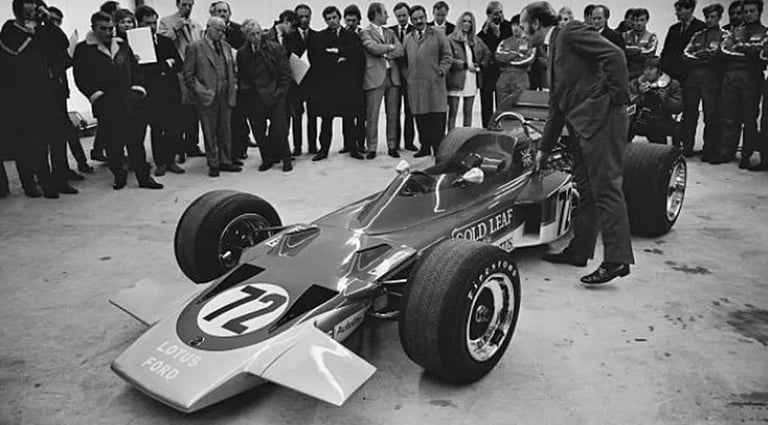
In 1970, Chapman introduced yet another concept that the rest of the field would spend years trying to replicate: the Lotus 72. Designed by Maurice Philippe under Chapman's direction, the car abandoned the conventional rounded nose in favour of a radical wedge-shaped profile, pushing the radiators to the sidepods and positioning the driver further back within the chassis. The result was a dramatically lower centre of gravity and a far more aerodynamically efficient form than anything previously seen on a Formula 1 grid. Inboard brakes — another Lotus first — further reduced unsprung weight and improved handling balance. In the hands of Jochen Rindt, the 72 was so dominant in 1970 that Rindt posthumously claimed the World Championship after his fatal accident at Monza — the only driver in Formula 1 history to win the title after his death. Emerson Fittipaldi then carried the car to a second championship in 1972. The Lotus 72 remained competitive for five full seasons, a testament not only to the brilliance of its original concept but to how far ahead of its time Chapman had once again engineered his creation.
Ground Effect Dominance
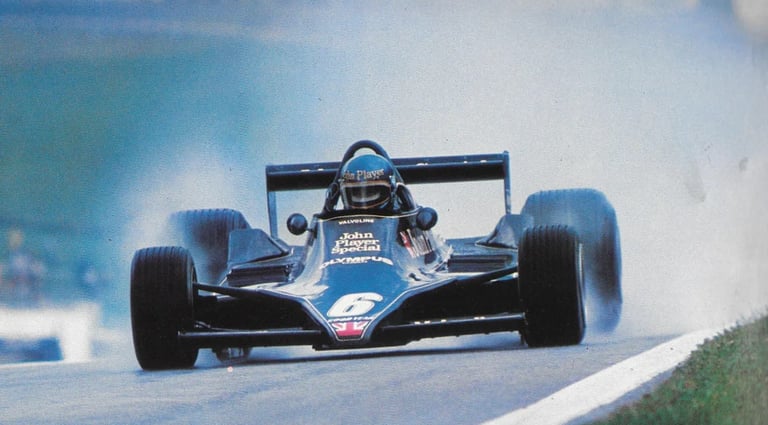
By the mid-1970s, Chapman was once again staring at the horizon while everyone else was looking at the road. His team developed the concept of ground effect aerodynamics, culminating in the Lotus 79 of 1978. By shaping the underfloor of the car into inverted wing profiles — aerodynamic tunnels running along the sidepods — the Lotus 79 generated massive downforce through suction rather than drag . The car was essentially glued to the track by the air beneath it.
The result was dominance. Mario Andretti and Ronnie Peterson were almost untouchable in 1978, and Andretti claimed the World Championship that year . Chapman wept on the pitwall when Andretti clinched the title — one of the few moments the usually controlled Englishman let his emotions show publicly. Once again, rival teams spent seasons reverse-engineering what Chapman had already moved on from.
But Chapman's genius didn't stop at engineering…
The Business Mind That Reshaped F1
The Birth of Sponsorship in Formula 1
In 1968, Colin Chapman did something that seems obvious in retrospect but was genuinely revolutionary at the time: he painted his car in the colours of a cigarette brand. The deal with Gold Leaf, a tobacco company owned by Imperial Tobacco, transformed the Lotus 49B into a rolling billboard — red, white and gold, completely abandoning the traditional British Racing Green .
This was the moment Formula 1's financial model changed forever. Before Chapman, cars wore national racing colours — a tradition dating back to the sport's origins. After Chapman, they wore money . The commercial logic was irresistible: manufacturers got global television exposure; teams got funding that dwarfed anything a national motorsport federation could offer. Every sponsorship deal in modern Formula 1 — from the Red Bull livery to the McLaren papaya — traces its lineage directly back to that Gold Leaf Lotus in 1968.
If you want to feel what it was actually like to be inside the Lotus operation during one of its most transformative seasons, this documentary footage bellow from 1968 offers a rare and candid glimpse. Shot in the same year Chapman introduced commercial sponsorship to Formula 1 — and just months after the loss of Jim Clark at Hockenheim — it captures the team in raw, unfiltered form: the garage atmosphere, the engineering culture, and the quiet intensity that defined how Chapman ran his operation.
Operating in the Grey Area
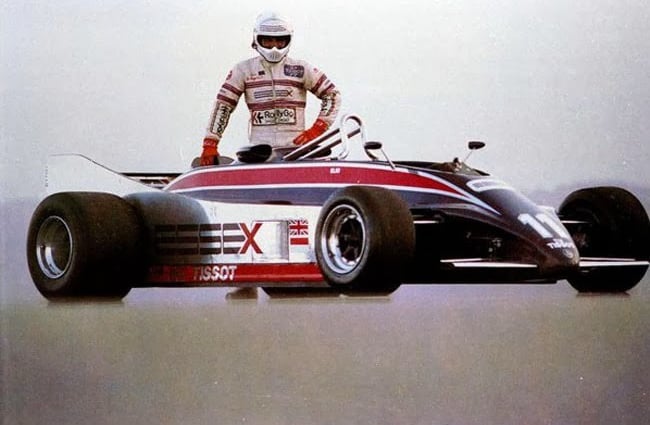
Chapman's willingness to push limits was not confined to the drawing board. He was known throughout the paddock as someone who treated regulations as puzzles to be solved rather than rules to be respected — and sometimes the line between ingenuity and gamesmanship became deliberately blurred . His twin-chassis Lotus 88, designed in 1981 to exploit a loophole in aerodynamic regulations, was banned before it could race, triggering a furious public dispute with the FIA that Chapman never fully resolved.
Financially, Chapman was equally aggressive. He ran Lotus on tight margins, made strategic decisions that occasionally sacrificed driver safety for performance, and cultivated a persona — part visionary, part showman — that drew investors and sponsors as much as engineering talent . The same force of personality that convinced Ford to fund the development of the Cosworth DFV engine also made him a polarizing figure: revered by those who worked with him, and wary-eyed by those who worked around him.
Road Cars: Turning the Track Into a Showroom
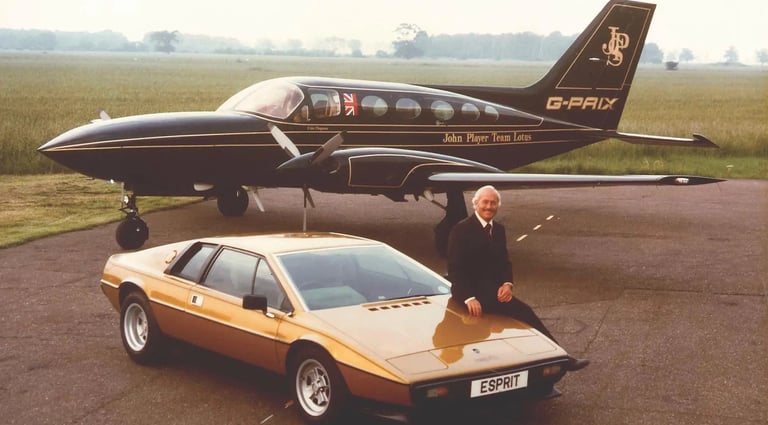
Chapman understood early that the racetrack was not just a battlefield — it was the world's most effective marketing platform. Lotus road cars were never conceived as luxury products or mass-market vehicles; they were, in essence, racing cars with number plates. The Lotus Elite (1957) was the first production car to use a fibreglass monocoque body-chassis unit, a direct translation of Chapman's obsession with structural lightness into a road-going package. The Lotus Elan, launched in 1962, became a cultural icon of the 1960s — light, sharp, and intoxicatingly responsive, it set the benchmark for the small sports car and directly influenced the first-generation Mazda MX-5 decades later. The Lotus Europa and later the Lotus Esprit — famously driven by James Bond in The Spy Who Loved Me (1977) — expanded the brand's reach into international popular culture while reinforcing Chapman's central thesis: that a car need not be heavy to be fast, powerful, or desirable. Each road car was, in Chapman's own words, a proof of concept. The commercial revenue they generated funded the racing programme; the racing programme, in turn, sold the road cars. It was a virtuous cycle that Chapman engineered as deliberately as any chassis.
The DeLorean Connection
In the late 1970s and early 1980s, Chapman became involved with John Z. DeLorean and the creation of the DeLorean Motor Company in Belfast, Northern Ireland. Chapman's role included engineering consultancy, and Lotus engineers contributed significantly to the development of what would become the iconic stainless-steel DMC-12 sports car . The project was backed in large part by the British government as an economic stimulus for a troubled region.
But beneath the glossy surface, serious financial irregularities were developing. Investigations revealed that approximately £10 million in British government funds had been diverted through a network of companies into Swiss bank accounts — accounts allegedly connected to Chapman and his financial associate Fred Bushell . Chapman was never charged. The investigation was ongoing at the time of his death, and its unresolved nature would permanently cloud his legacy. Whether he was an architect of the fraud or an opportunist swept up in someone else's scheme remains a question without a clean answer.
A Sudden and Controversial End
On December 16, 1982, Colin Chapman died of a heart attack at his home in Norfolk. He was 54 years old . The timing was extraordinary — the DeLorean investigation was intensifying, and Chapman had been due to face further questioning from authorities in the coming months. His death came before he could be formally charged with anything.
For those who knew him, the timing was simply tragic — a restless mind extinguished far too early. For others, it raised questions that have never been definitively answered . Some have speculated about the possibility of digitalis poisoning; others attribute it to the punishing lifestyle Chapman maintained — the long hours, the constant stress, the reported use of stimulants and sedatives to manage his extraordinary pace of work . The official cause of death was cardiac arrest. The circumstances remain, to this day, a subject of quiet debate among those who study his life.
The Legacy That Still Defines F1
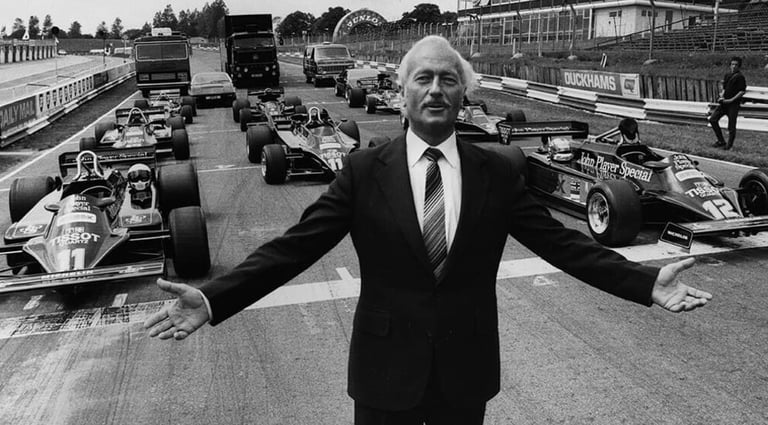
Walk through any modern Formula 1 garage and you are walking through Colin Chapman's ideas — refined, evolved, but unmistakably his. The monocoque safety cell. The engine as a stressed structural member. The obsession with minimising weight. The aggressive pursuit of aerodynamic downforce. These are not historical curiosities; they are the foundational architecture of every car on the grid today .
His influence extended beyond engineering. The commercial model he introduced in 1968 generates billions of dollars annually. His willingness to challenge the FIA at every regulatory boundary pushed the sport to write clearer rules — and in doing so, to better define what Formula 1 even was. Teams including McLaren have publicly acknowledged that Chapman's concepts shaped their own technical philosophy . Even Ayrton Senna, who drove for Lotus in the early years of his F1 career, cited the team's engineering culture as formative in his development.
A Genius Beyond His Time
The duality at the heart of Colin Chapman's story is what makes it endure. He was the man who convinced Ford to build one of the greatest racing engines in history on the basis of a handshake deal. He was also the man whose financial dealings in Belfast left questions that his death permanently foreclosed. He pushed his cars to the absolute edge of what physics allowed — and occasionally pushed his drivers past what safety could permit.
But measured against the canvas of Formula 1's entire history, Chapman's brushstrokes are everywhere. He didn't simply participate in the evolution of the sport. In three distinct decades, across three separate domains — chassis engineering, powertrain philosophy, and commercial structure — he defined the direction in which that evolution moved. Chapman wasn't just ahead of his time. He was the reason his time became what it was.