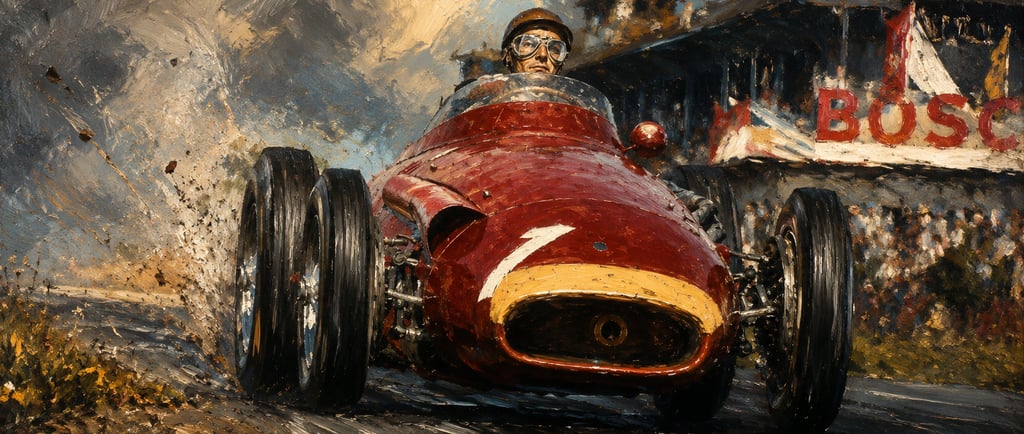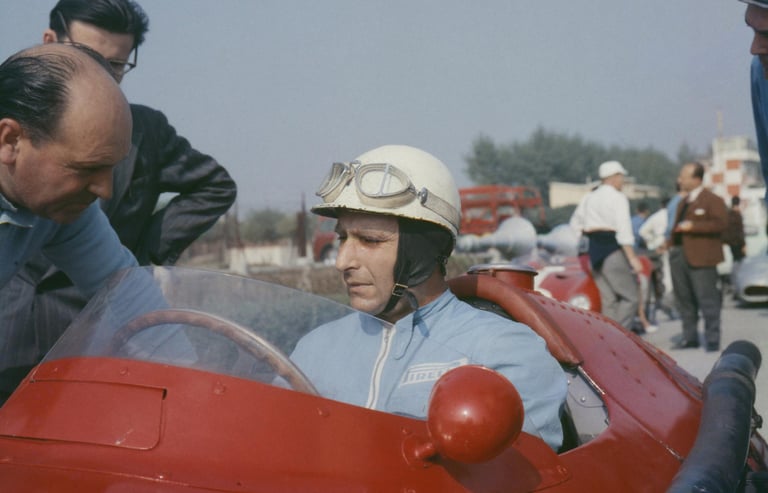
Fangio at Nürburgring ’57: The Drive That Turned Greatness Into Legend
In 1957, at 46 years old, Fangio lost nearly a minute in the pits at the Nürburgring — and answered by shattering lap records in an impossible chase. The result forever cemented his image as the greatest driver in Formula 1 history.
CLASSIC MOTORSPORT
7/1/20269 min read
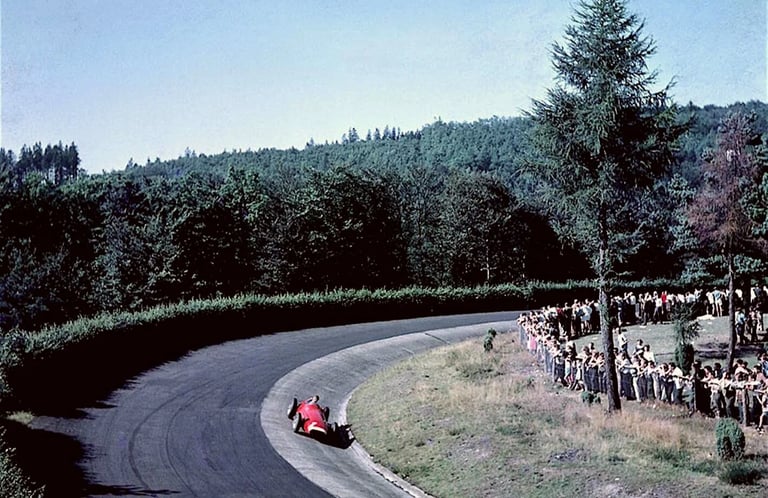
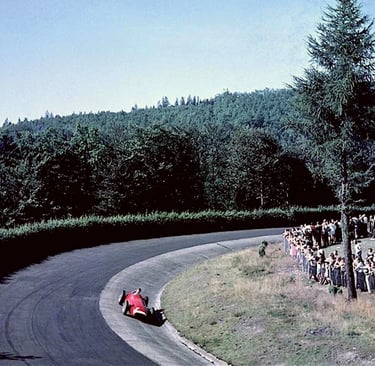
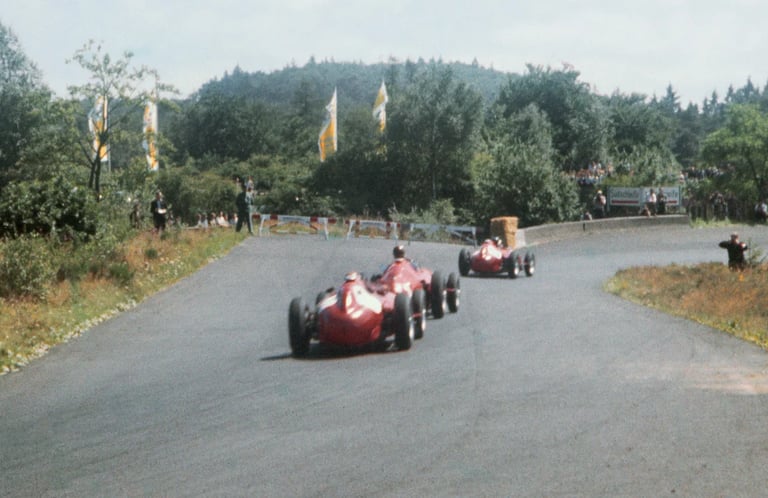
There are races that decide championships, and then there are races that decide legacies. The 1957 German Grand Prix belongs firmly to the second category. On a warm August afternoon at the Nürburgring, Juan Manuel Fangio delivered a performance so extraordinary, so far beyond what seemed physically possible for a man and a machine of that era, that it has since been enshrined as perhaps the single greatest drive in the history of motor racing. It was the race that took a champion already regarded as supreme and turned him into something closer to myth.
To understand why this race carries such weight, one must first understand where Fangio stood in the summer of 1957, what the Nürburgring demanded of any driver brave enough to attack it, and who the men were that shared the track with him that day. Only then does the drama of the race itself make sense — the slow pit stop, the seemingly hopeless deficit, and the relentless, almost inhuman chase that followed.
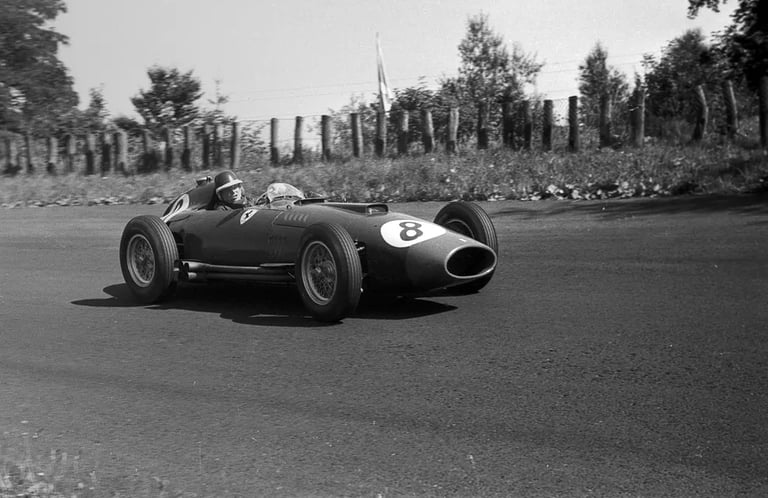
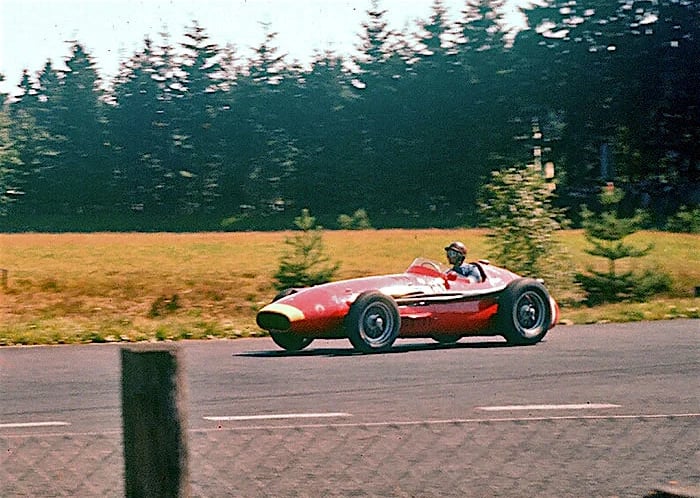
By the time the field rolled toward the start at the Nürburgring Nordschleife, Fangio was already the dominant figure of early Formula 1. He had won four World Championships with four different manufacturers, a record that spoke not only to speed but to adaptability, intelligence, and an almost unmatched ability to master very different cars and conditions. In 1957, driving the Maserati 250F, Fangio was still operating at the peak of his powers at 46 years old, an age when most drivers would have been considered veterans rather than title contenders. Yet the Argentine arrived in Germany with a real chance to secure a fifth crown, and with it a place in the sport’s permanent memory.
The Nürburgring was the perfect stage for such a moment. It was not a circuit in the modern sense, but a vast, brutal ribbon of asphalt carved through the forested hills of western Germany. Long, narrow, and relentlessly demanding, the Nordschleife punished hesitation and rewarded bravery only when that bravery was matched by absolute control. A driver needed rhythm, discipline, and a memory for detail that bordered on the unnatural. One bad corner could cost not just time, but life.
Fangio understood all of this better than anyone. He had already won at the Nürburgring before, and he knew that to win there again in 1957 would require more than speed. It would require judgment. It would require a plan.
The Season Around Him
By the middle of the 1957 season, the title picture had narrowed around Fangio. His victories earlier in the year gave him a significant cushion, but nothing in that era was ever guaranteed. Reliability was fragile, strategy was still evolving, and races were often decided as much by mechanical survival as by raw speed. In that environment, Fangio’s calm, intelligent style gave him an edge that younger, more aggressive drivers struggled to match.
Maserati had assembled a competitive package around the 250F, while Ferrari remained a dangerous threat with its own blend of speed and tactical discipline. The championship was a contest between philosophies. Maserati trusted Fangio to attack. Ferrari trusted Hawthorn and Collins to endure. That difference would shape the entire German Grand Prix.
The Nürburgring was the perfect venue for such a showdown. The Nordschleife was over 22 kilometers long and wound through a landscape that looked picturesque from a distance and merciless up close. It had little in common with the safer, shorter circuits that would eventually dominate Formula 1. There were no rhythm sections built for modern convenience, no forgiving runoff zones, no margins designed to rescue a small mistake. Instead, the driver had to memorize the circuit almost as though learning a language. Every rise, every compression, every blind apex had to be stored mentally and respected physically.
For Fangio, this was not a problem. It was a place to demonstrate mastery.
The Key Players
Ferrari’s challenge came through Mike Hawthorn and Peter Collins, two drivers who represented different strengths but formed a powerful partnership. Hawthorn was sharp, stylish, and fiercely competitive. Collins was younger, charismatic, and exceptionally smooth. Together, they were asked to apply pressure, make Fangio think, and capitalize on any strategic mistake.
Jean Behra, Fangio’s Maserati teammate, added another layer to the story. Behra was talented enough to matter, but on this day the race was not going to be decided by a deep field of contenders. The Vanwall team, with Stirling Moss, Tony Brooks, and Stuart Lewis-Evans, was also present, but suspension and damper problems effectively removed them from contention for the win. So the race would be Fangio versus Ferrari, intelligence versus calculation, precision versus patience.
The Nürburgring would expose whichever side had overestimated its own margin. As it turned out, the Ferrari camp believed the race could be controlled through consistency. Fangio’s camp believed the race could be won through pace plus a stop. Both approaches made sense on paper. Only one would survive contact with the track.
Opening Stages
From the beginning, Fangio looked composed and fast. He had taken pole position with a lap that already hinted at something exceptional, and once the race began he led with the kind of measured aggression that had defined his career. He was not throwing the Maserati around the Nürburgring in a wild attempt to create spectacle. He was placing it exactly where it needed to be, section by section, corner by corner, as though the track had been drawn for him.
The strategic plan was straightforward. Fangio would run lighter fuel and faster tires, build a cushion, stop in the middle of the race, and then attack again. Ferrari chose the opposite approach: heavier fuel, no stop, a longer opening stint, and a hope that consistency would reward discipline. On a normal circuit, that might have worked well enough. On the Nürburgring, where lap time is long and the cost of recovery huge, strategy becomes as important as speed.
For much of the first half of the race, Fangio’s approach looked ideal. He was fast enough to control the pace and measured enough to preserve the car. He completed his early laps with authority and appeared to have the race in hand. Then came the stop.
The Catastrophic Pit Stop
The pit stop is the moment most often remembered because it is the hinge on which the entire race turned. Fangio came in expecting a routine service, but the stop became a mess. The refueling and tire change took too long, and what should have been a manageable interruption became a near-catastrophic delay. By the time Fangio rejoined, the race had changed completely.
Now he was behind both Ferraris, with Hawthorn and Collins suddenly looking like the men in control. The deficit was enormous, nearly a minute in the broadest sense, with roughly 48 seconds separating Fangio from the front runners once the stop was complete. On a circuit as long and physically punishing as the Nürburgring, that was the kind of gap that could crush a race psychologically even before it became mathematically difficult.
For anyone else, it would have been a moment of damage limitation. For Fangio, it became the beginning of one of the most remarkable pursuits in racing history.
Comeback Starts
What Fangio did next separated the good from the immortal. He did not simply begin driving harder. He began driving at a level that seemed to dissolve the meaning of caution. Lap after lap, he attacked the Nürburgring with such rhythm and confidence that he started to erase the Ferraris’ lead in dramatic chunks. Reports and retellings of the race emphasize how relentlessly he lowered the lap record, repeatedly resetting the standard as he closed the gap.
At this point, the race ceased to feel like a conventional contest. It became a demonstration. Fangio was no longer just racing Hawthorn and Collins. He was racing time itself. The Nordschleife, with its endless sequence of bends, crests, drops, and blind turns, was supposed to break rhythm. Instead, Fangio imposed his own. He made a brutal circuit answer to his timing and line choice.
Fangio was not a reckless outsider gambling on one wild lap. He was an established master building speed through precision. He knew exactly how far he could push, and when the pressure demanded it, he found another level that did not appear visible at the start of the day.
The Ferraris, meanwhile, were not collapsing. Hawthorn and Collins drove well. They had been smart to favor consistency. But consistency, once Fangio found his second wind, could not hold the line. One by one, the seconds disappeared.
Final Catch
As the laps wound down, the chase reached its decisive phase. Fangio was now close enough to see the Ferraris as real targets rather than distant markers. He first closed in on Collins, then Hawthorn, and the overtake sequence that followed has become part of F1 folklore.
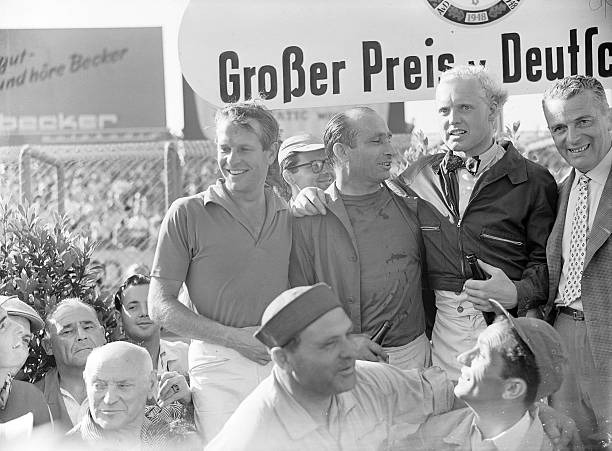
There was no theatrical excess to it. Fangio did not need drama in the modern sense. His authority came from the fact that the move itself was inevitable once he had arrived in range. He passed Collins, then turned his attention to Hawthorn, and by then the whole race had become his to finish. Fangio crossed the line as winner of the German Grand Prix, taking his fifth world championship in the process.
The final margin was only a few seconds, which only deepens the mystique. It means the race was about how close Fangio came to turning a ruined afternoon into a world title-winning triumph.
To truly appreciate the drama of that afternoon at the Nürburgring, some moments are best seen rather than described. Below, you can watch footage capturing key highlights of Fangio's legendary drive — the pit stop disaster, the record-breaking laps, and the decisive overtakes that sealed his fifth world title.
Racing history is full of great drives, but the 1957 German Grand Prix stands apart because it combined so many elements at once. There was the age factor: a 46-year-old driver still outperforming younger rivals. There was the circuit itself, a place that demanded complete technical and mental harmony. There was the strategy gamble, the pit stop failure, the impossible deficit, and the response that followed.
But beyond those facts, there is something more difficult to measure. Fangio’s drive at the Nürburgring projected a sense of control so complete that it changed the way people spoke about him. He was no longer just a great champion. He was the man who could take a race that seemed lost and bend it back into a victory through pure authority.
That is why this race is remembered as the moment Fangio’s legend hardened into something permanent. Drivers come and go, championships are won and lost, but performances like this are rare because they require the perfect collision of talent, pressure, and context.
Fangio’s Legacy
Fangio later regarded this as the greatest race of his career, and it is easy to understand why. He had won in many different cars, on many different circuits, against many different rivals. But the 1957 German Grand Prix represented something more complete than a single victory. It became the clearest proof that Fangio was not merely fast, but supreme in the deepest sense of the word.
What he did at the Nürburgring helped define the early mythology of Formula 1 itself. The sport was still young, still forming its identity, still searching for its icons. Fangio gave it one of its most enduring images: a master, under pressure, at one of the hardest circuits ever built, recovering from disaster with a drive that made the impossible look methodical.
That is why the 1957 German Grand Prix endures. It was not only a race. It was a statement. Fangio did not just win the day. He helped define what greatness in Formula 1 could mean.