Forever 29: The Tragic Story of François Cevert, Formula One's Lost Champion
François Cevert. Born Paris, 25 February 1944. Died Watkins Glen, 6 October 1973. French Formula 3 Champion, 1968. Third in the Formula One World Championship, 1971. One Grand Prix victory. Great potential.
CLASSIC MOTORSPORT
4/6/20269 min read
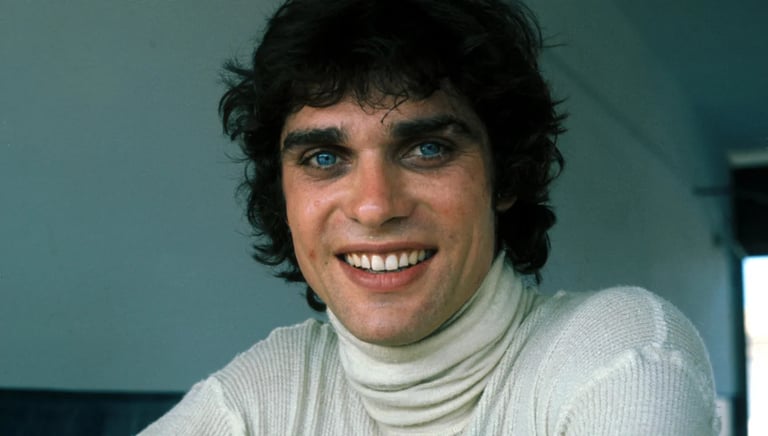
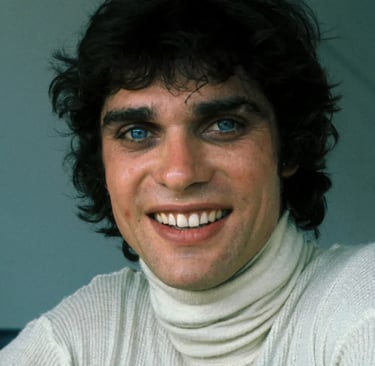
He had the face of a movie star, the hands of a pianist, and the heart of a racer who would stop at nothing. François Cevert was everything Formula One wanted in the early 1970s — elegant, fast, charming, and dangerous in the best possible way. By the time the sport took him, at 29, he was on the verge of becoming its next great champion. What remains is a story of breathtaking promise, a bond between driver and mentor unlike any other in the paddock, and a death so violent it forced Jackie Stewart to walk away from the sport he had conquered.
This is the story of Albert François Cevert, and it deserves to be told in full.
A Family That Chose Survival
To understand François Cevert, you first need to understand where the name comes from — because it almost wasn't his.
His father, Charles Goldenberg, was born in Russia and brought to Paris as an infant to escape the persecution of Jews under Tsarist autocracy. He built a life in the French capital as a jeweller, married Huguette Cevert, and started a family. When the Nazi occupation of France began in World War II, Charles joined the French Resistance — but to protect his children from the reach of the Reich, all four of them were registered under their mother's surname.
Charles Goldenberg became the father of four Ceverts. After the liberation of France, he considered reverting the family name to Goldenberg, but by then the children had grown into their identity. They stayed Cevert. It was a small act of history reshaping a life — and that life would eventually reshape Formula One.
Albert François Cevert was born on 25 February 1944, in Paris, as the war still raged across Europe.
The Scooter on the Streets of Paris
There was no karting dynasty behind Cevert, no racing family pedigree, no famous father handing down a helmet. What there was, at age 16, was a teenager racing his mother's Vespa scooter against friends on the streets of Paris — the kind of reckless, joyous, absolutely illegal thing that young men did in postwar France when speed felt like freedom.
The more deliberate entry into motorsport came through his older sister, Jacqueline, who became romantically involved with — and later married — Grand Prix driver Jean-Pierre Beltoise. Through that connection, Cevert was pulled deeper into the racing world. He graduated from the Vespa to his own Norton motorcycle at 19, and after completing his compulsory national service, he enrolled at the Winfield Racing School at Magny-Cours.
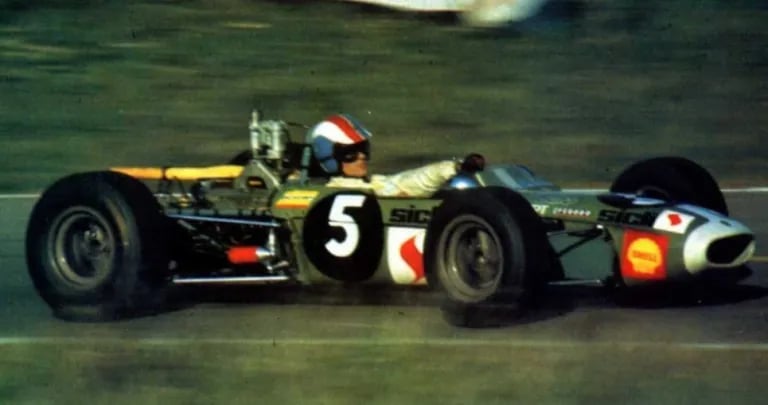
There, in 1966, he entered the Volant Shell scholarship competition — a prestigious talent hunt for young French drivers — and won it, beating a certain Patrick Depailler to first place. The prize was a fully-sponsored season in French Formula 3, driving an Alpine-Renault. It was the door he needed. He walked through it and never looked back.
Rising Through the Ranks: F3, F2, and the Eye of Jackie Stewart
Cevert's first season in Formula 3 was humbling. Underfunded and inexperienced at setting up a racing car, he struggled with the Alpine. But Cevert was not the kind of man to be embarrassed into quitting. He found sponsorship for 1968, switched to the more competitive Tecno chassis, and immediately the results came. By the end of the season, he was French Formula 3 Champion, edging out Jean-Pierre Jabouille in a tight fight.
Formula 2 was the next logical step, and Cevert took it with Tecno in 1969, finishing third in the European F2 Championship — a remarkable result for a driver in only his second year of single-seater racing. He also made his unofficial Grand Prix debut that year, driving in the F2 class of the German Grand Prix.
It was during an F2 race at Crystal Palace that the moment happened — the one that changed everything. Jackie Stewart, already a Formula One World Champion, found himself stuck behind the young Frenchman, unable to get past. It was not the kind of thing that happened to Jackie Stewart. After the race, Stewart walked straight to Ken Tyrrell and told him to keep an eye on the kid.
That conversation would prove to be one of the most consequential in Formula One history.
Tyrrell Calls, and a Legend Begins
The opening Cevert needed came mid-season in 1970. Johnny Servoz-Gavin, Tyrrell's second driver alongside Stewart, suffered a sudden deterioration in his eyesight and was forced to retire from racing. Tyrrell needed someone immediately. Stewart's recommendation was still fresh in his mind, and Cevert got the call.
He made his Tyrrell debut at the Dutch Grand Prix in Zandvoort, driving a customer March-Ford. He was raw but quick, and he closed the gap to Stewart with almost every race. By the Italian Grand Prix at Monza, he scored his first World Championship point with a sixth-place finish. It was modest, but it was enough to confirm what Tyrrell and Stewart already suspected: this was no mere number two driver filling a seat. This was a future champion learning his trade.
1971: The Pupil Wins His First Grand Prix
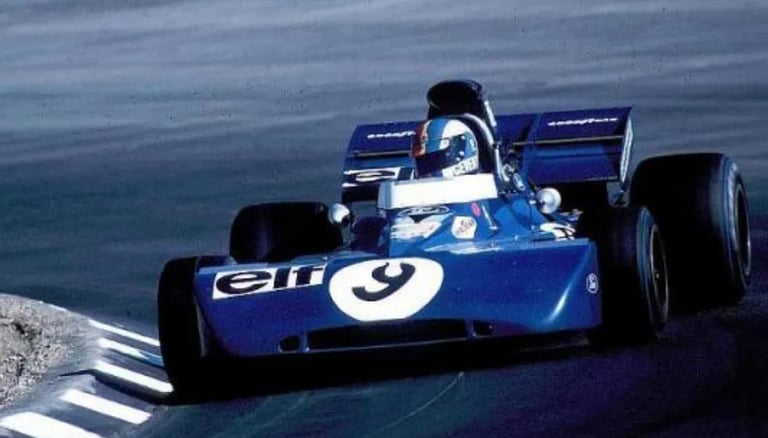
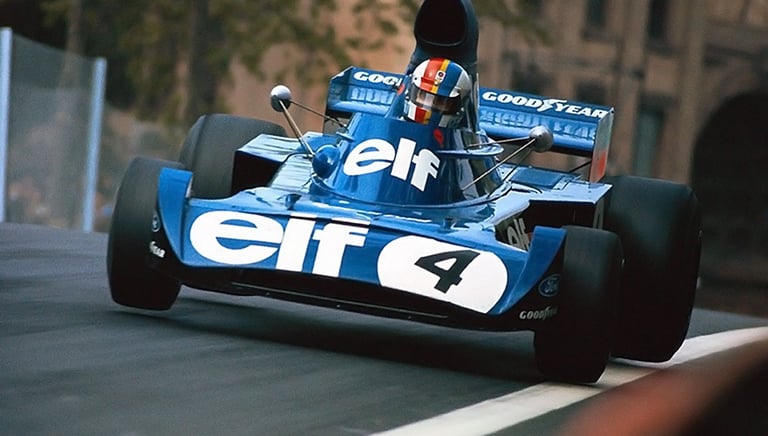
The 1971 season was transformative for Cevert. Tyrrell was now running their own chassis — the iconic Tyrrell 001 and 002 — and Stewart was on his way to a dominant World Championship. But Cevert was no decoration. He finished second in France, second in Germany, and third in Italy, establishing himself as one of the most consistent drivers on the grid.
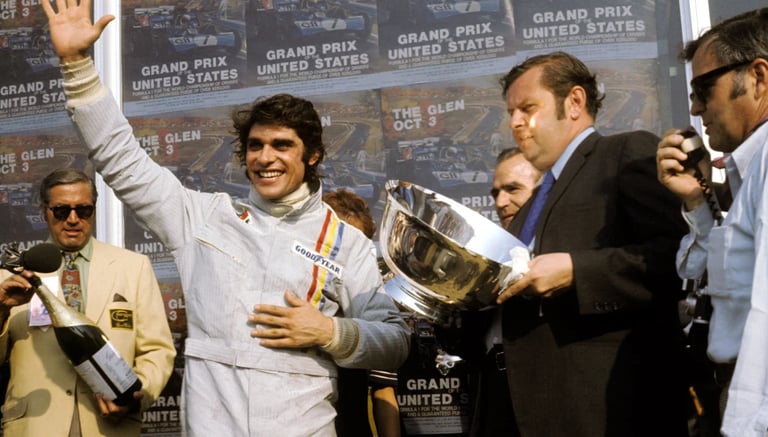
Then came Watkins Glen, New York, and the final race of the season — the United States Grand Prix.
Starting from fifth on the grid, Cevert took the lead from Stewart on lap 14 as Stewart's tyres began to deteriorate in searing heat. From there it was a matter of managing the car, resisting the pressure of Jacky Ickx's charging Ferrari, and bringing it home. Ickx closed to within 2.2 seconds before his alternator failed catastrophically, punching a hole in the gearbox and ending the Ferrari's challenge. Cevert coasted to victory, waving both hands above his head as he crossed the line — a gesture of pure, unbridled joy.
He was only the second Frenchman in history to win a Formula One World Championship Grand Prix, following Maurice Trintignant's victories at Monaco in 1955 and 1958. He was 27 years old, and it felt like the beginning of something extraordinary.
The result gave him third in the World Drivers' Championship, behind Stewart and Ronnie Peterson — not a bad address to keep for a driver in only his second full season of Formula One.
The Mentor and the Protégé
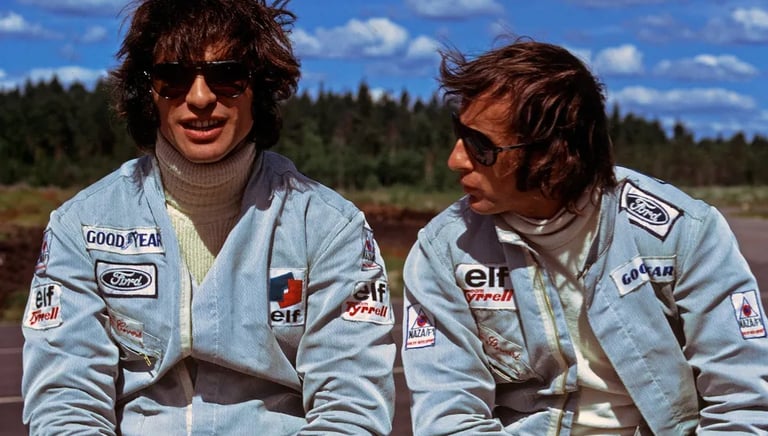
The relationship between Jackie Stewart and François Cevert was one of the great partnerships in the history of the sport — part friendship, part apprenticeship, part mutual fascination between two very different men who brought out the best in each other.
Stewart was methodical, disciplined, analytical. He wore his trademark tartan cap with the confidence of someone who had already figured out exactly what he wanted from life and from racing. Cevert was mercurial, passionate, and glamorous in the effortless French way — the kind of man who drew attention without trying. Off-circuit, he played piano with genuine skill, modelled for photographers, and moved through the paddock with an ease that made rivals simultaneously admire and envy him.
But on track, Cevert was ruthlessly devoted to improvement. He absorbed Stewart's teachings with the discipline of a professional athlete: braking points, tyre management, how to read a circuit's rhythm and work with the car rather than against it. Stewart later said openly that Cevert had become, by 1973, perhaps the most complete driver he had ever seen. The student was nearly ready to surpass the teacher — and Stewart knew it.
1972: A Year of Patience
The 1972 season was a step sideways rather than forward. The Tyrrell package was not at its best, and Cevert scored points only three times — second in Belgium, second in the United States, and fourth at his home race in France at the treacherous Clermont-Ferrand circuit.
But away from Formula One, there were glimmers of brilliance. At Le Mans, sharing a Matra-Simca 670 with New Zealand's Howden Ganley, Cevert finished second overall in one of the world's most gruelling races. In Can-Am, he won at Donnybrook, showing the versatility of a driver who was never purely a Formula One specialist — he simply loved to race, in whatever machine was available.
He also continued to compete in Formula 2, remaining sharp and competitive even when not required to. The season felt like a year of patience, a year of waiting for the machine to catch up with the man.
1973: The Crown Was His to Claim
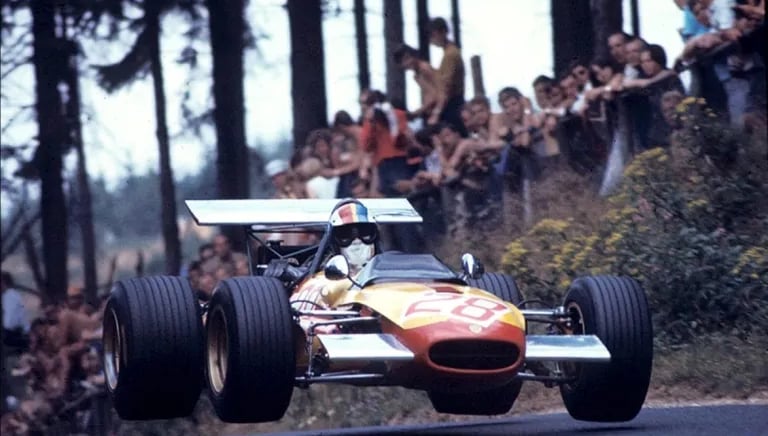
Everything clicked in 1973. The Tyrrell 006 was a superb car, Stewart was on course for his third World Championship, and Cevert was his shadow — relentless, fast, and impossible to ignore. He finished second no fewer than six times during the season, three of them directly behind Stewart. The partnership was working exactly as designed: Tyrrell collected maximum points, Stewart clinched the title, and Cevert waited for his moment.
And that moment was coming. Stewart had privately made the decision to retire from Formula One at the end of 1973. He told nobody outside his closest circle. For 1974, the plan was clear: François Cevert would become the number one driver at Tyrrell, the heir apparent to the most successful team in Formula One.
He also dominated in the World Sportscar Championship with Matra that year, taking five pole positions and six fastest laps across six races — a display of sheer speed that underlined just how complete a driver he had become.
Everything was in place. The crown was his to claim.
Watkins Glen, October 6, 1973
Saturday morning. Qualifying for the United States Grand Prix at Watkins Glen, New York. The circuit was fast and unforgiving, carved through the hills and forests of upstate New York with a sequence of corners that demanded total commitment and offered zero margin for error.
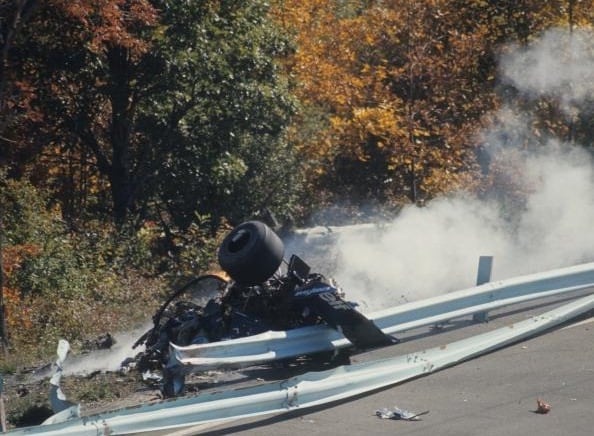
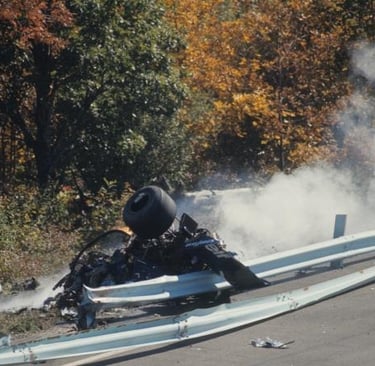
In the uphill sequence known as The Esses, Cevert's Tyrrell 006 drifted fractionally too far to the left, catching the kerbs. The bump sent the car swerving violently to the right, where it hit the powder-blue safety barriers. The car spun and crossed the track at near 90 degrees, striking the barriers on the opposite side with catastrophic force — uprooting them entirely.
François Cevert was killed instantly. He was 29 years and 224 days old.
Jackie Stewart, who arrived at the scene shortly after, found the marshals had left Cevert in the car. The reason was obvious. He turned and walked back to the pits. When Colin Chapman of Lotus was told who the driver was and that it was "very bad," he took one look at Stewart's face as he climbed from his car — and understood without a word. He shook his head and muttered, "Cevert… bloody hell."
Peterson, returning to his pit, was asked by Peter Warr what had happened. His answer: "I have never seen anything like it."
Tyrrell withdrew both entries from the race. Stewart never competed again — his planned farewell, what would have been his 100th Grand Prix start, never took place. He said years later that Cevert's death was something he never fully recovered from. The sport had taken his protégé, his friend, the man he had spent three years building into a champion.
Emerson Fittipaldi, one of the greatest champions of the era, sat in the paddock and asked himself, "Is this what I really want?" It was the question the entire sport was forced to confront.
The Legacy of a Man Who Should Have Been Champion
François Cevert was buried in the Cimetière de Vaudelnay in Maine-et-Loire, France — a long way from the circuits where he had burned so brightly.
The tragedy at Watkins Glen prompted immediate safety changes: a chicane was added to the circuit in 1975 to slow cars through The Esses. It came too late for Cevert, and too late for Helmut Koinigg, who died at the same circuit in 1974.
What Cevert left behind is harder to measure than a chicane. In 47 World Championship points, one Grand Prix victory, and four seasons of Formula One, he demonstrated a quality that transcended raw statistics: the rare, undeniable sense that you were watching someone who had not yet reached his ceiling. His best racing was still ahead of him. He was still becoming.
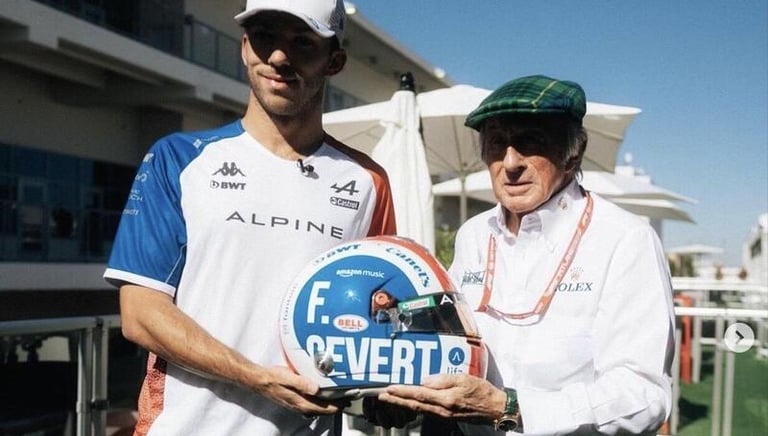
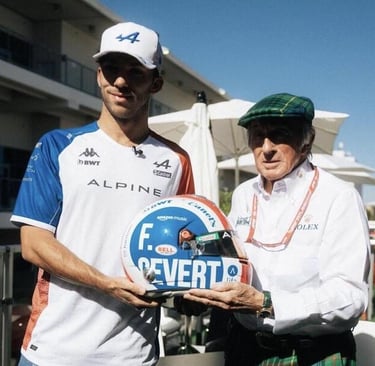
In 2023, fifty years after his death, Pierre Gasly wore a helmet tribute to Cevert at the United States Grand Prix. Jackie Stewart, attending the race, was moved to tears.
That is the mark of a driver who was never just a statistic. François Cevert was the prince of a generation, the heir to a dynasty that never was — a man the sport consumed at exactly the moment it was about to become his.
In a different world, we would be talking about his World Championships. In this one, we remember who he was: brilliant, irreplaceable, and forever 29.