Fourteen Kilometers of Glory and Blood: The Untold Story of Old Spa-Francorchamps
CLASSIC MOTORSPORT
3/16/202616 min read
Introduction: Farewell to a Giant
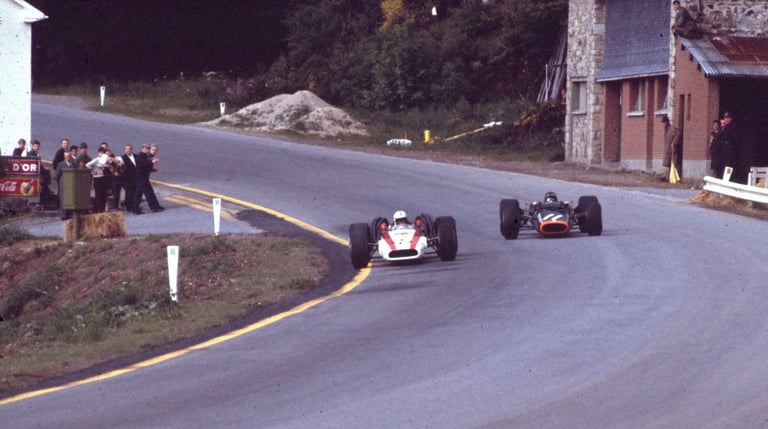
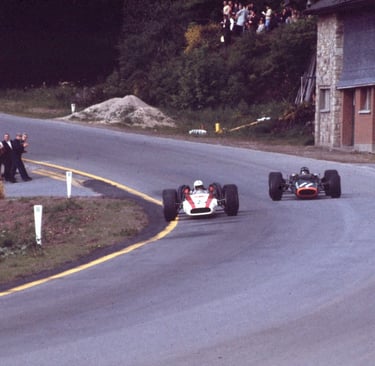
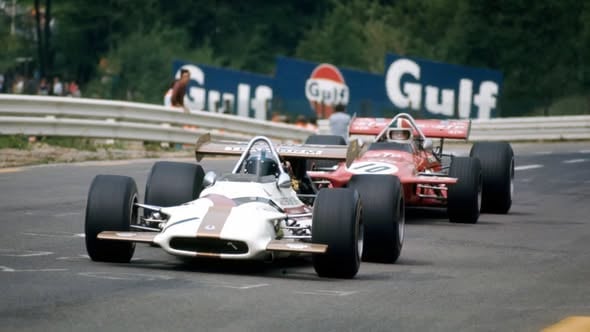
It was Sunday, June 7, 1970. In the hills of the Belgian Ardennes, among ancient forests and stone villages, the air smelled of gasoline, burnt oil, and history. For the last time, Formula 1 engines roared through the public roads of old Spa-Francorchamps — that enormous 14.1-kilometer circuit that, for decades, had been simultaneously the most glorious and the most feared stage in all of motorsport.
Nobody officially announced it was the end. There was no ceremony, no farewell speech. But everyone knew. The drivers knew. The mechanics knew. The spectators scattered along the corners, leaning against trees and house walls just meters away from cars at full speed, knew it too. Spa was living on borrowed time.
And here lies the paradox that makes this story so fascinating and so heartbreaking at the same time: the circuit that was banned from Formula 1 was, in the unanimous opinion of those who had raced at every corner of the world, the greatest racing circuit ever built. The fastest. The most spectacular. The purest test of courage and genius a driver could ever face. Juan Manuel Fangio loved it. Jim Clark mastered it like no other.
So why was Spa banned? Why did Formula 1 turn its back on its most magnificent track?
The answer lies in the trees with no crash barriers. In the wooden telegraph poles standing meters from the racing line. In the bodies of young drivers found in ditches and fields at the edge of the road. In a sport that, for too long, had confused danger with greatness — and paid for it in blood.
This is the story of Old Spa-Francorchamps. The story of a monster that everyone loved, nobody could tame, and the world eventually had no choice but to put down.
The Birth of the Circuit
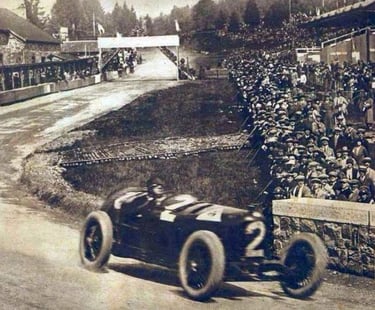
Long before Formula 1 existed, the Belgian Ardennes were already a playground for speed. Motor racing had been held in the region since 1896, and as early as 1902, public roads in the area were being closed to host competitive events — reportedly the first time in history that a public road was shut down specifically for motor racing.
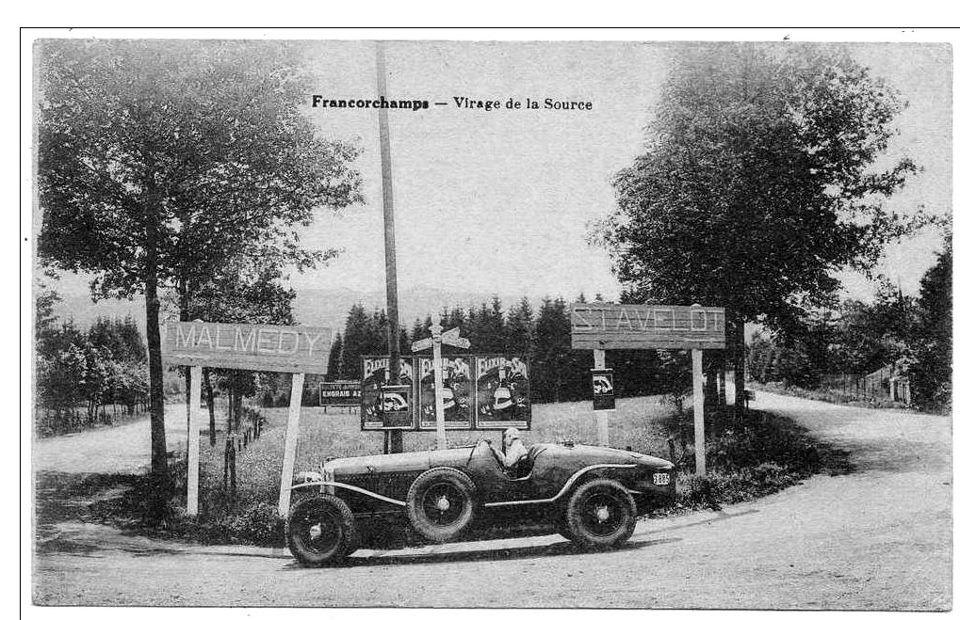
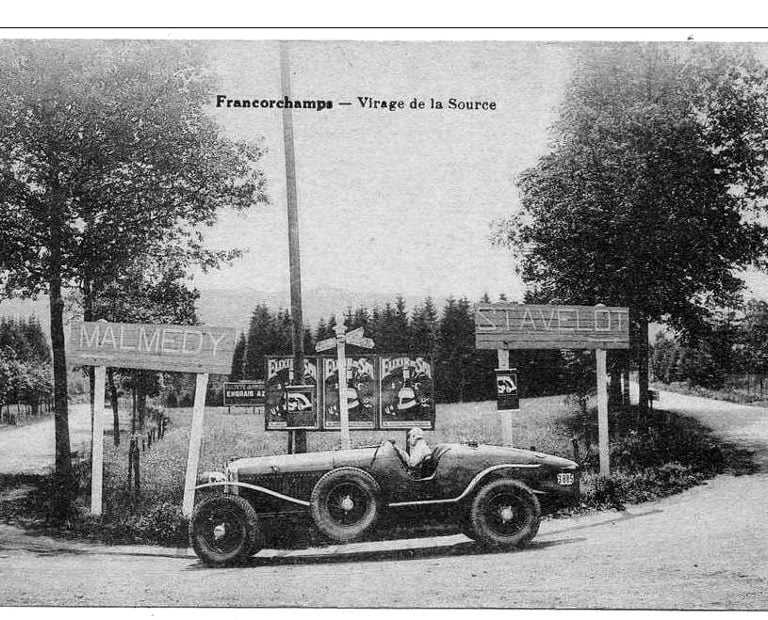
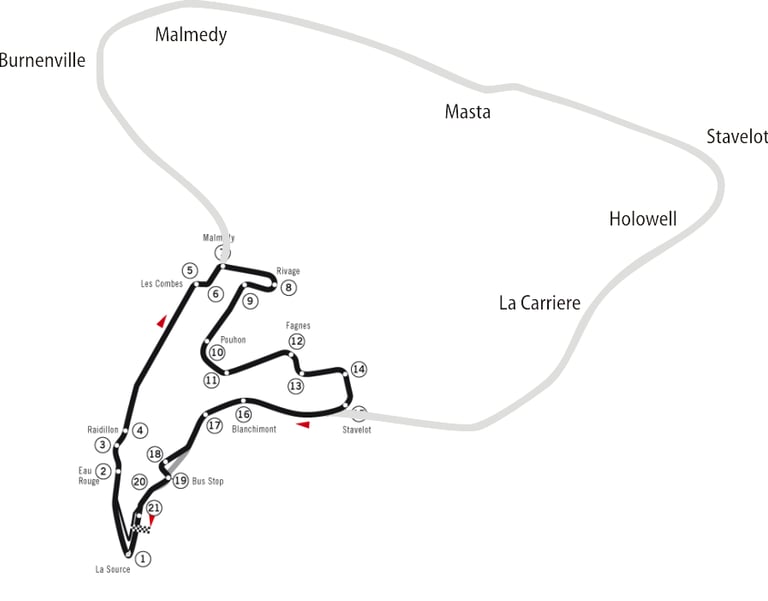
The circuit as the world would come to know it was born in the early 1920s, conceived by two men: Jules de Thier, owner of the newspaper La Meuse, and Henri Langlois Van Ophem, chairman of the Royal Automobile Club of Belgium. Their idea was elegant in its simplicity: use the natural triangle of public roads connecting the villages of Francorchamps, Malmedy, and Stavelot to create a permanent racing circuit. No bulldozers carving through the landscape, no artificial structures. Just the roads as they were — winding through forests, dropping into valleys, climbing over hills — with the Ardennes themselves as the grandstand.
The first car race on the new layout was originally scheduled for 1921, over a distance of nearly 14.982 kilometers, but had to be cancelled due to a lack of entries — only one competitor registered.
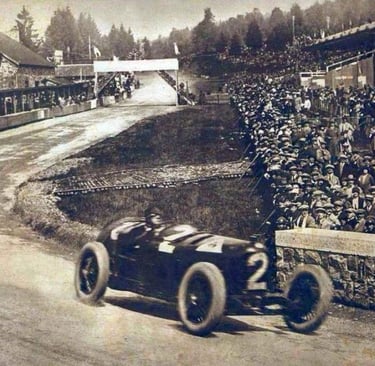
Instead, the circuit made its competitive debut with a motorcycle race in 1922. The cars followed in 1924 with the first edition of the 24 Hours of Francorchamps, one year after Le Mans had launched its own legendary endurance race. Then in 1925 came the first Grand Prix de Belgique — also designated the Grand Prix of Europe that year — won by Antonio Ascari, father of the man who would later become one of F1's most beloved champions.
From those first laps, one thing was immediately clear: Spa-Francorchamps was not like any other circuit. It didn't feel like a race track. It felt like a challenge thrown down by the landscape itself. And for the next five decades, the bravest drivers in the world would accept it.
The Characteristics That Made Spa Unique
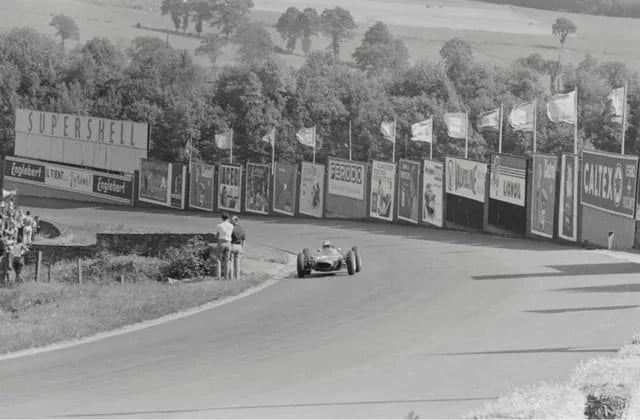
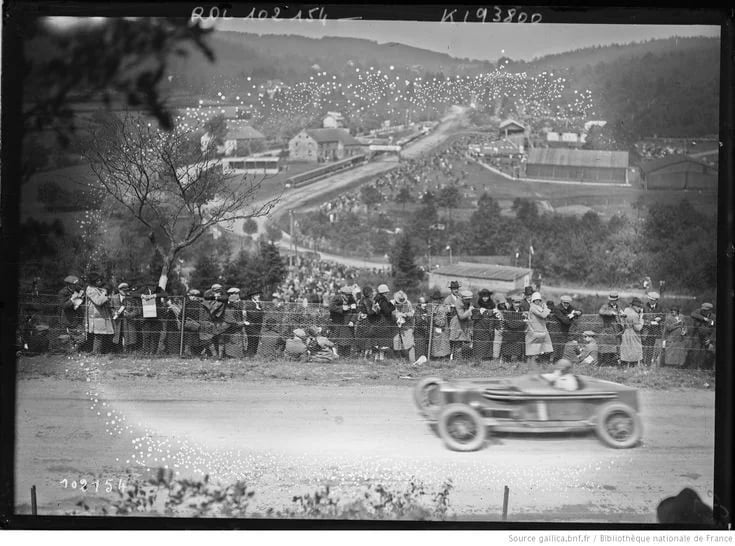
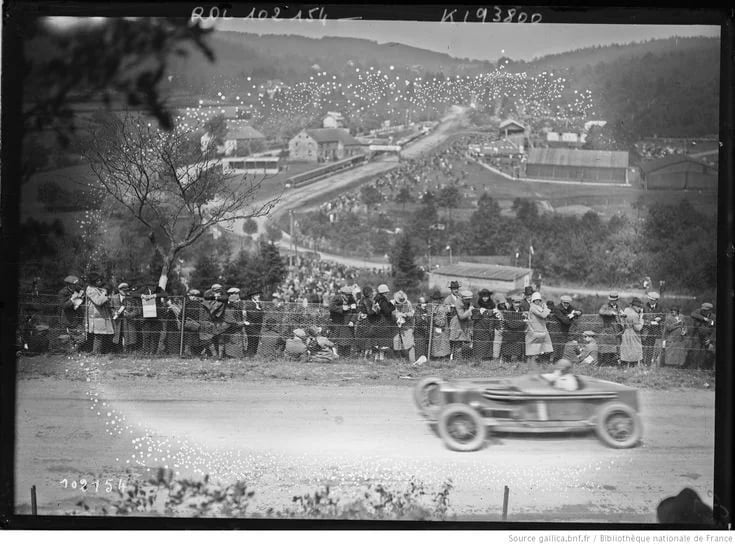
To understand why old Spa-Francorchamps was so extraordinary — and so deadly — you first need to understand its scale. This was not a purpose-built racing facility. It was 14.1 kilometers of public roads, unchanged from their everyday use, looping through the hills and forests of the Belgian Ardennes. While other Grand Prix circuits of the era were measured in a handful of kilometers, Spa was closer in length to a small town. One lap took a driver nearly three minutes. A single mistake could happen anywhere across those 14 kilometers, far from any marshal post, any doctor, any help.
The circuit began at La Source, a tight uphill hairpin near the paddock, before plunging downhill toward the most iconic corner in racing history: Eau Rouge. In the old layout, Eau Rouge was a far more violent beast than the version known today — in the 1930s it even contained a hairpin in the middle of it, with spectators sitting at the roadside with their picnics just meters away, and no armco barriers anywhere in sight. Even in the 1950s, cars would go over the crest of the hill with all four wheels leaving the ground at high speed.
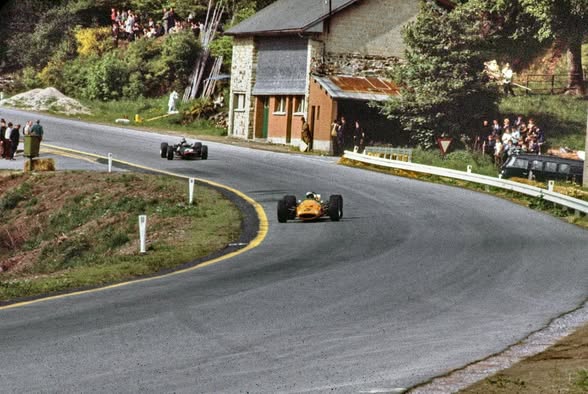
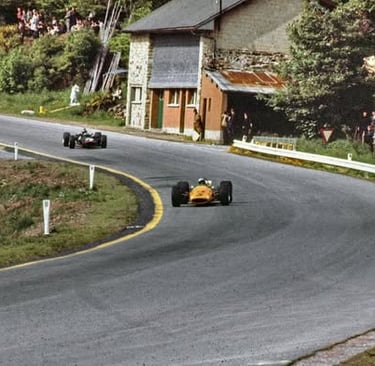
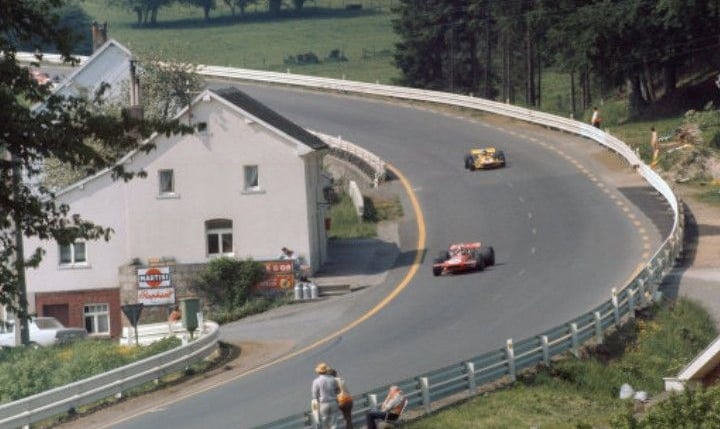
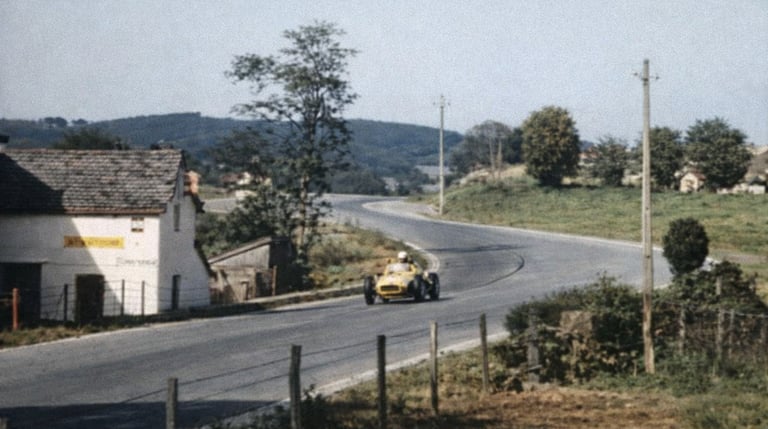
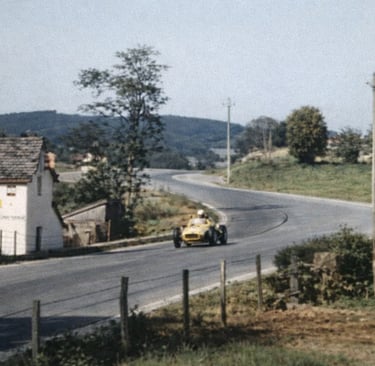
After Eau Rouge, the cars flew down the Kemmel Straight before reaching Les Combes, the highest point of the circuit. Here the old layout diverged dramatically from what exists today: instead of turning back toward the paddock, drivers continued downhill, past houses and spectators lining the road, toward the fast downhill right-hander of Burnenville. The houses were not protected by anything. There were no barriers, no gravel traps, no run-off areas — just the road, the trees, and stone walls, exactly as they were for any passing car on an ordinary Tuesday.
Beyond Burnenville came the Malmedy corner, another high-speed descent, before the track reached what many drivers considered the single most terrifying stretch in Formula 1 history: the Masta Straight and the Masta Kink. Here, cars were still accelerating downhill at speeds exceeding 240 km/h through a long, fast, slightly bent section of public road flanked by houses and farm buildings. There was no margin for error. To go through Masta flat out was an act of pure bravado — and not every driver who attempted it came back.
Then there was the weather. The microclimate of the Ardennes was — and remains — notoriously unpredictable. On any given lap, a driver could exit La Source in bright sunshine, reach the bottom of the circuit near Stavelot in torrential rain, and return to the start-finish straight in fog. Because the circuit was so long, conditions could be radically different from one sector to the next. Rain on one part of the track might not be visible from the pits at all. In the era before radio communication, drivers discovered these changes at full speed with no warning.
All of this combined — the length, the public roads, the absent barriers, the violent corners, the unpredictable weather, and the raw speed — made Spa-Francorchamps a circuit unlike anything before or since. It was not just a racetrack. It was a force of nature.
The video below features a lap around the legendary old Spa-Francorchamps, recreated in the Automobilista 2 simulator. Experience the sheer, breathtaking speed of the iconic Lotus 49C as it tackles the fearsome 1970 layout — the very configuration used in the circuit’s final race of that era. A raw and thrilling glimpse into one of the fastest and most dangerous periods in Formula 1 history.
What Did the Drivers Think About the Old Spa Circuit
It seems almost irrational. A circuit with no barriers, no run-off areas, houses and trees at arm's reach, a weather system with a mind of its own, and a lap so long that help could take minutes to arrive — and yet the greatest drivers in the world spoke about it with reverence, even affection. Spa was not just a circuit they respected. It was a circuit they loved.
The reason was simple: Spa was honest. It did not reward machinery alone, or tactics alone, or luck alone. It rewarded mastery. Every tenth of a second gained on that 14.1-kilometer lap was earned through pure skill, bravery, and intelligence. With speeds consistently above 240 km/h for three to four minutes without any real let-up, drivers had nowhere to hide — every weakness in technique, every moment of hesitation, was exposed and punished immediately. As one driver described it, Spa did not ask whether you were good. It demanded proof.
Nowhere was this more evident than in the wet. The Ardennes rain could transform Spa from breathtaking into genuinely terrifying within a single lap. And yet it was precisely in those conditions that the true legends defined themselves. Jim Clark, who openly admitted he disliked Spa, won four Belgian Grands Prix there — including a 1963 race in torrential rain in which he continued at 160 mph with one hand on the wheel and the other physically holding the gear lever in place after it broke, winning by nearly five minutes. It was the kind of performance that made teammates and rivals quietly shake their heads in disbelief.
Jackie Stewart, who would later become the most vocal critic of Spa's safety, was also one of its greatest conquerors, winning there three times. His feelings about the circuit were deeply conflicted — and deeply human. Years after his career ended, he drove the old layout with his son and described the experience: "We both had shivers down our spines afterwards, imagining the dangers of racing there at full speed." And yet even he acknowledged what made it irreplaceable: Spa was the ultimate filter. The drivers who went fastest at Spa were, almost without exception, the greatest drivers of their generation.
The Accidents and Tragedies
Spa's danger was not theoretical. From its earliest years, the circuit collected victims with grim regularity. The first fatal accident at the circuit dated back to 1925, the very year of the first Belgian Grand Prix, and the losses continued across the following decades. By the time Formula 1 arrived as a World Championship in 1950, the circuit already carried a long and sobering record.
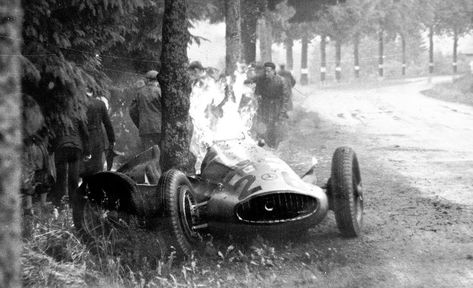
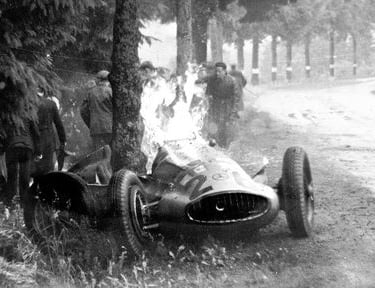
The deaths at Spa did not begin with Formula 1. One of the most haunting episodes in the circuit's pre-war history came on June 25, 1939 — just months before World War II would suspend motor racing altogether — when Richard "Dick" Seaman, a 26-year-old Englishman driving for the Mercedes-Benz factory team, crashed fatally while leading the Belgian Grand Prix.
On that wet June afternoon, Seaman was 31 seconds clear of the field when, on lap 22 approaching La Source, he took a dry-weather line through a corner that was treacherous in the rain. His Mercedes W154 snapped sideways into a tree at approximately 200 km/h. The impact ruptured the fuel tank, engulfing the car in flames with Seaman unconscious inside. By the time marshals pulled him free, he had suffered severe burns across his entire body.
He briefly regained consciousness at the hospital, where he told team manager Alfred Neubauer: "I was going too fast for the conditions — it was entirely my own fault. I am sorry." He died a few hours later. He was 26 years old.
Through the 1950s, accidents were frequent — some fatal, others that left drivers with careers ended or permanently altered. The infrastructure was essentially nonexistent by any modern standard: no armco barriers, no gravel traps, no medical helicopters, no doctors stationed around the circuit. When something went wrong at Burnenville or Masta, several kilometers from the pits, the response was improvised at best.
The darkest weekend: 1960
No single event in the history of old Spa concentrated so much tragedy in so short a time as the 1960 Belgian Grand Prix weekend. It began in practice, when Stirling Moss suffered a major accident that left him with two broken legs and two broken arms, ending his participation before the race had even started. Shortly afterward, Mike Taylor's steering column failed at high speed, sending him off the road with severe injuries.
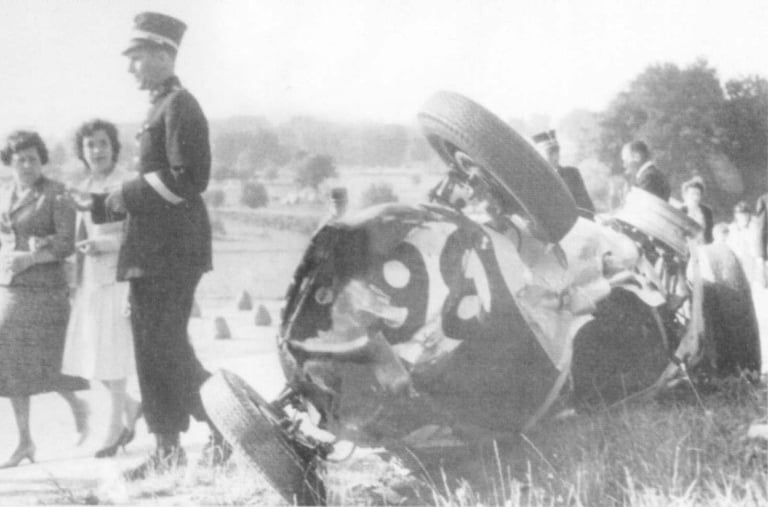
Then came race day. On lap 19, British driver Chris Bristow, 22 years old, lost control of his Cooper Climax at the Burnenville curve. The car was thrown against the barriers and Bristow was killed instantly. He had been racing in Formula 1 for less than a year.
Less than ten laps later, Alan Stacey — a driver who raced with a prosthetic right leg, having lost his real one in a childhood accident — crashed at high speed and died at the scene. Witness accounts suggested his visor was struck by a bird in flight, though this was never formally confirmed.
Four drivers seriously hurt or killed in a single weekend, on the same circuit, in front of crowds standing at the roadside with no protection. The sport took note — and then, largely, carried on.
This mini-documentary below explores the tragic events of the 1960 Belgian Grand Prix at Spa-Francorchamps, a race forever remembered as one of the darkest weekends in Formula 1 history. Discover what happened during those fateful days, the drivers involved, and how the sport was forced to confront the brutal reality of safety in its most dangerous era.
1966: The Start of the Turning Point
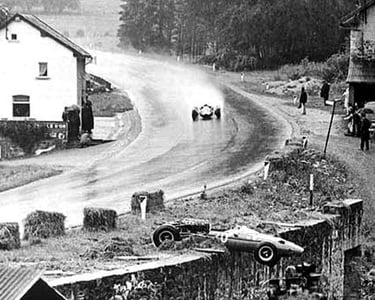
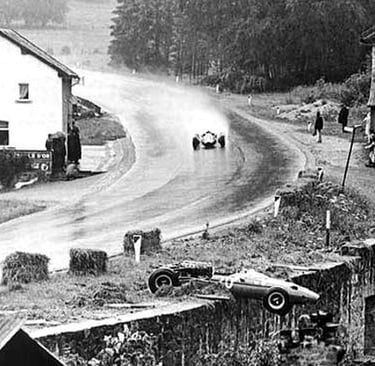
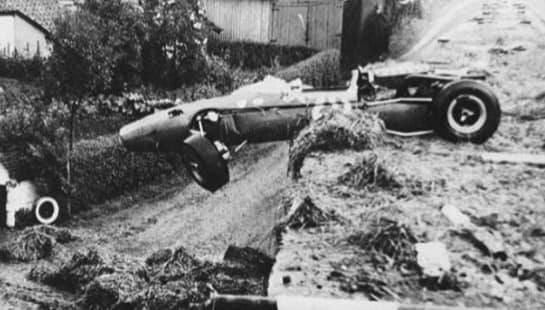
Burnenville did not forget. Six years after claiming the life of Chris Bristow, the same corner delivered one of the most dramatic near-misses in the circuit's history during the 1966 Belgian Grand Prix, when Jo Bonnier lost control of his Cooper-Maserati at the corner's exit and slid off the road, the car coming to rest on the very edge of a steep ravine with nothing but a sharp drop below. Bonnier walked away uninjured — but the image of the Cooper teetering on the precipice of Burnenville achieved a life of its own far beyond the racing world: the footage was featured in Grand Prix, the landmark 1966 John Frankenheimer film that brought Formula 1 to mainstream cinema audiences worldwide, cementing that moment as one of the most iconic visuals in motorsport history. The photograph and footage were a reminder that Burnenville did not always demand a life, but it always demanded respect. And on the days it received neither, the consequences were absolute.
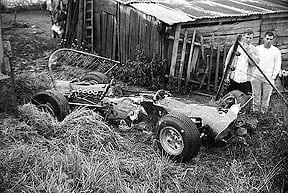
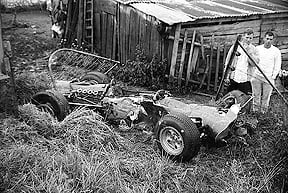
And then came the accident that would change the course of motorsport safety forever. On the same 1966 Belgian Grand Prix, in heavy rain, Jackie Stewart's BRM left the road at the Masta section — the fastest and most exposed part of the circuit — and came to rest in a farmyard ditch, wedged under a fence. Stewart was trapped inside the cockpit with the fuel tank ruptured and petrol flooding around him.
He remained trapped for approximately 25 minutes. Fellow drivers Graham Hill and Bob Bondurant, who had also crashed nearby, worked to free him. There were no specialized tools at the scene — a farmer's spanner was eventually used to remove the steering wheel and extract Stewart from the car. When an ambulance finally arrived, it reportedly got lost on the way to the hospital. There was no doctor stationed at the accident site, no fire crew close enough to intervene quickly, and no established medical protocol for such an event.
Stewart survived with broken ribs and shoulder injuries. But what he saw and experienced that afternoon — the complete absence of any serious safety infrastructure across 14 kilometers of public roads — turned him from a racing driver into a crusader. From that day forward, he would make circuit safety the defining cause of his public life, and Spa would be his primary example of everything that needed to change.
The Boycott, the Last Race, and the End of an Era
Jackie Stewart's accident in 1966 was the catalyst, but the movement he helped build took years to reach a breaking point. Together with fellow drivers, Stewart used the Grand Prix Drivers' Association (GPDA) as the vehicle for demanding real, structural changes at every circuit on the Formula 1 calendar. Spa was always at the top of his list. The demands were not extreme by any reasonable measure: proper Armco barriers along the most dangerous sections, adequate medical facilities stationed around the track, fire marshals at key points, and clearly marked emergency exit routes. What the GPDA was asking for, in essence, was the minimum standard of organization that any serious sporting event should have offered already.
The organizers of the Belgian Grand Prix, constrained by the reality that modernizing 14.1 kilometers of public roads was an entirely different proposition from upgrading a purpose-built facility, were unable — or unwilling — to meet those demands in time for the 1969 season. The result was unprecedented: the 1969 Belgian Grand Prix was cancelled. Not postponed due to weather, not cancelled due to a political crisis — cancelled because the drivers refused to race there. It was the first time in the history of Formula 1 that the drivers collectively blocked a Grand Prix on safety grounds. The race was replaced on the calendar by the French Grand Prix at Clermont-Ferrand.
The cancellation sent a clear message to the racing world — but it did not, ultimately, save Spa. For 1970, the Belgian Grand Prix was reinstated and returned to the old circuit. The required safety improvements had not been fully implemented. What had changed, however, was the understanding on all sides that this would almost certainly be the last time.
June 7, 1970. The last race.
To appreciate the full weight of what happened that day, one must first understand the numbers. In the final years of the old circuit, Formula 1 cars were averaging 240 km/h (150 mph) across the entire lap — not as a top speed on a straight, but as a sustained average over 14.1 kilometers of public roads, including corners, elevation changes, and village sections. For context, that average speed figure remains faster than the top speed of most road cars built today. In the 1970 race, Jackie Stewart had taken pole position with a lap of 3 minutes 28.0 seconds, and Chris Amon set the race's fastest lap at 3 minutes 27.4 seconds — an average of 244.6 km/h (152.0 mph). These were not brief bursts of speed on a purpose-built facility. These were sustained speeds through forests, farmyards, and village streets, with spectators standing at the roadside and no barriers between them and the cars.
Against this backdrop, Pedro Rodríguez in the BRM P153 and Chris Amon in the March 701 engaged in a fierce, wheel-to-wheel battle from the opening laps, exchanging the lead multiple times across the full length of the circuit. Rodríguez held on to win — one of the finest drives of his career — with Amon crossing the line just 1.1 seconds behind in second place. It was the last Formula 1 victory for BRM at a Belgian Grand Prix, and the last win for Dunlop tyres in the entire history of the World Championship.
For many who were present that day, the atmosphere after the race carried the unmistakable weight of a goodbye. There were no formal announcements, no closing ceremony. But the sport's direction was clear. Formula 1 needed circuits that could be controlled, fenced, and managed. Spa, in its original form, could be none of those things.
Follows a brief highlight edit showcasing the final Formula 1 race on the original Spa-Francorchamps circuit in 1970. Feel the intensity of flat-out racing through endless straights and daunting corners, as drivers pushed both machinery and courage to the limit on a track that would soon become part of history.
The Abandonment and Legacy
After the 1970 race, the old Spa-Francorchamps circuit was quietly removed from the Formula 1 calendar — no official ban, no dramatic announcement, just the absence of its name from the 1971 schedule. The Belgian Grand Prix did not disappear with it, but what replaced Spa made painfully clear what the sport had lost. In 1972, the race moved to Nivelles-Baulers, a flat, anonymous 3.7-kilometer circuit south of Brussels, purpose-built and utterly forgettable — won by Emerson Fittipaldi, remembered by almost no one. The following year it shifted to Zolder, which at least had some character, though its tarmac broke up during practice causing days of disputes before the 1973 race could even begin. The Belgian Grand Prix alternated between the two circuits for the remainder of the decade, never finding a permanent home and never recapturing anything close to the spectacle that Spa had provided.
The old circuit did not simply vanish. Parts of it remained as public roads, exactly as they had always been. The Masta Kink is still there today, driveable by anyone with a road car and a sense of history. Burnenville still exists. The stone farmhouses that lined the course still stand. But the roads are now narrow, quiet, and unremarkable — impossible to imagine as the stage for the fastest race laps in Formula 1 history, where a driver's single lap averaged over 244 km/h across 14 kilometers of public tarmac.
The Spa name did eventually return to Formula 1 — but as a different circuit. In 1979, construction began on a redesigned layout that used only a fraction of the original roads, most notably preserving Eau Rouge and La Source. The new circuit measured 6.940 kilometers and opened for its first Formula 1 race in 1983, when Alain Prost took victory on the triumphant return. The new Spa was shorter, safer, and genuinely excellent — it would go on to be voted the greatest circuit on the modern calendar by generations of drivers. But it was not the same place. It was a respectful tribute, not a resurrection.
The old circuit had been racing's last great wilderness: a place where the road, the weather, and the landscape itself were as much a part of the competition as the cars and the drivers. Its abandonment marked the definitive end of an era in which motor racing accepted danger as an inherent and inseparable part of the sport. Jackie Stewart, the man most responsible for bringing that era to a close, never apologised for his role — and was right not to. The deaths were real, the suffering was real, and the absence of basic safety measures was indefensible. But even Stewart acknowledged what was lost: a kind of racing that demanded everything from a driver, and gave everything back in return.
Old Spa-Francorchamps was never replaced. It was only mourned.