Gucci and Alpine Are Huge, But Formula 1 and Fashion Went Together Long Before
Gucci’s arrival at Alpine may look like a bold new chapter in Formula 1, but it is really the latest step in a relationship between racing and fashion that has been building for decades. From Benetton and Emporio Armani to AlphaTauri and Lewis Hamilton’s style era, F1 has been dressing like a fashion story for a long time.
CLASSIC MOTORSPORT
6/2/20269 min read
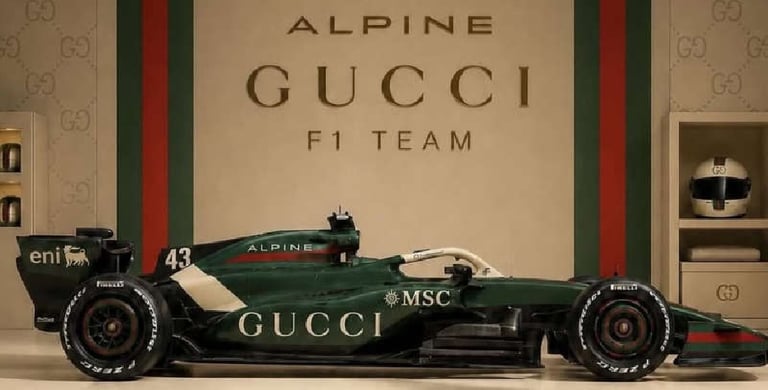
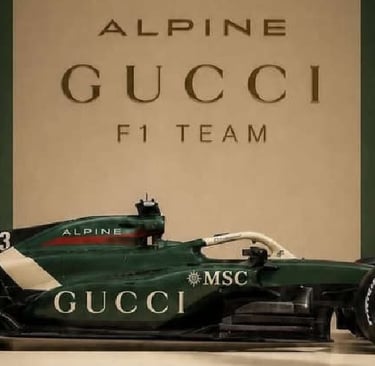
Gucci's announcement as the title sponsor of Alpine for the 2027 Formula 1 season is impossible to ignore. The partnership will see the French team renamed Gucci Racing Alpine Formula One Team, marking the first time a luxury fashion house has taken title-sponsor status in Formula 1 history. The deal, officialized in May 2026, signals that fashion is no longer merely decorating the paddock—it is rewriting the identity of teams themselves.
But while Gucci's entry into Formula 1 feels unprecedented, it is far from the first time the sport and fashion have collided. The history of Formula 1 is filled with moments when clothing brands, designers, luxury houses, and style itself became central to the story of racing. This article explores the factual history of how fashion and Formula 1 have mixed over the decades, using Gucci's arrival as the entry point into a much deeper and older story.
Benetton: The First Fashion Team to Win Championships
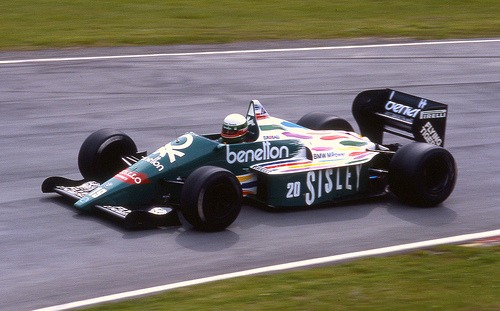
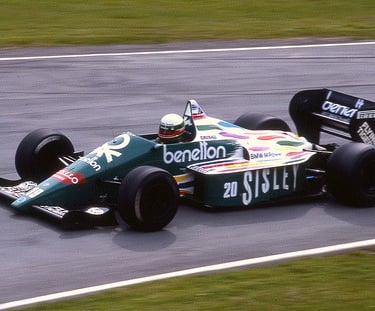
The most important precedent for Gucci and Alpine is Benetton. No other fashion brand in Formula 1 history has done what Benetton did: not just sponsor, but own a team, not just appear on the car, but win world championships.
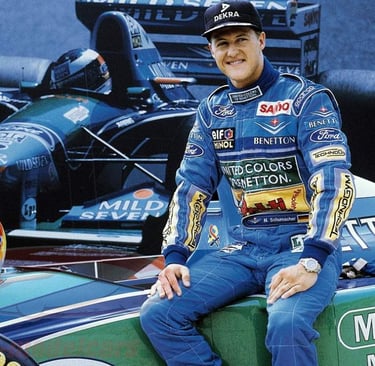
Benetton first entered Formula 1 as a sponsor in 1983, initially backing the Tyrrell team and then the Alfa Romeo Team in 84 and 85. But the brand's ambition went beyond decals. In the end 1985, Benetton purchased the Toleman team, renaming it Benetton Formula, and placed Flavio Briatore at the helm as team manager. This was a radical move at the time: a clothing brand becoming a full-fledged constructor in the highest category of motorsport.
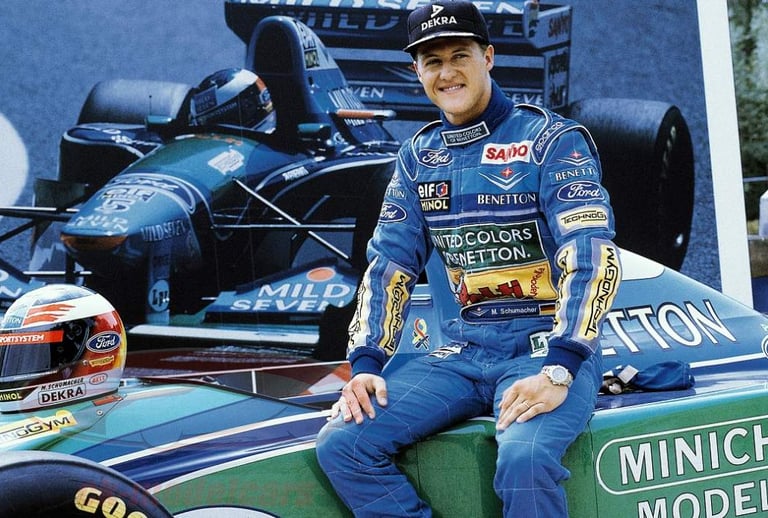
The results were undeniable. Under Benetton's ownership, the team became a competitive force. Michael Schumacher, discovered and developed by Briatore's organization, drove for Benetton and won back-to-back drivers' championships in 1994 and 1995. The team also claimed the Constructors' Championship in 1995. These titles were the result of a well-funded, strategically-run operation that happened to be owned by an Italian fashion brand.
Benetton proved that motorsport could serve as a global marketing stage for a clothing brand while still being taken seriously as a competitive entity. The team ran until 2001, when it was sold to Renault and became the Renault F1 Team.
There is also a direct historical link between Benetton and the current Gucci-Alpine deal: Flavio Briatore. The same man who built Benetton into a championship-winning team is now executive advisor to Alpine, and his influence is widely seen as instrumental in bringing Gucci into the sport. This creates a narrative symmetry: the first great fashion-era team in Formula 1 is connected, through Briatore, to what may become one of the most ambitious fashion partnership in the sport's history.
Emporio Armani and Brabham: Fashion on the Car in 1986
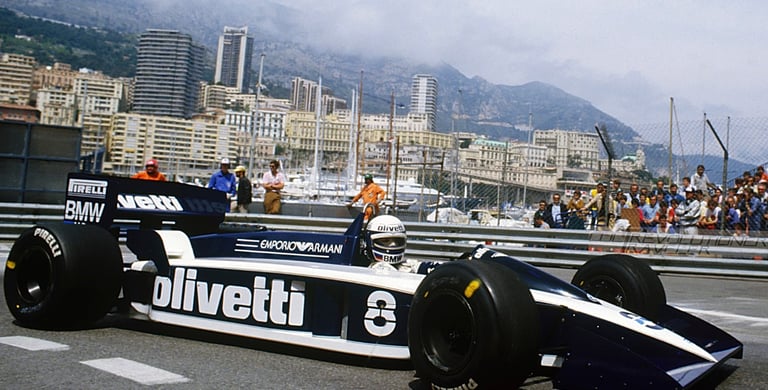
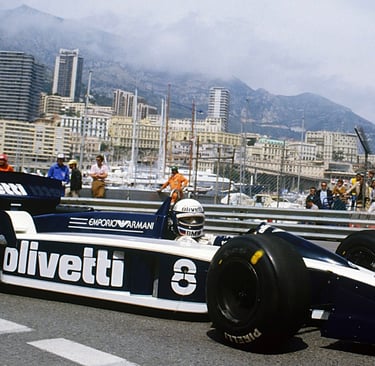
If Benetton was the first fashion brand to own and win with a Formula 1 team, Emporio Armani showed another way fashion could enter the sport: as a visible sponsor on a real racing machine. In Brabham's 1986 campaign, the BT55 carried the Emporio Armani logo on the car, with the brand on the engine cover.
The Brabham BT55 was the famous “skate” designed by Gordon Murray and David North, an ultra-low concept intended to improve aerodynamics by lowering the car as much as possible. It was a radical machine, but also a troubled one, remembered as one of the boldest and least successful technical bets of the season.
This was not a random appearance. The Brabham team in 1986 was heavily commercialized, and the presence of both Olivetti and Emporio Armani shows how Italian industrial and fashion prestige converged around one squad. That makes the Brabham BT55 one of the clearest historical examples of fashion functioning as an authentic visual sponsor in Formula 1.
It was the last car raced by Elio de Angelis, who died after a testing accident later that year, and the team’s line-up also included Riccardo Patrese and later Derek Warwick. So the Armani-branded Brabham is tied not only to fashion history, but to one of the most tragic chapters of the turbo era.
Tommy Hilfiger and Lewis Hamilton: Fashion Meets the Driver as Celebrity
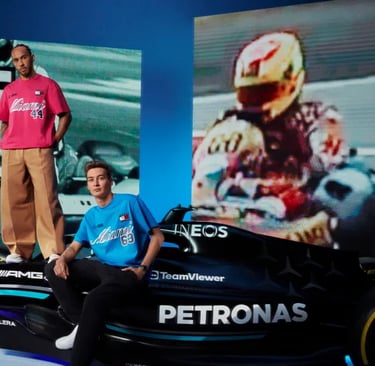
If Benetton showed that fashion could own a team, Tommy Hilfiger showed that fashion could become a long-term cultural partner of Formula 1 drivers themselves. The American brand's history in the sport is deep and spans decades, but its most visible impact came through its relationship with Lewis Hamilton and Mercedes.
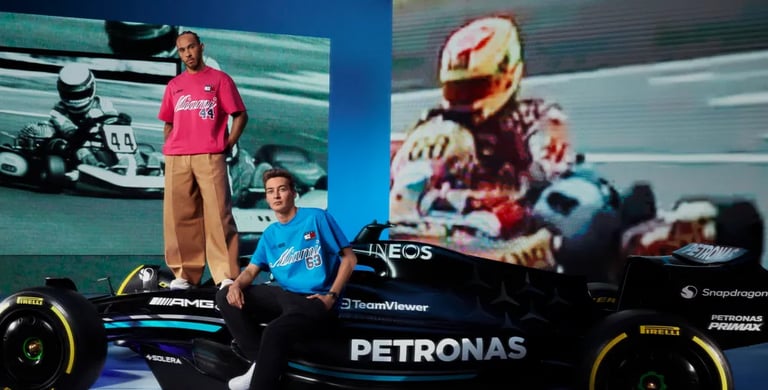
Tommy Hilfiger first appeared in Formula 1 in the 1990s, sponsoring the Lotus team during a period when the British team was struggling financially. The brand later appeared on Ferrari cars in 1998 and 1999, but its modern identity in the sport was built much later. In 2018, Tommy Hilfiger became an official partner of Mercedes-AMG Petronas, and more importantly, formed a direct collaboration with Lewis Hamilton.
The partnership produced the “Tommy x Lewis” collection, a series of fashion releases that blended Hamilton's personal style with Tommy Hilfiger's aesthetic. It was a co-creation that positioned Hamilton not just as a driver, but as a fashion figure with influence beyond the paddock.
Hamilton's relationship with fashion also extended beyond Tommy Hilfiger. He has partnered with Dior, Valentino, and Prada, and has used his platform to challenge traditional stereotypes about masculinity and style in motorsport. His visibility helped normalize the idea that a Formula 1 driver could be as much a fashion icon as an athlete.
The sport was no longer just about engineering, lap times, and rivalries. It became a cultural space where clothing, celebrity, and visual identity could create as much attention as qualifying performance. Tommy Hilfiger and Hamilton together demonstrated that fashion could be integrated into Formula 1 through personalities.
AlphaTauri: Fashion as a Team Identity
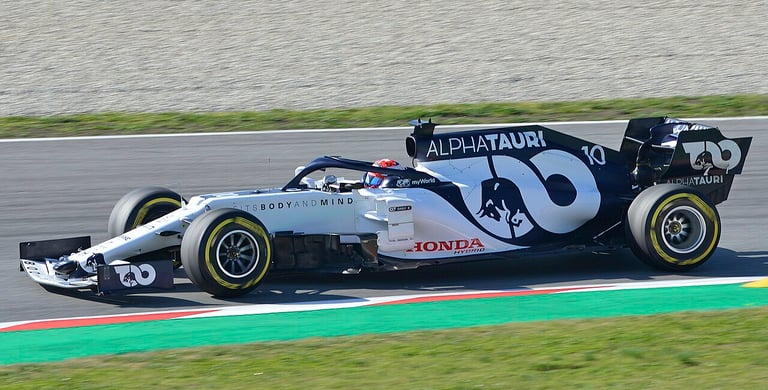
The AlphaTauri case takes the fashion-F1 relationship one step further. Instead of simply sponsoring a team or dressing a driver, Red Bull turned a fashion brand into the identity of its own Formula 1 operation. That makes AlphaTauri one of the clearest examples of fashion being used not as decoration, but as architecture.
AlphaTauri was created in 2016 as Red Bull's fashion brand, with a name derived from Alpha Tauri, the star in the Taurus constellation. Three years later, in 2019, Red Bull renamed its junior team from Toro Rosso to AlphaTauri, using the racing outfit as a marketing platform for the clothing label. The move was unusual even by Formula 1 standards: a fashion brand becoming the name of a team that still had to compete on-track every Sunday.
That identity went beyond branding. The AlphaTauri project was part of Red Bull's broader strategy to connect the fashion line, the junior team, and the parent company under a coherent lifestyle image. It showed that modern Formula 1 teams can function as multi-purpose brand engines, not merely as sport-specific entities.
For the broader history of fashion in Formula 1, AlphaTauri is important for one simple reason: it represents the point where fashion became the official identity of an entire team, not just a sponsor or partner.
Ferrari: When a Racing Brand Became a Fashion Brand
Ferrari occupies a unique position in the relationship between Formula 1 and fashion. Unlike most teams, Ferrari already possessed inherent luxury status before it ever considered fashion as a strategic category. The brand's red color, its Italian heritage, and its racing mythology gave it a premium aura that few other teams could match. But in recent years, Ferrari made this dimension explicit by entering the fashion world on its own terms.
The pivotal moment came in 2021, when Ferrari launched its first dedicated fashion collection, presenting it at Milan Fashion Week from within the company's own factory in Maranello. The collection was designed by Rocco Iannone, Ferrari's creative director, and marked the first time the brand positioned itself not just as a racing team or car manufacturer, but as a fashion house in its own right.
This was a significant reversal of the traditional model. Historically, fashion brands borrowed Formula 1 imagery to create capsule collections or limited-edition products. Ferrari flipped this dynamic: a Formula 1 brand asserting itself as a legitimate player in the fashion industry.
LVMH, Rolex, and the Luxury Economy of Formula 1
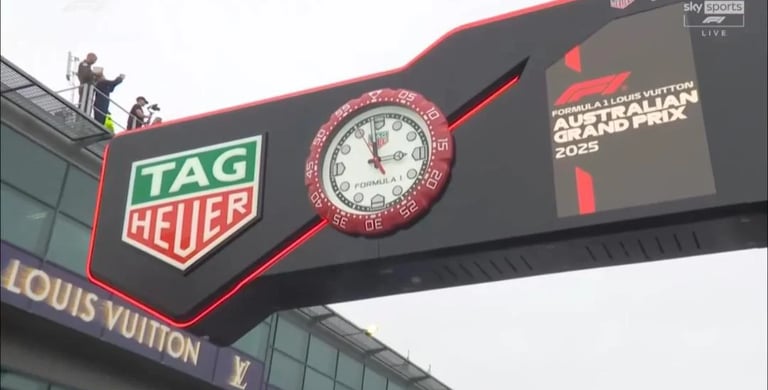
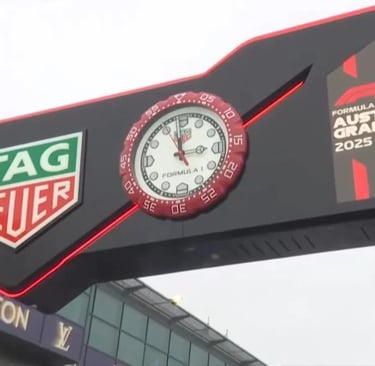
The arrival of Gucci cannot be understood without recognizing the broader trend of luxury groups moving into Formula 1. One of the clearest signals of this shift was the major agreement involving LVMH and Formula 1 starting in 2025. LVMH, the parent company of Louis Vuitton, TAG Heuer, Moët & Chandon, and dozens of other luxury brands, signed a multi-year partnership that brought these names deeper into the championship ecosystem.
This deal was not merely about event sponsorship. It represented a strategic decision by the world's largest luxury group to position Formula 1 as one of its primary global stages. Whether through watches, luggage, champagne, or fashion, the message is consistent: high-end groups increasingly see Formula 1 as one of the best platforms in global sport.
Rolex also played a foundational role in this shift. The Swiss watchmaker was the official timekeeper of Formula 1 from 2013 to 2024, cementing the championship's premium positioning. Rolex's long-term presence helped normalize the idea that luxury brands belonged at the highest level of motorsport, paving the way for other high-end names to follow.
Streetwear, Celebrity, and the New F1 Audience
The modern convergence of Formula 1 and fashion has not been limited to old luxury houses. Streetwear and youth-oriented brands have also identified the paddock as a place where cultural relevance can be produced quickly and globally. This shift aligns with Formula 1's transformation into a broader entertainment product, particularly in the years after the championship expanded its digital presence and attracted younger audiences.
Several examples from recent years make the trend easy to trace:
Puma x A$AP Rocky (2023): The rapper was named creative director for Puma's Formula 1 line, bringing celebrity creative direction into the sport's retail expression. His involvement culminated in high-profile appearances at races like the Las Vegas Grand Prix.
Palm Angels x Haas (2023): The Italian streetwear brand became a partner of the American team, marking another instance of fashion colliding directly with team identity.
Mercedes x Balenciaga: The two brands collaborated on a helmet made of polyurethane that became a fashion object rather than pure racing equipment. The project blurred the line between safety gear and design piece.
BAPE x F1 (2019): The Japanese streetwear brand released a Formula 1 car covered in its iconic camouflage pattern, demonstrating how fashion could literally rewrite the visual identity of a racing machine
These projects vary in depth and seriousness, but together they reveal a decisive commercial truth: Formula 1 now sells image as effectively as it sells competition. That matters for a company like Gucci because the championship offers a rare blend of elitism, global exposure, technical prestige, celebrity access, and visual drama. Few platforms can stage a brand in Monaco, Miami, Monza, and Las Vegas while still claiming authenticity through speed and engineering.
What This Means for Alpine and the Future of Fashion in F1
For Alpine, the Gucci partnership is about more than cash. It is about relevance. The team has often struggled to project a clear identity compared with the strongest brands on the grid, especially in an era when Red Bull, Ferrari, Mercedes, and McLaren each communicate something distinct not only competitively but culturally.
Gucci offers Alpine a language of prestige that may be more powerful than any standard sponsor package. If executed well, the deal can reposition the team from a mid-grid constructor with occasional flashes of competitiveness into a brand with a sharper silhouette in the public imagination.
Still, there is risk. If on-track performance does not match the glamour of the presentation, the partnership could invite accusations of style over substance. Benetton worked because it won. Ferrari's fashion strategy works because Ferrari already carries myth. Alpine will need results, narrative coherence, and visual discipline for Gucci's involvement to feel transformative rather than cosmetic.
A New Peak in an Old Story
Seen in historical perspective, Gucci sponsoring Alpine is not a random modern crossover. It is the latest and boldest chapter in a relationship that has moved through Benetton ownership, Emporio Armani on the Brabham BT55, Tommy Hilfiger and Hamilton's image politics, AlphaTauri's team-as-fashion-brand model, Ferrari's runway ambitions, and a wave of luxury and streetwear collaborations across the paddock.
What changes now is the scale and the explicitness. Fashion is no longer merely decorating Formula 1 from the outside. It is helping define what a team is, how the sport looks, and which audiences it wants to attract. In that sense, the Gucci-Alpine story is not just about sponsorship. It is about Formula 1's evolution into a complete cultural industry, where lap times and luxury campaigns increasingly occupy the same frame.
Gucci's arrival is the clearest sign yet that this convergence has reached a new level of ambition.