How Niki Lauda and Ferrari ended a 20-year Monaco drought in 1975 — rain, strategy, Graham Hill's farewell, and 2.78 seconds of pure drama
CLASSIC MOTORSPORT
3/16/20266 min read
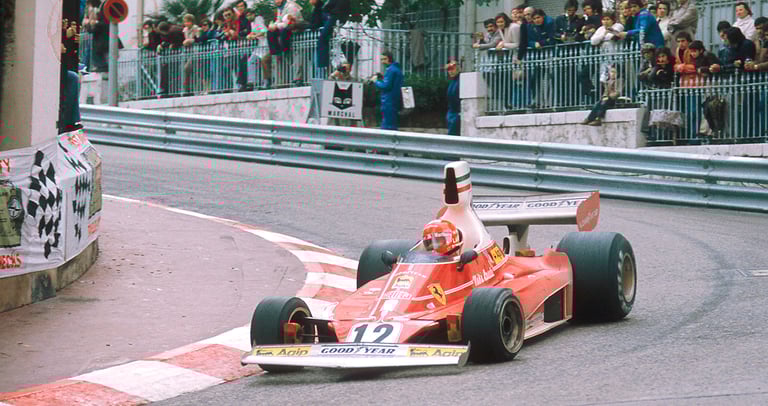
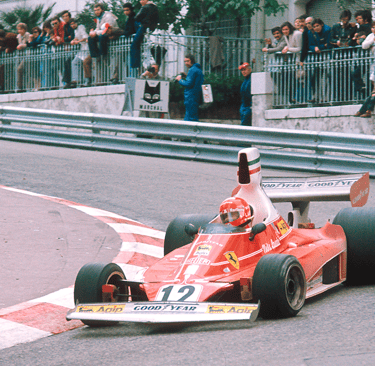
Monte Carlo, May 11, 1975. The streets were wet. The air was thick with tension — not only the usual nervous electricity that Monaco always conjures, but something heavier, darker. Just two weeks before, Formula 1 had been shaken to its core by tragedy in Spain. And yet, here the circus was again, winding its machinery through the narrow boulevards of the Principality, the glamour sitting uneasily alongside the grief. What unfolded over the next two hours would not only crown one of the greatest drivers of his generation but also mark the symbolic resurrection of the most storied name in motorsport: Ferrari.
The Shadow of Spain
To understand Monaco 1975, you must first understand what happened at the Circuit de Montjuic on April 27th. The Spanish Grand Prix had ended in catastrophe. Rolf Stommelen's Hill-Ford suffered a rear wing failure, sending the car airborne into the crowd. Four people died. The race had been stopped prematurely. Formula 1's safety debate, simmering since the tragedies of the early 1970s, had once again boiled over into public outrage.
The FIA responded immediately. By the time the paddock arrived in Monaco, a decision had been made: the starting grid would be limited to just 18 cars — a dramatic reduction from the usual field. Drivers who had traveled to Monte Carlo expecting to race suddenly found themselves fighting not just for glory, but for the right to start at all. It was in this atmosphere — tense, grieving, yet defiantly alive — that one of the decade's most memorable races was about to be written.
The End of a Legend: Graham Hill's Last Dance
Among those fighting for one of those precious 18 grid slots was a man who needed no introduction in Monaco. Graham Hill — two-time Formula 1 World Champion (1962 and 1968), winner of the Monaco Grand Prix an extraordinary five times, a man so synonymous with the circuit that he had earned the nickname "Mr. Monaco."
But time is merciless in motorsport. Hill, now 46 years old, was driving for his own team, Embassy Hill, with equipment that simply couldn't match the frontrunners. In qualifying, he missed the cut by a razor-thin margin — just 0.377 seconds. After 176 Grand Prix starts, after five victories on this very circuit, Graham Hill would not take the start in Monaco that Sunday. It was his 179th and final attempt to qualify for a Formula 1 Grand Prix.
Tragically, the story ended even more painfully. In November 1975, Graham Hill died when the private plane he was piloting crashed near London in fog. Along with him perished several members of his own racing team. The Monaco grid that May afternoon had been his last act in Formula 1. The margin of 0.377 seconds feels less like a timing sheet entry and more like a final, heartbreaking footnote.
Tom Pryce: The Quiet Shock
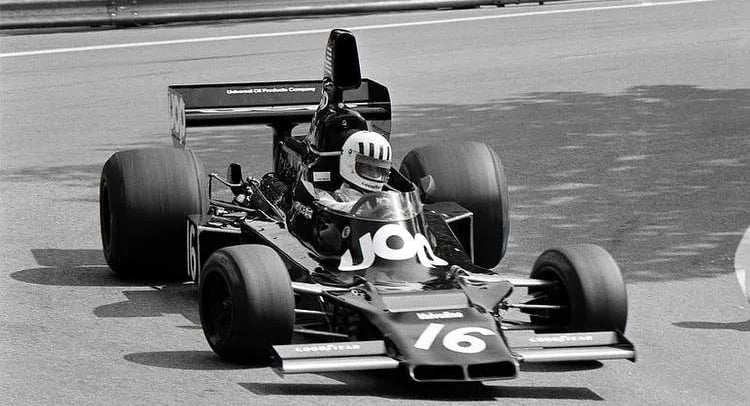
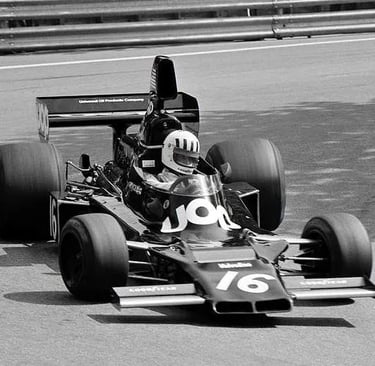
If Graham Hill's absence created the weekend's most emotional subplot, the qualifying results delivered its biggest surprise. Alongside Niki Lauda on the front row — in second position, outqualifying established stars like Fittipaldi, Scheckter, and Pace — sat a 24-year-old Welshman named Tom Pryce, driving a black Shadow DN5.
A year earlier, Pryce had been considered raw, a promising talent but far from the finished article. Now, on the most demanding street circuit in the world, he had put his Shadow on the front row. Quiet and unassuming by nature, Pryce said little about his achievement. But the lap time said everything. In a field condensed by adversity and safety measures, a young man from North Wales had announced himself on the grandest of stages.
It was a debut into the spotlight that hinted at enormous potential — potential that would end far too soon. Tom Pryce was killed in a tragic accident during the 1977 South African Grand Prix. But on that Sunday in May 1975, he was simply extraordinary.
Ferrari's 20-Year Wait
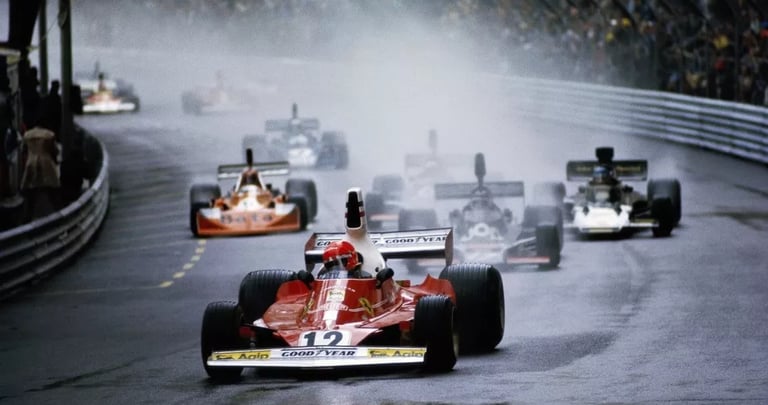
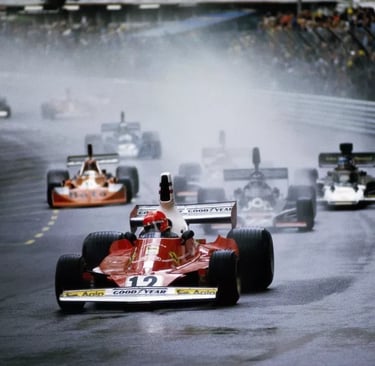
When Niki Lauda steered his Ferrari 312T onto the Monaco grid from pole position, he carried with him the weight of two decades of disappointment. The last time a Ferrari had won the Monaco Grand Prix was 1955. Since then, Ferrari had watched Monaco fall to Moss, to Hill, to Clark, to Stewart, to Rindt — to everyone but them.
The 1975 Ferrari 312T was, simply put, a different breed of machine. Engineered under the direction of Mauro Forghieri, the transversely-mounted gearbox — the "T" in 312T — had transformed the car's handling balance. Lauda had tested it obsessively over the winter, feeding back precise, clinical data to the engineers in a way that was revolutionary for the time. At Monaco, he qualified on pole with 0.69 seconds over the rest of the field. In a city where centimetres matter, that was a gulf.
The Race: Control, Crisis, and 2.78 Seconds
Race morning brought low clouds and steady rain that had soaked the circuit overnight. Every car took the grid on wet-weather tyres — with dry slicks stacked in the garages, waiting for the sun that everyone knew was coming. The grid was arranged in a staggered single-file formation, an emergency measure born directly from the tragedy in Spain.
When the lights went out, Lauda launched cleanly and never looked back. Behind him, the opening lap turned violent almost immediately. Jean-Pierre Jarier, who had qualified third in the second Shadow, muscled past Pryce into second — but lasted barely half a lap. At Mirabeau, his car clipped the barrier and ricocheted along the Armco all the way to the chicane. Regazzoni and Brambilla, both caught in first-lap contact further back, dropped to the tail of the field with damaged cars.
For thirteen laps the wet asphalt kept everyone honest. Then, on lap 14, the sun broke through the clouds above the harbour and the circuit began to dry sector by sector. The pit lane erupted. Hunt was the first frontrunner to commit to dry tyres on lap 17, followed by a cascade of stops through laps 21 to 25. Lauda pitted on lap 24 — Ferrari's crew executed a clean, fast stop — and when he rejoined, the lead was still his.
Through the middle laps, attrition did its work. Scheckter's tyre deflated while pressuring Pace for third. Watson stalled avoiding a Brambilla incident. Regazzoni ended his day in the barriers — the car had to be lifted out by crane. Pryce spun a second time on lap 39, damaging the Shadow beyond repair. One by one, the field shrank to nine survivors.
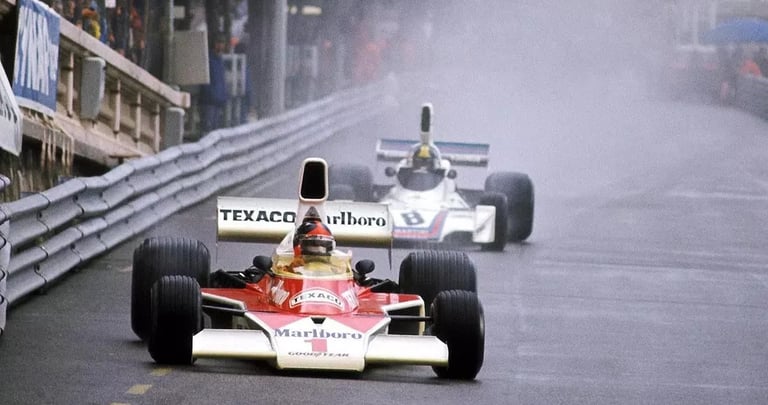
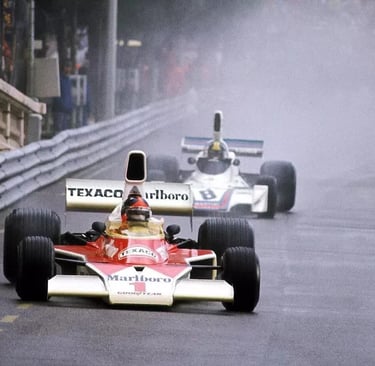
Then the arithmetic of the two-hour rule came into play. The wet opening phase had consumed enough time that the full 78 scheduled laps would not be completed before the clock expired. Lauda managed the gap with cold precision. But Fittipaldi — the championship leader entering Monaco — kept pushing with the steady, grinding pressure of a champion. The gap that had been comfortable was suddenly 2.78 seconds and shrinking. Then the flag came.
Lauda won. Fittipaldi second. Pace third. Patrick Depailler claimed fifth with a late pass on Jochen Mass through the tunnel — the race's last overtake — and Ronnie Peterson took fourth in the Lotus 72. The race covered 75 laps at an average of 121.552 kph over 2 hours, 1 minute and 21 seconds. On a day when the circuit tried everything to stop the cars from finishing, speed was never really the point.
If you prefer to watch this story unfold, we've covered the 1975 Monaco Grand Prix in full detail on our YouTube channel:
A Trophy from a Princess
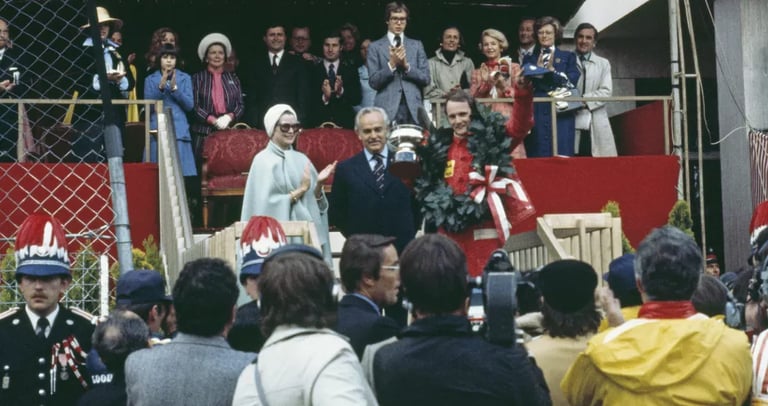
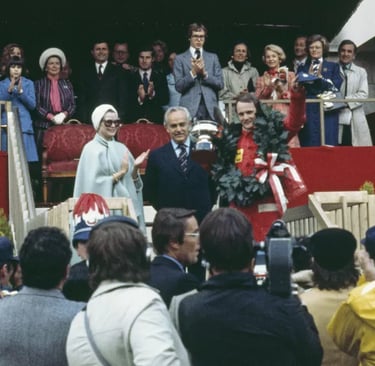
In the Monaco of 1975, the trophy ceremony was not a generic corporate affair on a temporary podium. Grace Kelly — former Hollywood icon, wife of Prince Rainier III of Monaco — personally presented Niki Lauda with the winner's trophy. The image of the elegant princess handing the prize to a precise, sharp-eyed Austrian engineer became one of the iconic photographs of the season. It was Monaco at its most Monaco.
The Championship Charge Begins
With his Monaco victory, Lauda didn't just win a race — he sent a message to the entire field. Fittipaldi, despite his heroic late charge, was losing ground. Lauda would go on to win the 1975 World Championship with a race to spare — clinching the title at Monza in September — finishing the season with five victories and a level of consistency that bordered on clinical. Monaco was the pivot point. It confirmed, beyond any doubt, that the Ferrari 312T and its driver were operating at a different level from the rest of the field.
Ferrari Was Back
Twenty years. That is how long Ferrari had waited to hear its name called in victory at Monaco. When it came, it came with the full force of inevitability — a great team, a great car, and a great driver arriving at the perfect moment on the perfect circuit. The 1975 Monaco Grand Prix was not merely a race result. It was a statement.
The streets of Monte Carlo had seen great champions before — Hill's five victories, Stewart's mastery, Rindt's brilliance. But that Sunday in May 1975, they witnessed the beginning of a new era: red, precise, and unstoppable.