Ickx vs Rodríguez: The Wet Zandvoort Duel That Left the Rest of the Field a Lap Behind Them
CLASSIC MOTORSPORT
2/3/20264 min read
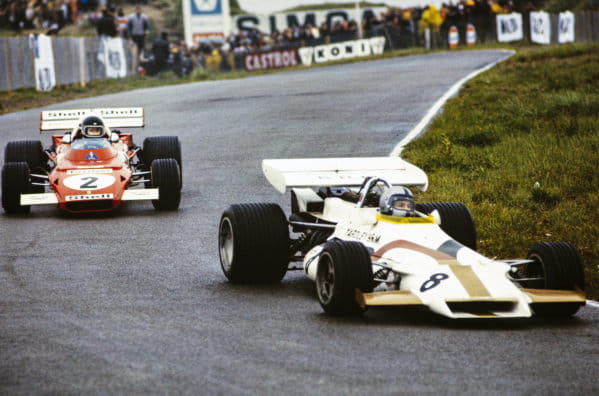
When the 1971 Dutch Grand Prix started at Circuit Zandvoort, it was clear almost immediately that this would not be a race decided by car performance alone. Persistent rain changed the character of the circuit, blurring braking points, reshaping the racing line, and turning every corner into a test of judgment.
Zandvoort was already a demanding track in dry conditions. In the wet, it became something else entirely: narrow, flowing, and unforgiving. Under those circumstances, Formula One’s usual hierarchy began to dissolve.
Two drivers operating on a different level
While much of the field struggled to adapt, two names emerged almost instantly: Jacky Ickx and Pedro Rodríguez.
From the opening laps, both drivers established a pace that felt controlled rather than aggressive. There were no wild corrections, no visible moments of survival driving. Their laps had a rhythm that the rest of the grid simply could not match.
What the lack of data does — and does not — hide
Any discussion of races from this era comes with unavoidable limitations. There is no detailed telemetry, no comprehensive onboard footage, no lap-by-lap data to dissect with modern tools. That absence matters — but it does not make the result meaningless.
What cannot be measured precisely can still be observed clearly. And what stood out at Zandvoort was not just that Ickx and Rodríguez were faster, but that their advantage was sustained. Lap after lap, the gap grew. Mistakes from others accumulated, but control from the front remained intact.
Why Ickx and Rodríguez thrived in conditions others could not master
It would be simplistic to credit this performance to a single factor. Wet-weather dominance rarely comes from one source. Instead, it emerges when skill, confidence, and adaptability align.
Both Ickx and Rodríguez had reputations built on precisely those traits. In changing grip conditions, smoothness mattered more than aggression. The ability to feel where the limit was — and stay just inside it — became decisive.
Up to this point, the story of Zandvoort 1971 can be told in words. But wet races from this period are not fully understood on paper alone. They are about rhythm, spacing, and how small differences compound over time.
The 11-minute race summary below shows the race breathing. You can see the field stretch, the gaps forming naturally, and the way confidence — or its absence — reveals itself corner by corner. At a circuit like Circuit Zandvoort, in those conditions, control becomes visible long before times.
Watching the race unfold, one detail becomes impossible to ignore: calm looks fast. While much of the field appears busy — correcting slides, hesitating under braking, constantly reacting — Jacky Ickx and Pedro Rodríguez seem to operate in a narrower, more controlled window.
The separation does not come from a single decisive moment. It builds quietly. Each lap adds a little more margin, until the gap stops being situational and starts to feel structural. This is why the rest of the field fades from relevance rather than contention.
Seen this way, the footage does not explain the race — it reinforces it. The dominance was not dramatic, but cumulative. Not aggressive, but disciplined.
A duel defined by execution, not wheel-to-wheel drama
Despite often being described as a duel, this race was not shaped by constant lead changes or close combat. There was no prolonged wheel-to-wheel fight for first place.
Ickx and Rodríguez were not battling each other so much as they were separating themselves from the chaos behind. Their contest unfolded in the margins — through consistency, through error avoidance, through the ability to maintain pace while others faded.
The rest of the field was not simply beaten. It was removed from contention altogether.
Lapping the field: an outcome that demands explanation
By the end of the race, nearly every other car had been lapped. In the early 1970s, large gaps were not unheard of, but this result still stands out. It was achieved not through attrition or mechanical superiority, but through sustained dominance in conditions that punished even small mistakes.
This was not a race where survival was enough. To compete at the front required control at a level few could reach that day.
Reading the race without mythmaking
It would be wrong to claim that Zandvoort 1971 redefined wet-weather driving or exposed a fundamental weakness across the grid. What it did, however, was offer a reminder of how decisive driver influence could be when conditions stripped away predictability.
In that sense, the race remains compelling precisely because it resists easy explanations. There is no single technical breakthrough to point to, no dramatic turning point. Just two drivers executing at a level that made everything else secondary.
Why the Zandvoort duel still resonates
More than fifty years later, the Ickx–Rodríguez duel endures because it represents a form of excellence that modern data often struggles to capture. In an era before numbers dominated analysis, performances were judged by contrast — by how clearly one driver stood apart from the rest.
At Zandvoort in 1971, that contrast could not have been sharper. The rain created disorder. Ickx and Rodríguez imposed order on it.
Race Results and Official Classification
The race finished under official timing as follows:
Jacky Ickx – Ferrari – 70 laps – 1:56:20.090 – 9 championship points
Pedro Rodríguez – BRM – +7.990s – 6 pts
Clay Regazzoni – Ferrari – +1 lap – 4 pts
Ronnie Peterson – March – +2 laps – 3 pts
John Surtees – Surtees – +2 laps – 2 pts
Jo Siffert – BRM – +2 laps – 1 pt
Howden Ganley – BRM – +4 laps
Gijs van Lennep – Surtees – +5 laps
Jean-Pierre Beltoise – Matra – +5 laps
Graham Hill – Brabham – +5 laps
Jackie Stewart – Tyrrell – +5 laps
Denny Hulme – McLaren – +7 laps
Technical Summary and Performance Insights
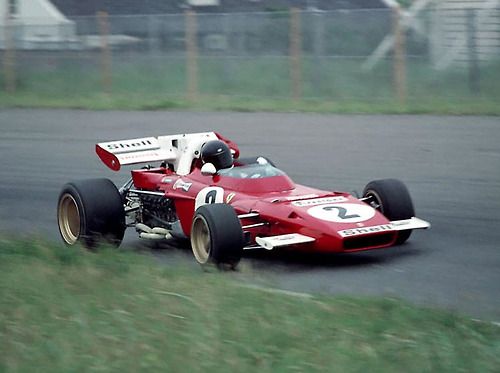
Ferrari achieved a 1–3 finish, highlighting the balance and drivability of the 312B2 chassis in wet conditions.
BRM secured second and sixth, with Rodríguez leading nearly one-third of the race distance.
Average race pace was dictated by grip management rather than peak lap time potential.
Multiple retirements were caused by mechanical failures and loss of control, common in prolonged wet races of this era.
Once in clear air, Ickx maintained stable lap times and avoided unnecessary risks, a decisive factor in securing victory.

Ickx and his Ferrari: Masterclass Drive