Jack Brabham: The Driver Who Built His Own Champion Car and Rewrote F1 History
In the entire history of Formula 1, only one man has ever won the World Championship in a car bearing his own name. That man was Jack Brabham — and this is his story.
CLASSIC MOTORSPORT
6/11/202611 min read
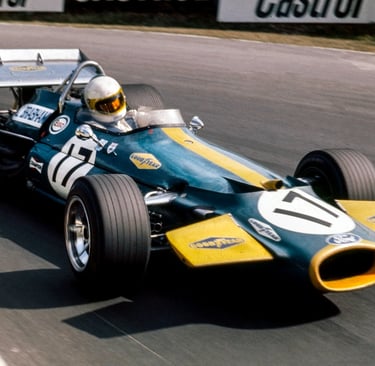
Introduction: An Unrepeatable Achievement
In the century-long history of top-level motorsport, few achievements compare to what Australian Jack Brabham accomplished in 1966. That year, a 40-year-old man — nicknamed "Geriatric Jack" by younger rivals — not only won the Formula 1 World Championship, but did so at the wheel of a car he himself had conceived, built, and financed, under a team that bore his own name. No driver, before or since, has managed to repeat this feat. Jack Brabham remains, to this day, the only F1 champion to lift the ultimate trophy in a car of his own manufacture.
The story of Sir Jack Brabham is the story of a self-taught mechanic from Sydney who became an engineer, entrepreneur, technical pioneer, and three-time world champion — all with the pragmatic seriousness of a man who preferred work to the spotlight, and results to glamour.
Origins: The Greengrocer's Son from Hurstville
John Arthur "Jack" Brabham was born on April 2, 1926, in Hurstville, a suburb of Sydney, Australia. An only child of a greengrocer, he showed from an early age that his father's fruits and vegetables held far less interest than the delivery trucks. While most children played in backyards, young Jack dismantled engines and learned to drive the family's vehicles well before he was old enough for a license.
He was not a dedicated student. At 15, Brabham dropped out of formal education and went to work at a machine shop and a garage. This choice, which might have seemed like a dead end to many, turned out to be the beginning of an extraordinary technical education. At 18, he joined the Royal Australian Air Force (RAAF) in Adelaide, intending to learn to fly. Fate, however, had other plans: the military needed mechanics, and Jack's skills were too valuable to waste. He spent the war repairing aircraft — an experience that deepened his understanding of high-performance machines even further.
After being discharged in 1946, an uncle who worked in construction built Jack a workshop in Sydney. There, the young ex-RAAF mechanic opened his own engineering business, buying and selling used cars and gradually establishing himself as a local authority on vehicle preparation.
First Laps: Midget Racing and the Discovery of Speed
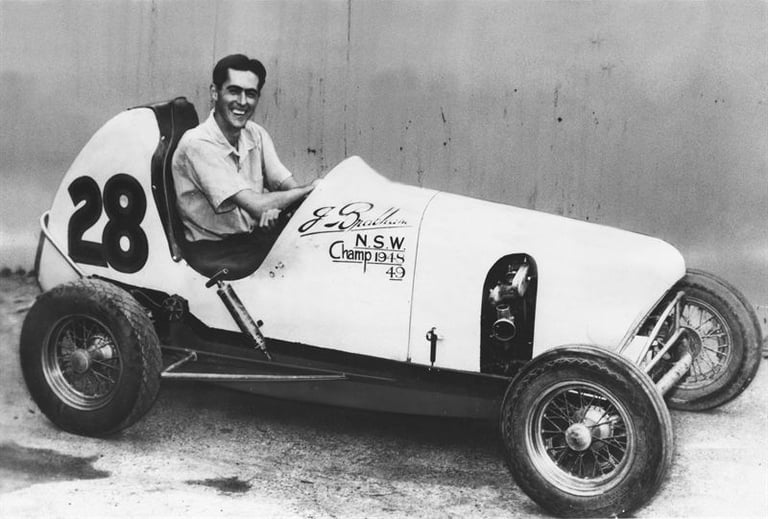
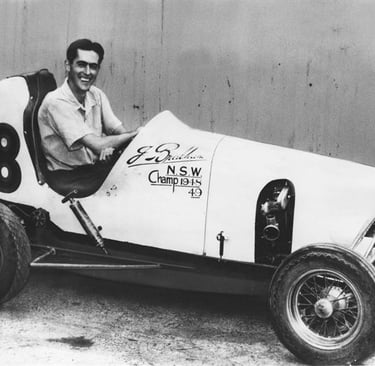
Brabham's entry into racing was almost accidental. A friend who raced midgets — small cars competing on oval dirt tracks — asked for his help building a new vehicle. When the friend decided to quit racing, Jack took the wheel and never looked back.
The talent was immediately apparent. In midgets he prepared himself, Brabham won four consecutive Australian championships. In 1953, he became hillclimb champion in a British-built Cooper-Bristol — his first major connection with the marque that would define his rise to the world stage.
In 1951, Jack had married Betty, who gave him three sons: Geoffrey, Gary and David. All would inherit their father's passion for racing and build careers in motorsport, though none would reach the patriarch's dimension. The family was the counterbalance to the nomadic life of a driver on the rise — and Betty, by all accounts, was the voice of reason in many of Jack's most important decisions.
The Crossing to Europe and the Partnership with Cooper
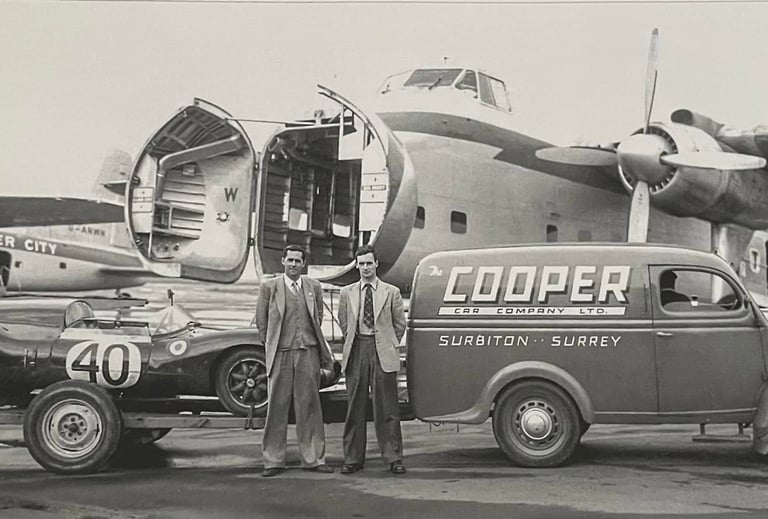
In 1955, with ambition overflowing Australia's borders, Brabham packed his bags and traveled to England. He did not arrive as a celebrity — he arrived as a determined Australian mechanic, with enough money to buy a Cooper and compete in national events. What happened next would change the history of Formula 1.
A meeting with brothers John and Charles Cooper — builders of his successful Australian car — turned into friendship and partnership. Brabham was not merely a hired driver; he was an active technical collaborator, a man who spent nights in the workshop when everyone else slept, investigating solutions and proposing modifications. His ability to feel the car, translate that perception into engineering language, and quickly implement improvements was something that fascinated his teammates.
Brabham's most revolutionary contribution to Cooper — and to Formula 1 as a whole — was his active role in convincing the Coopers to adopt a rear-engine layout in their F1 cars. While Italian and German teams insisted on the traditional front-engine configuration, Brabham helped push the small British manufacturer in the opposite direction. The result was a revolution: the compact rear-engine Coopers, lighter and more agile, began beating the imposing machines from Maranello and Stuttgart. The era of front-engine F1 cars came to an end within a few seasons.
The 1959 and 1960 Titles: Coronation With Cooper
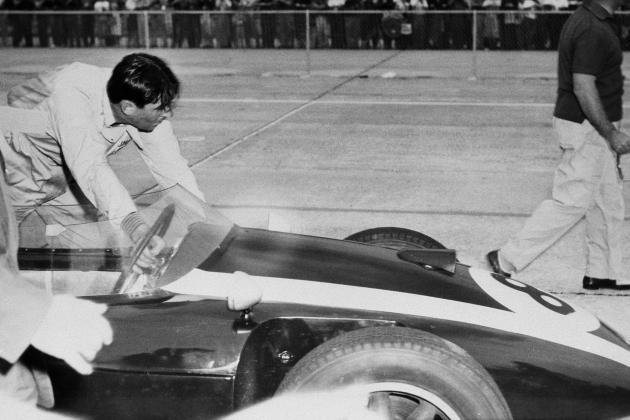
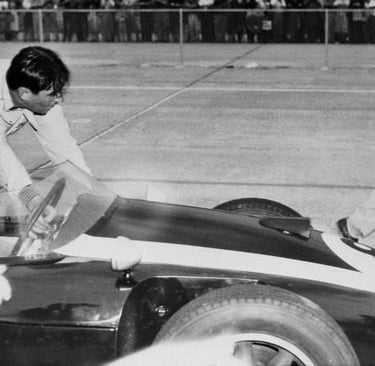
On May 12, 1959, Jack Brabham won his first Formula 1 Grand Prix, at Monaco — the most iconic circuit on the calendar. It was the beginning of a season that would end in epic fashion. At the US Grand Prix in Sebring, Brabham ran out of fuel just yards from the finish line. Rather than retire, he climbed out of the car and pushed the Cooper across the line to finish fourth — enough points to clinch his first World Championship. The image of the Australian pushing his car became one of the most iconic in F1 history.
In 1960, there was no drama: Brabham was dominant. He won five consecutive Grands Prix — Netherlands, Belgium, France, Britain and Portugal — and secured the second successive title in overwhelming fashion. He was the most complete driver on the grid, with a distinctive style: he drove with large controlled slides, dirt-track style, and had no hesitation in throwing gravel at anyone who tried to overtake him, an aggressive tactic inherited from Australian oval tracks.
But Brabham was not just a driver. He was a constant analyst, a technical perfectionist who, behind the scenes, worked as hard as he raced. His reputation was for very few words — the nickname "Black Jack" referred not only to his dark hair, but to his tendency to maintain an almost brooding silence. In an era of extroverted, glamorous drivers, Brabham was the antithesis: serious, direct and totally focused on the job.
The Great Turning Point: Founding His Own Team
After the dominance of 1959 and 1960, the 1961 season was frustrating. Ferrari emerged in full force and the Coopers fell behind. For Brabham, that situation was unacceptable — not out of vanity, but from a genuine technical conviction that he could build better cars.
In 1961, still competing for Cooper, Brabham embarked on one of the greatest gambles in motorsport history: together with talented Australian designer Ron Tauranac, he founded Motor Racing Developments (MRD), a racing car manufacturing company. In 1962, he left Cooper definitively to race under his own team. The partnership with Tauranac was fundamental — while Brabham was the mechanical genius with a driver's feel, Tauranac was the rigorous engineer capable of turning intuitions into blueprints.
The first Brabham cars achieved immediate success in Formula 2, a category they dominated for several years, helping launch the careers of numerous young drivers.
The Brabham F1 car first appeared at the end of 1962. Over the following years, the team grew steadily, with Brabham personally perfecting the chassis setup and refining the Climax engines. In 1964 came the team's first F1 victory — not with Brabham himself at the wheel, but with teammate Dan Gurney at the French Grand Prix in Rouen. It was a historic moment: the first victory for the Brabham name in the sport's top category.
Dan Gurney, who raced alongside Brabham between 1963 and 1965, left one of the most revealing tributes after the Australian's death in 2014: "A giant of motor racing has left our planet, whose combined achievements as an F1 World Champion driver and racing car constructor will, in all probability, never be equalled. 'Black Jack' was a fierce competitor, an exceptional engineer, a tiger at the wheel, a fine politician and a visionary creator. He opened the rear-engine door at Indianapolis. He was a doer, a true Australian pioneer!"
1966: The Impossible Year and the Unique Achievement
The 1966 season was simultaneously the pinnacle of Brabham's career and one of the most extraordinary chapters in Formula 1 history.
The FIA had decreed new technical regulations, doubling the maximum engine displacement to 3 litres. This meant every team would need new engines — and reliable, competitive 3-litre engines simply did not exist in abundance on the market. Ferrari, BRM and Honda scrambled to develop their units. Brabham went looking for a different, unexpected solution.
He convinced Repco, an Australian automotive components manufacturer, to develop an F1 engine from a production Oldsmobile V8 block — a unit considered obsolete by many experts. The project seemed insane at first glance: using an engine derived from an American road car in Formula 1. But Brabham and Tauranac saw what others missed: the engine would be light, compact, reliable and powerful enough to compete in the technical chaos of that first year under the new formula.
The strategy was brilliant. While rivals more powerful on paper — Ferrari, Honda, BRM — suffered reliability problems and mechanical failures, the humble Brabham-Repco finished races. And finished at the front.
To make matters worse for the rivals, the driver at the wheel was 40 years old — an eternity in a sport that, at the time, consumed young men with brutal voracity. The media and competitors loved the angle. Before the Dutch Grand Prix at Zandvoort — his first race after turning 40 — Brabham appeared on the starting grid wearing a long fake beard, leaning on a walking cane, playing up the "Geriatric Jack" persona. His rivals, laughing, helped him into the cockpit. Brabham started from pole position. He threw away the beard and the cane. And won the race.
That image captures the essence of "Black Jack": the understated humour of a man who could laugh at himself, before proving every doubter wrong.
Throughout 1966, Brabham won in France, Britain, the Netherlands and the Nürburgring — the notoriously dangerous and demanding German circuit, which Brabham himself considered his most satisfying victory of his entire career. By season's end, he had 42 points and his third world title.
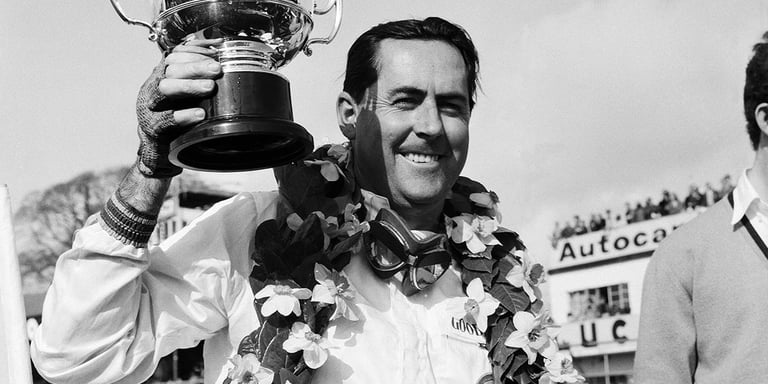
For the first — and, to this day, only — time in Formula 1 history, the World Champion had the same name on the car and on the helmet.
The Brabham Team Legacy: More Than 500 Cars
It would be a mistake to analyse Jack Brabham's greatness solely through his titles as a driver. His contribution as a constructor is equally monumental.
Through the partnership with Ron Tauranac at MRD, more than 500 racing cars were produced throughout the 1960s, sold to teams and private drivers around the world. Brabham was a pioneer on several technical fronts: it was the first F1 team to use a wind tunnel for aerodynamic development. In Formula 2, Brabham cars were the default choice of any serious team, and through them passed some of the greatest talents in motorsport — many of whom were discovered, mentored, or simply given their first real opportunity by the ecosystem Jack created.
Brabham's teammates over the years form a list that reads like a motorsport Hall of Fame: Bruce McLaren, Dan Gurney, Denny Hulme, Jochen Rindt, Jacky Ickx. All benefited from his mentorship, from the proximity to his technical expertise and from the opportunities he gave them. As Peter Windsor wrote: "One of my favourite pillars is that Jack helped give others their opportunities. And in 1966, Denny Hulme was his teammate — and won the championship in 1967, the following year, again in a Brabham-Repco."
Upon retiring in 1970, Brabham sold his share of the team to Ron Tauranac, who would subsequently sell the operation to Bernie Ecclestone. Under different owners, the Brabham name remained in F1 for three more decades, winning two constructors' titles with Niki Lauda and Nelson Piquet in subsequent years.
The Man Behind the Wheel: "Black Jack"
To fully understand Jack Brabham, one must go beyond the numbers. One must understand the character.
"Black Jack" was not a glamorous nickname. It was an accurate description. Brabham had dark hair, a closed expression, and a silence that intimidated more than any speech. While contemporaries like Stirling Moss were adored by the media and carefully cultivated their public images, Brabham avoided interviews, detested small talk, and preferred to spend his spare time in garages rather than appearing at parties.
He was, above all, a worker. The same man who raced in F1 on Sunday would fly his own plane back to base on Monday, was suspicious of European cuisine and brought his own steaks on international trips. This refusal to adapt to European glamour was part of his identity: he was Australian to the bone, and proud of it.
But there was a deeper layer beneath that pragmatism. Tony Davis and Akos Armont, authors of the biography "Brabham: The Untold Story of Formula One" (2019/2021), revealed that Jack kept secrets even from those closest to him — rivals, teammates and family. It was a conscious strategy: information was a competitive advantage, and Brabham did not distribute it freely. This generated hurt and misunderstanding throughout his life, but also contributed to his unmatched success.
Dan Gurney, his former teammate, put it best of all: "Only three men in racing history have built, competed in and won with their own Formula One cars. Bruce McLaren and I won races. Sir Jack Brabham won World Championships. He will forever stand in a class of his own."
The Final F1 Years: Retirement and Legacy
After the 1966 title, Brabham continued racing with the same level of commitment. In 1967, his teammate Denny Hulme won the championship — once again in a Brabham-Repco — making him the only driver to claim the title in a car not of his own making. The team also won the constructors' title that year.
In 1970, at 44 years of age, Brabham competed in his final full F1 season. His last victory came at the South African Grand Prix that year — a result few drivers of any age could have achieved. In that same 1970 season, he almost won the Monaco Grand Prix before making an error on the final lap and being passed by Jochen Rindt. That was Jack Brabham: competing at the limit until the very end, conceding nothing.
Upon retiring, he returned to Australia, where he ran a farm, a car dealership and an aviation company, while following his sons' racing careers closely.
In 1978, he became the first Formula 1 driver to receive a knighthood, officially becoming Sir Jack Brabham — recognition from the British Crown for his contributions to motorsport. Over the following years, he accumulated further honours: Australian of the Year in 1966, Sport Australia Hall of Fame Legend in 2003 and Australian Living Treasure in 2012.
Sir Jack Brabham passed away peacefully at his Gold Coast home on May 19, 2014, aged 88. His youngest son David, speaking on behalf of the family, expressed in a few words what his father had been: "He lived an incredible life, achieving more than anyone could ever dream of, and will live on through the extraordinary legacy he leaves behind."
A Legacy No Number Can Capture
In 2026, the Goodwood Revival — one of the world's greatest historic motorsport events — announced it would honour Jack Brabham in celebration of the centenary of his birth, gathering historic Brabham cars and family members for a celebration of the Australian's legacy. It is a sign that, more than a decade after his death, the figure of Brabham continues to grow in the motorsport world's imagination.
His numbers are impressive: 129 Grands Prix entered, 14 victories, 13 pole positions, 31 podiums and 3 world titles. But those numbers do not tell the whole story. They do not speak of the self-taught mechanic who arrived from Australia without speaking the local language and convinced the Coopers to change the direction of F1 technology. They do not speak of the pioneer who opened the door to rear-engined cars at Indianapolis before he was even a two-time champion. They do not speak of the more than 500 cars built that helped launch the careers of dozens of drivers around the world.
Above all, no number captures the feat of 1966: a 40-year-old man, at the wheel of a car he himself imagined, financed, built and refined, winning the Formula 1 World Championship and inscribing his name — forever, and exclusively — in the annals of the most competitive sport on the planet.
In Formula 1, many have become champions. Only one became champion with his own name on the car. That man was Jack Brabham — and there will likely never be another like him.
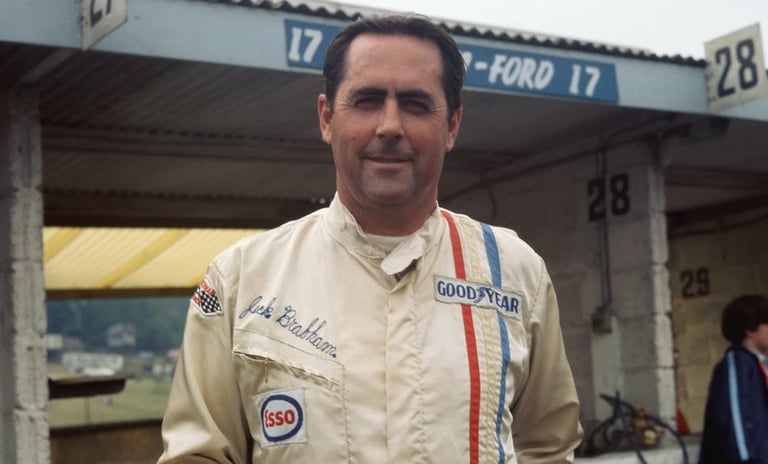
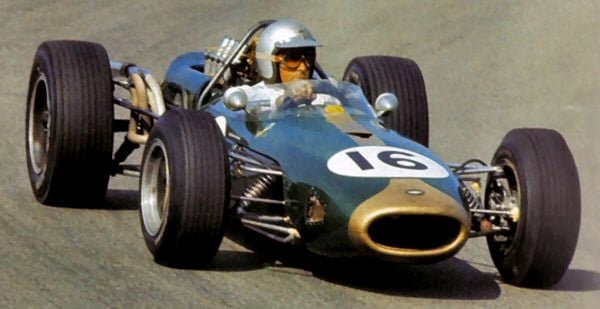
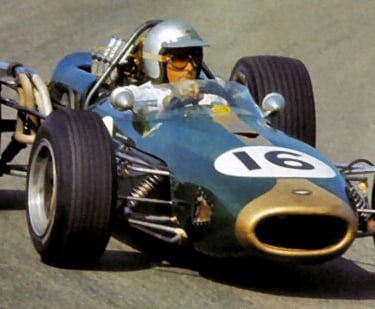
Jack Brabham and his car powered by an engine derived from a road-car block. The unbeatable combination of 1966.
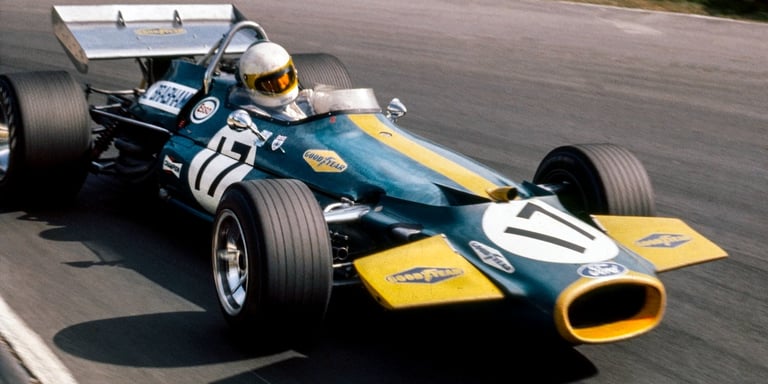
Brabham in his last season in 1970
Brabham celebrating an achievement that no driver had ever accomplished before—or has managed since: winning the World Championship in a car bearing his own name.
In the dramatic finale of the 1959 championship, Brabham pushed his Cooper across the finish line to secure the World Championship.
Jack Brabham and John Cooper at Le Mans in 1957