One Corner, Eight Cars, One Hailstorm: The Madness of the 1975 British Grand Prix
CLASSIC MOTORSPORT
3/12/20268 min read
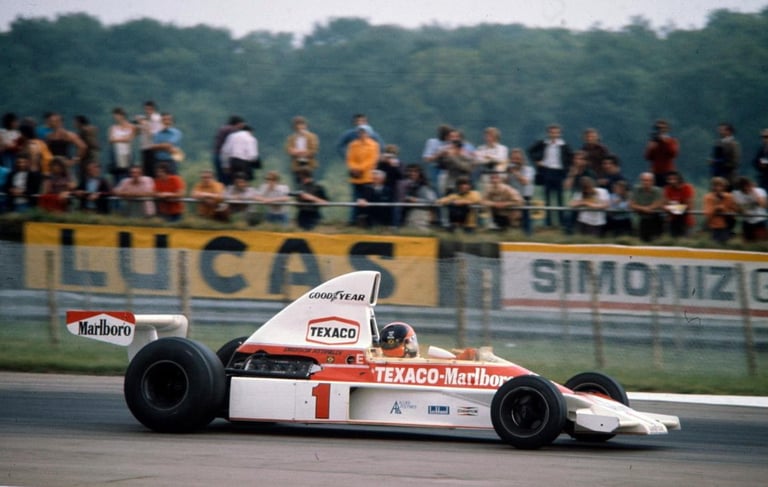
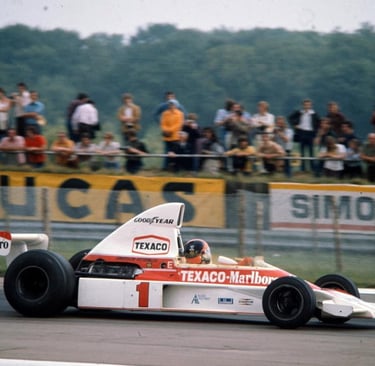
Silverstone, July 19, 1975. The John Player Grand Prix — the official name of that year's British round — promised a classic battle between the sport's sharpest minds and fastest cars. Instead, it devolved into one of Formula 1's most spectacular descents into mayhem: a race halted by a hailstorm, a mass pile-up at a single corner, and Emerson Fittipaldi claiming the win in circumstances nobody could have scripted. It was also the day the sport bid farewell to one of its greatest legends — and a day tinged, in retrospect, with tragic foreshadowing.
A New Silverstone Born of Fear
The 1975 British Grand Prix arrived in the aftermath of safety trauma. The Spanish Grand Prix at Montjuïc earlier that spring had ended in catastrophe, claiming lives and forcing the FIA to confront its safety deficit with urgency. At Silverstone, the response was already built into the asphalt: the iconic Woodcote Corner — that terrifying 145–150 mph sweep where cars teetered on the absolute limit of tyre adhesion — had been neutered by a new chicane. In its place, a right-left-right ess-bend taken at around 100 mph awaited the drivers.
Purists mourned. The chicane added roughly three seconds to lap times and robbed the circuit of its most dramatic moment. The irony would become clear before the afternoon was over: no chicane could stop what the English sky had planned.
Graham Hill: A Legend Walks Away
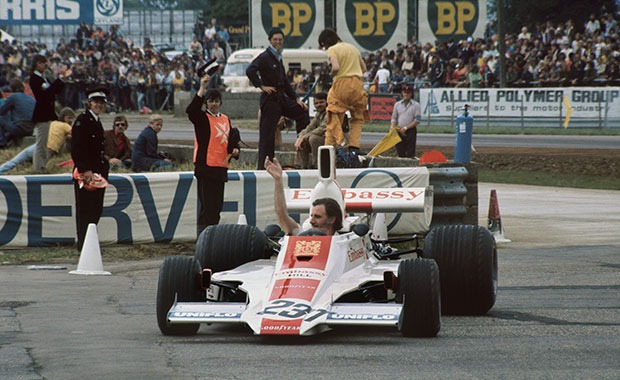
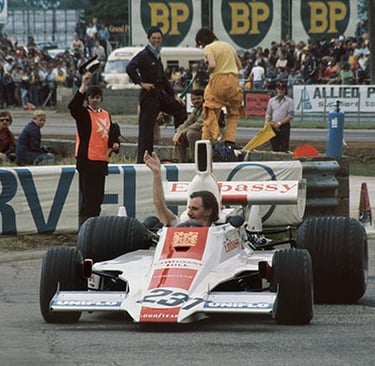
One hour before the start, the crowd at Silverstone witnessed something no race result could match in emotional weight. Graham Hill — winner of two World Championships (1962 and 1968), the Indianapolis 500, the Le Mans 24 Hours, and the Targa Florio, the only man in history to achieve motorsport's Triple Crown — drove a slow, unhelmeted, overalls-free lap around the circuit in a road car. It was his farewell.
Hill had already officially retired as a driver after 176 Grand Prix starts — a world record at the time — following his failure to qualify at Monaco. Now he was concentrating entirely on managing his Embassy Hill team, with the immensely promising young Briton Tony Brise as his lead driver. The crowd applauded a man who had given them seventeen extraordinary years.
What none of them could know — what nobody could know — was that four months later, in November 1975, Graham Hill would die in a plane crash near London alongside Brise and four other team members, closing one of racing's greatest stories with the cruelest of full stops.
Qualifying: A Welshman's Finest Hour
Practice across the preceding days unfolded beneath the same unsettled, stormy skies that would define the weekend. When the final qualifying order was set, the biggest story was Tom Pryce. The young Welshman, driving the Shadow-Ford, had delivered a stunning performance to claim the first and only pole position of his career with a lap of 1:19.36. The home crowd roared.
Behind him, Brazilian Carlos Pace qualified second for Brabham, separated from pole by just 0.14 seconds. Niki Lauda and Clay Regazzoni locked out the second row in their Ferraris, confirming the Scuderia's status as the season's dominant force. Reigning World Champion Emerson Fittipaldi, however, could only manage seventh in his McLaren M23, while James Hunt qualified ninth in his Hesketh. Neither result hinted at their starring roles to come.
The Dry Race That Never Quite Was
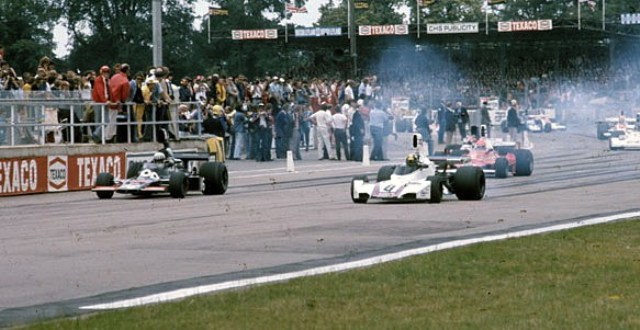
The start of the British Grand Prix made history in its own quiet way: for the first time in Formula 1, a traffic light system replaced the traditional national flag to send the field away. When the green light appeared, Pace muscled his Brabham past Pryce to lead into the first corner, with Regazzoni, Lauda, Scheckter, and Hunt in close attendance.
The early laps belonged to Regazzoni. Displaying the audacity that always made him exciting to watch, the Swiss-Italian passed Pace in a breathtaking side-by-side move through the new Woodcote chicane on lap 13 to take the lead. His Ferrari looked comfortable, in control, and capable of winning the race at will.
Then, on lap 19, the rain began to fall on the far side of the Silverstone airfield — at Stowe Corner and Club Corner. Within a lap, Regazzoni lost control, clouting his rear wing on a barrier at Club. He limped into the pits. Pryce, who had taken the lead, crashed out at Becketts on lap 21. Just like that, the race's two most natural frontrunners were gone.
What followed was Formula 1 strategy at its most chaotic and human. Jody Scheckter briefly led before diving for wet tyres as rain spread across the full circuit, returning the lead to Pace. Behind, Lauda's pit stop collapsed into farce: a wheel was improperly secured and fell off before his Ferrari had even left the pit lane. Sent back for repairs, the championship leader lost over a lap — one of the most damaging blunders of his title defence.
With the Ferraris neutralised by crash and comedy, the real battle became a gamble between the elements and the timing board. Pace, Fittipaldi, Hunt, and Mass pressed on brave slick tyres while Scheckter, now on wets, charged through them all and appeared to run away with the race — until the circuit dried and he was forced to pit again. Jarier in the Shadow led for two laps, then he too pitted. By lap 43, with Fittipaldi having picked off a power-sapped Hunt, the Paulista was running first, smooth and calculating, the position he had earned through patience while others scrambled.
It looked, at last, like the race would settle. The sun was even shining.
Then the English summer delivered its final verdict.
From lap 53 onward, the weather deteriorated from unsettled to savage. This was no light shower — it was, as Motorsport Magazine reported at the time, "a good torrential downpour," sweeping across the fields from beyond Stowe. A heavy hailstorm with ice pellets turned the circuit into an aquaplane trap, and no driver — no matter their skill — could do anything about it.
On lap 54, Jean-Pierre Jarier became the first victim, losing control at the Woodcote chicane and flying into the catch-fences with sufficient violence to leave him with head injuries, while flying debris struck a spectator.
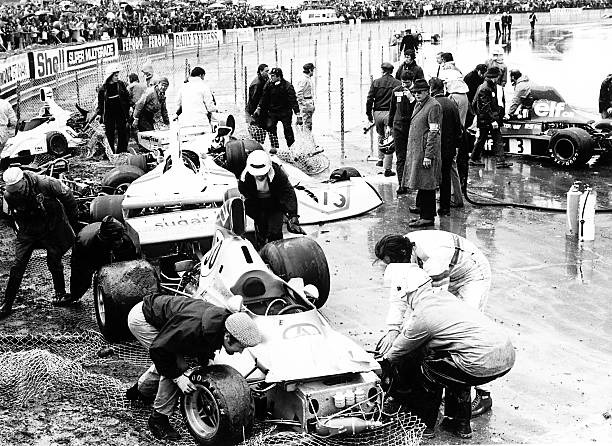
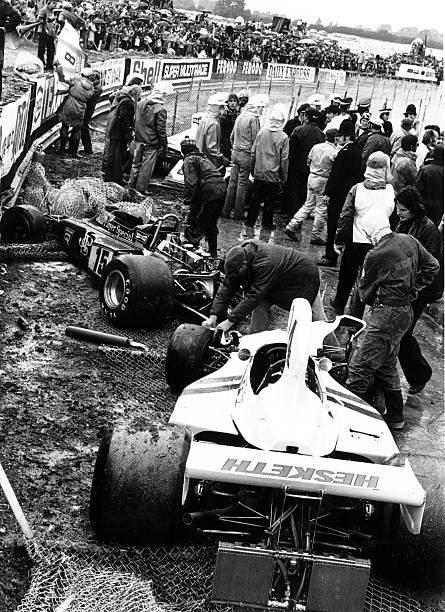
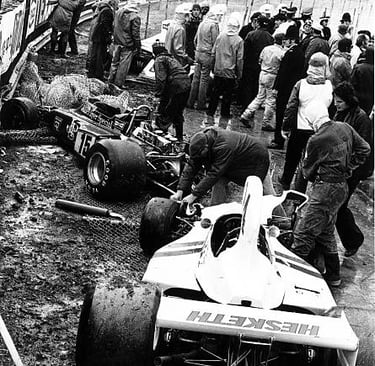
Then came lap 56. Club Corner, already notorious, became a scene of mass destruction. Tony Brise, Carlos Pace, Jody Scheckter, James Hunt, Brian Henton, John Nicholson, Dave Morgan, and Wilson Fittipaldi — Emerson's own brother — all aquaplaned off at the same corner in rapid succession, one after another, helpless against the standing water. At Stowe Corner simultaneously, Jochen Mass, Mark Donohue, and John Watson added to the carnage.
A marshal at Club Corner was seriously injured. Tony Brise — the young driver who had been circulating impressively all afternoon — suffered nasty facial injuries. The catch-fencing, designed to protect drivers and spectators, had been flattened by the sheer volume of crashing cars and was no longer providing any protection whatsoever. The marshal in charge of the corner called race control: it was over.
The red flag came out.
A Controversial Conclusion
Emerson Fittipaldi had already entered the pits at the end of lap 56 for wet tyres. He completed lap 57 before the red flag finally reached him. In the chaos, the RAC deliberated for three days before confirming the official result: positions would be classified as last observed in order — which placed Fittipaldi first, Pace second, Scheckter third, Hunt fourth, and Donohue fifth, despite most of them being in the gravel at Club Corner when the flag fell.
Ferrari, with both their cars classified on lap 54 after Lauda's tyre misadventure and Regazzoni's wing damage, protested vigorously. The RAC rejected every appeal.
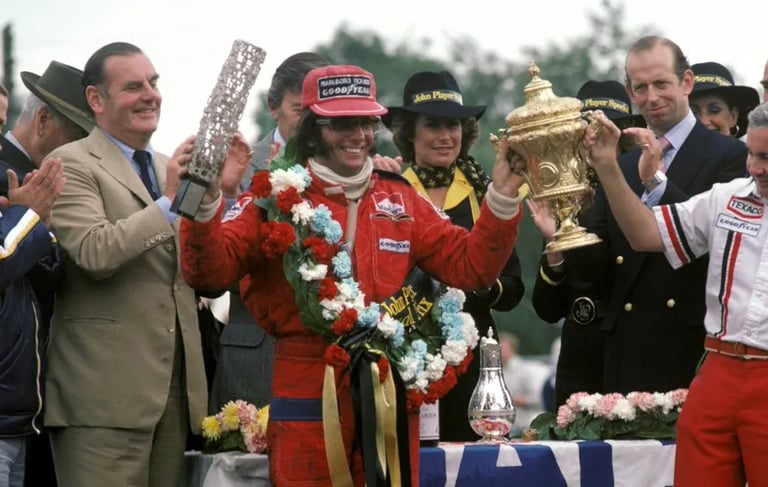
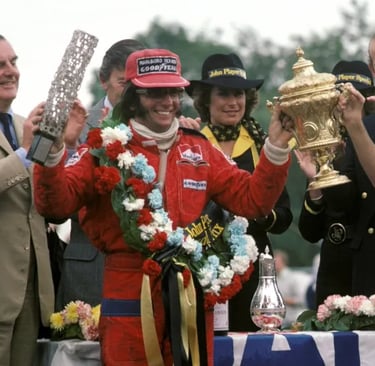
Emerson Fittipaldi was the winner — and, though no one knew it that afternoon, it was the 14th and final victory of his Formula 1 career. He would race until 1980 without ever returning to the top step of the podium. The win propelled him past Carlos Reutemann into second in the Drivers' Championship, but Lauda still led by 14 points — 47 to 33 — with four races remaining. The Austrian, despite a catastrophic afternoon that yielded only eighth place and zero points, retained an iron grip on the title he would eventually claim.
Watch the full story unfold: Want to see the chaos for yourself? The highlights of the 1975 British Grand Prix — including the hailstorm, the mass pile-up at Club Corner, and Fittipaldi's dramatic victory — are captured in the video below.
The 1975 British Grand Prix is remembered not as a triumph or a tactical masterpiece, but as a collision of everything Formula 1 can be at once: brilliant and brutal, poetic and chaotic, historic and heartbreaking. In a single afternoon at Silverstone, the sport produced a legendary farewell, a debut pole position for a national hero, the first traffic light start in Grand Prix history, a three-act tyre strategy war, and a hailstorm that hospitalised a marshal and demolished a corner's worth of catch-fencing.
Fittipaldi drove the perfect race — composed, relentless, clinical — only to have history bury his victory under the weight of the storm around it. In the end, the rain had the last word at Silverstone. It almost always does.
🏁 1975 British Grand Prix — Silverstone, July 19, 1975
Laps completed: 56 of 67 scheduled | Distance: 264 km
1st — Emerson Fittipaldi | McLaren-Ford | 56 laps | 1:22:05.0 | Started: 7th | 9 pts
2nd — Carlos Pace | Brabham-Ford | 55 laps | Accident | Started: 2nd | 6 pts
3rd — Jody Scheckter | Tyrrell-Ford | 55 laps | Accident | Started: 6th | 4 pts
4th — James Hunt | Hesketh-Ford | 55 laps | Accident | Started: 9th | 3 pts
5th — Mark Donohue | March-Ford | 55 laps | Accident | Started: 15th | 2 pts
6th — Vittorio Brambilla | March-Ford | 55 laps | +1 lap | Started: 5th | 1 pt
7th — Jochen Mass | McLaren-Ford | 55 laps | Accident | Started: 10th
8th — Niki Lauda | Ferrari | 54 laps | +2 laps | Started: 3rd
9th — Patrick Depailler | Tyrrell-Ford | 54 laps | Accident | Started: 17th
10th — Alan Jones | Hill-Ford | 54 laps | +2 laps | Started: 20th
11th — John Watson | Surtees-Ford | 54 laps | Accident | Started: 18th
12th — Mario Andretti | Parnelli-Ford | 54 laps | +2 laps | Started: 12th
13th — Clay Regazzoni | Ferrari | 54 laps | +2 laps | Started: 4th
14th — Jean-Pierre Jarier | Shadow-Ford | 53 laps | Accident | Started: 11th
15th — Tony Brise | Hill-Ford | 53 laps | Accident | Started: 13th
16th — Brian Henton | Lotus-Ford | 53 laps | Accident | Started: 21st
17th — John Nicholson | Lyncar-Ford | 51 laps | Accident | Started: 26th
18th — Dave Morgan | Surtees-Ford | 50 laps | Accident | Started: 23rd
19th — Wilson Fittipaldi | Fittipaldi-Ford | 50 laps | Accident | Started: 24th
Ret. — Hans-Joachim Stuck | March-Ford | 45 laps | Accident | Started: 14th
Ret. — Jim Crawford | Lotus-Ford | 28 laps | Accident | Started: 25th
Ret. — Tom Pryce | Shadow-Ford | 20 laps | Accident | Started: 1st (pole)
Ret. — Lella Lombardi | March-Ford | 18 laps | Engine | Started: 22nd
Ret. — Ronnie Peterson | Lotus-Ford | 7 laps | Engine | Started: 16th
Ret. — Jacques Laffite | Williams-Ford | 5 laps | Gearbox | Started: 19th
Ret. — Carlos Reutemann | Brabham-Ford | 4 laps | Engine | Started: 8th
Fastest Lap: Clay Regazzoni — Ferrari — 1:20.9
Pole Position: Tom Pryce — Shadow-Ford — 1:19.36