Precision, Superstition, and Tragedy: The Incredible Story of Alberto Ascari
On May 26, 1955, Alberto Ascari climbed into a borrowed Ferrari at Monza without his lucky blue helmet. That afternoon, at 36 years old, he was dead — the same age his father had died, on the same day of the month, under almost identical circumstances. Some call it coincidence. Others call it destiny.
CLASSIC MOTORSPORT
6/1/202613 min read
Alberto Ascari remains one of the most compelling figures in Formula 1 history because his life brought together greatness, discipline, family legacy, superstition, and tragedy in almost unbelievable proportions. He was Ferrari’s first Formula 1 world champion, the first driver to win back-to-back F1 titles, and, to this day, the last Italian to win the world championship.
Yet Ascari’s story is not only about trophies. It is also about a child who grew up in the shadow of a famous father, a young man shaped by loss, and a champion who combined precise, almost scientific racecraft with rituals and omens he never fully escaped. That contrast is what still makes him unforgettable. On the one hand, he was calm, smooth, and methodical behind the wheel; on the other, he was deeply superstitious, protective of his lucky blue helmet, and haunted by the fear that he might share his father’s fate.
For Ferrari, Ascari was the driver who transformed ambition into authority. For Italy, he became the national racing hero of the early 1950s. For Formula 1, he set the first real standard of championship dominance. And for anyone who studies the history of the sport, Alberto Ascari remains a rare figure: a champion whose statistics alone are impressive, but whose life story is even more remarkable than his record.
A Child of Racing Royalty
Alberto Ascari was born in Milan on 13 July 1918 into one of Italy’s best-known racing families. His father, Antonio Ascari, was one of the leading Grand Prix drivers of the pre-war era and had built a formidable reputation through speed, courage, and major victories. In Italy, the Ascari name already carried weight long before Alberto ever sat in a racing cockpit.
That legacy came at a terrible cost. In 1925, when Alberto was only seven years old, Antonio Ascari was killed while leading the French Grand Prix at Montlhéry, in a crash whose exact cause was never established. The death shocked Italian motorsport and left the Ascari family without its central figure. For a young Alberto, it created both an emotional wound and a strange kind of inheritance: racing was no longer just a profession associated with glory, but also with danger, fate, and unresolved grief.
Even so, Alberto was drawn toward the same world that had taken his father. The loss did not deter him; instead, he immersed himself in racing culture from an early age and grew up around both motorcycles and cars. During those years he also came into contact with Enzo Ferrari, who had been close to Antonio Ascari, a link that would later prove decisive in Alberto’s career.
This early background mattered because it formed Ascari’s identity long before he became famous himself. He was not a self-created outsider arriving from nowhere, but neither was he simply living off a famous surname. He carried a legacy that opened doors, yet also brought expectations and ghosts. In many ways, the rest of his life can be understood as a dialogue with that inheritance: he wanted to honor his father, surpass him, and somehow avoid repeating his fate.
From Motorcycles to Cars
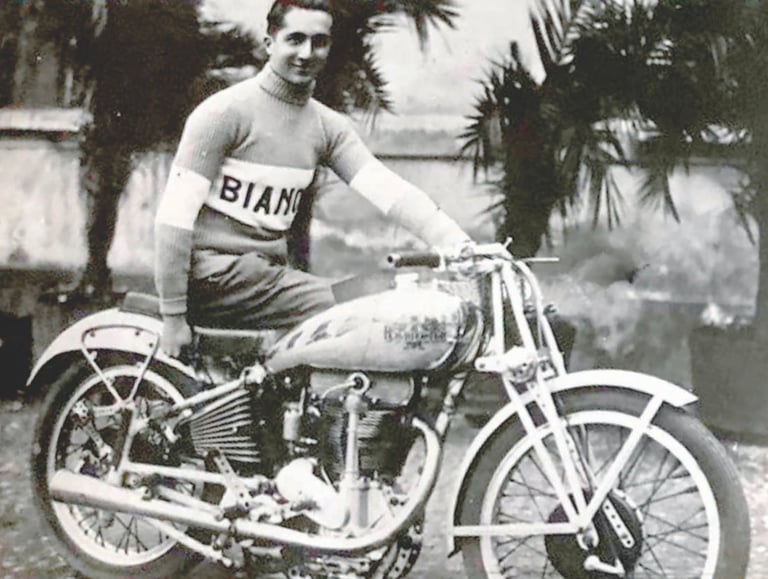
Ascari’s route into top-level racing began on two wheels. At the age of 19, he joined the Bianchi motorcycle race team, taking his first formal steps into professional competition. Those years were more important than they sometimes appear in short biographies, because motorcycle racing sharpened the qualities that later defined him as a car driver: balance, sensitivity, mechanical sympathy, and a smooth style that wasted little motion.
His switch to cars came in 1940 in the Mille Miglia, when he made his debut in an Auto Avio Tipo 815, effectively a precursor to a Ferrari. That entry carried symbolic importance. Enzo Ferrari had already become a major figure in Italian racing, and Ascari’s first serious experience in cars connected him directly to the man and organization that would shape the most glorious period of his career.
Then history intervened. The Second World War brought European motor racing to a halt, interrupting the early development of countless drivers, including Ascari. During the war years, he took responsibility for the family’s Fiat dealership and workshop in Milan, and he was also involved with an Italian army transport company in North Africa. Rather than being lost years, this period helped mature him. He learned discipline, responsibility, and the value of structure, qualities that fit naturally with the methodical racer he later became.
After the war, Luigi Villoresi, another important Italian driver and a partner in Ascari’s business life, encouraged him to return fully to competition. By 1949, Ascari and Villoresi were teammates in Enzo Ferrari’s Scuderia. That move placed Alberto exactly where he needed to be: in the strongest Italian team, under the guidance of a man who had known his father, and at the threshold of Formula 1’s birth as a world championship.
The Personality Behind the Helmet
Before looking at Ascari the champion, it is essential to understand Ascari the man. He was widely remembered as open, friendly, and outwardly calm, with a reputation for always seeming in control. He did not look like a driver trying to wrestle a car into submission; instead, he gave the impression of operating within a precise internal rhythm, always aware of what the machine could do and what it should not be forced to do.
That is why his driving style is so often described as precise and measured. Especially effective when he started at the front, he was rarely overtaken. A man who appeared quick without ever seeming to push beyond control. In an era when many drivers were visibly dramatic and violent in their inputs, Ascari stood out for his economy and flow.
At the same time, he was deeply superstitious. That was not unusual in the lethal environment of early 1950s racing, but Ascari’s rituals became a defining part of his image. Pirelli’s historical material states that he was terrified of black cats and strongly aware of the mortal risks of his profession. Fondazione Pirelli adds that he was troubled by the thirteen letters in his own name and his father’s, avoided driving on the 26th because Antonio had died on the 26th of July, and would never race without his lucky blue helmet.
These habits reveal more than a few eccentric quirks. They suggest a man trying to impose order on an environment that offered very little certainty. Ascari’s professionalism and superstition were not opposites; they were two responses to the same reality. One was rational, rooted in preparation and precision. The other was emotional, rooted in fear, memory, and the desire to bargain with fate.
Ferrari, Formula 1, and the Rise of a Contender
When the Formula 1 World Championship for Drivers began in 1950, Ascari was already positioned to become one of its early stars. He competed in four Grands Prix that season and reached the podium twice, including a second place in Monaco on Ferrari’s debut. That result showed Ferrari could be immediately competitive at the highest level and that Ascari was more than capable of carrying the team’s hopes.
In 1951 he moved from promise to proof. Ascari scored his first Formula 1 victory in Germany and followed it with another win at Monza in the Italian Grand Prix. These wins did more than build his confidence. They established him as a genuine title contender and confirmed Ferrari as Alfa Romeo’s principal challenger at the top of Grand Prix racing.
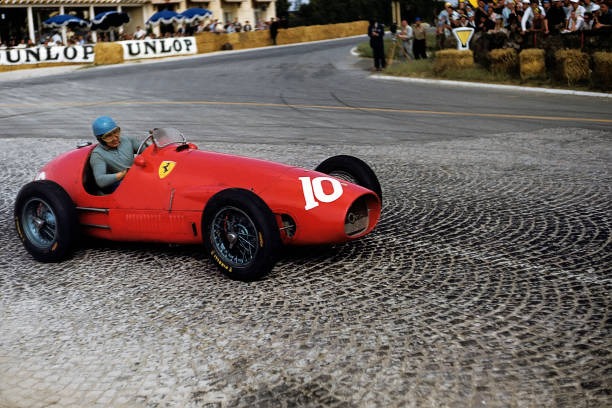
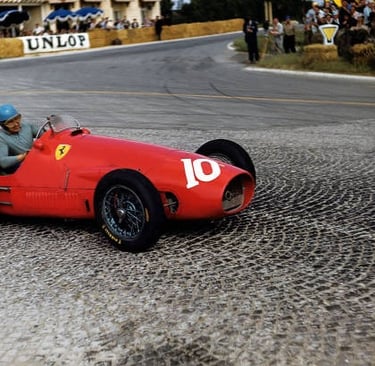
Ferrari’s position entering 1952 was different from anything it had experienced before. According to Ferrari’s own history, the team was no longer satisfied merely with podium finishes; its objective was clearly to win the championship. The timing was favorable. For the 1952 and 1953 world championships, Formula Two regulations were adopted, with a maximum naturally aspirated engine capacity of two litres. Ferrari responded with the 500 F2, powered by a new 2-litre inline four-cylinder engine.
That car changed everything. It was reliable, well-balanced, and perfectly suited to Ascari’s smooth, disciplined approach. Great champions often need a machine that amplifies their strengths rather than forcing them into compromise, and the Ferrari 500 F2 did exactly that for Ascari. The result was one of the most dominant periods in early Formula 1 history.
1952: The Season That Made Ferrari
The 1952 championship did not begin smoothly for Ascari. Ferrari sent him to the Indianapolis 500 with the 375 Indianapolis, which meant he had to skip the Swiss Grand Prix in Bern two weeks earlier. The Indy venture ended badly when he retired because of a wheel problem. Two races into the championship, he had no points, and on paper his season looked compromised before it had really begun.
What followed was total command. Starting with the Belgian Grand Prix at Spa-Francorchamps, Ascari won all six remaining rounds of the championship season. Monza, on 7 September 1952, crowned him world champion after his sixth consecutive Grand Prix victory, giving Scuderia Ferrari its first Drivers’ World title. He also delivered five pole positions and six fastest laps during that crushing campaign.
This run was the moment Ferrari became Ferrari in the championship sense that later generations would recognize. The team had ambition before Ascari, but in 1952 it finally converted that ambition into supremacy.
The character of the title mattered as much as the title itself. Ascari dominated it systematically, week after week, through pole positions, fastest laps, controlled victories, and an extraordinary sense of composure. He was not simply the fastest man in the field; he was the one who best understood how to combine speed, reliability, and consistency into an unbeatable formula.
For Ferrari, it was a transformational breakthrough. The team that would become the most famous and successful name in Formula 1 had found its first true champion. For Ascari, it was vindication. He was no longer known first as Antonio Ascari’s son or Enzo Ferrari’s protégé. He was now the man who had placed himself permanently in the history of the sport.
1953: From Champion to First Double Champion
If 1952 established Ascari at the summit of Formula 1, 1953 confirmed that he belonged there. Repeating as champion is always harder than winning the first title because expectations change. Rivals study weaknesses more carefully, pressure rises, and any loss of focus is magnified. Ascari, however, maintained his level.
He repeated the six-race winning feat in 1953 and secured his second Drivers’ title. In the Ferrari 500 F2, Ascari scored 11 wins from 14 starts and won two championship titles. That figure alone shows how completely he controlled the category during the Formula Two rules era.
He swept the final six races of 1952, then in 1953 continued by winning the first three European rounds, creating a longer streak that reached seven straight championship victories and nine if Indianapolis is excluded. However one counts the sequence, the broader point is unmistakable: Ascari’s control over world championship racing across 1952 and 1953 was extraordinary.
His second title also carried immense symbolic value. Ascari became the first back-to-back world champion in Formula 1 history, a pioneer in the truest sense. Ferrari had not just won its first championship; it had built a dynasty around a driver whose calm intelligence and mechanical sympathy allowed the team to exploit its advantage to the fullest.
There is also an important historical irony here. Formula 1’s early years are often remembered through the giant reputations of Juan Manuel Fangio and Ferrari as an institution, but Ascari’s 1952 and 1953 campaigns deserve equal attention because they created the first great pairing of driver and team in world championship history. Before the later eras of Clark and Lotus, Stewart and Tyrrell, Schumacher and Ferrari, there was Ascari in the Ferrari 500 F2, setting the pattern for what dominance could look like.
Why Ascari Was So Hard to Beat
Ascari’s dominance in 1952 and 1953 was not built on one simple factor. The Ferrari 500 F2 was essential, but other drivers had strong cars in early F1 history too. What separated Ascari was how completely his strengths matched the demands of the period.
First, he was unusually smooth. In the early 1950s, when mechanical reliability was fragile and tracks were dangerous, smoothness was not just aesthetically pleasing; it was strategically decisive. A driver who abused the car might produce one heroic lap, but a driver who understood how to preserve tyres, brakes, engine, and rhythm could dominate over a race distance. Ascari belonged firmly in the second category.
Second, he was mentally organized. The same personality that produced rituals and superstitions also produced routine, concentration, and emotional control. He rarely looked hurried. He rarely appeared to be improvising. He approached races with the demeanor of a man solving a problem step by step.
Third, he was lethal when leading from the front. He was not a chaotic racer living on desperate recovery drives. He was a constructor of victories. Give him the lead, a balanced Ferrari, and a race he could dictate, and he would often make the rest of the field look ordinary.
Finally, he understood risk better than many of his peers. That did not mean he was slow or timid. It meant he knew where the real limit of a race lay, and he usually refused to step beyond it unless absolutely necessary. This judgment, more than raw bravery, was one of the foundations of his greatness.
Superstition, Fate, and the Blue Helmet
Ascari’s superstition is one of the most frequently retold aspects of his life because it feels inseparable from the dramatic arc of his story. He would never race without his lucky blue helmet and would never get behind the wheel on the 26th of a month because his father had died on 26 July 1925.
He did not treat his father’s death as a distant family fact. He carried it with him into the cockpit, into the paddock, and into his private habits. Every ritual was, in a sense, an attempt to control a future that had once already destroyed his family.
That is why the later details of his death became so haunting to those who knew his story. His death highlights a series of eerie coincidences: both Antonio and Alberto died on the 26th of a month, both were 36 years old, both died four days after surviving major crashes, both had won 13 Grands Prix at the highest level at which they competed, and both crashed exiting fast left-hand corners, leaving behind a wife and two children.
Even if one strips away any temptation to romanticize coincidence, the emotional impact remains powerful. Ascari spent years fearing patterns like these, and in the end the patterns seemed to close around him.
The Final Season and the Fatal Crash
By 1954, Ferrari was no longer as competitive as it had been during Ascari’s title years, and he accepted a lucrative offer from Lancia to continue in Formula 1. The D50 showed promise but initially lacked reliability, so the new chapter did not produce immediate continuation of his earlier world championship form. Still, Ascari remained one of the outstanding drivers in Europe, and his prestige was undiminished.
He also won the Mille Miglia for Lancia in 1954, proving that his class extended well beyond Formula 1. But the final act of his life unfolded in 1955 and has become one of the most discussed episodes in racing history.
On 22 May 1955, during the Monaco Grand Prix, Ascari was leading when he made a mistake at the harbour chicane and plunged into the water. He survived, escaping with a broken nose, bruises, and a severe shock. Given how dangerous the incident looked, many assumed he had been extraordinarily lucky.
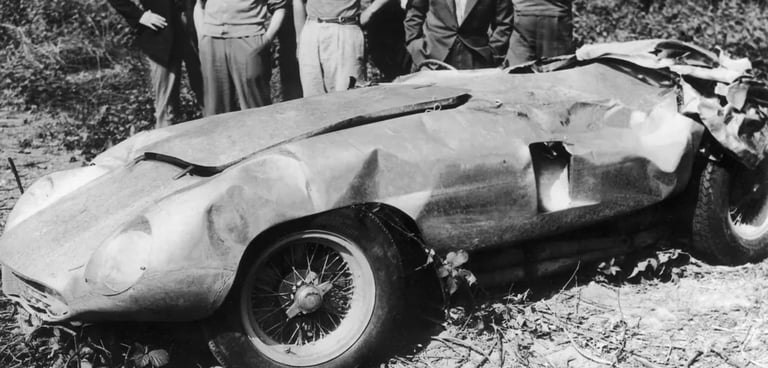
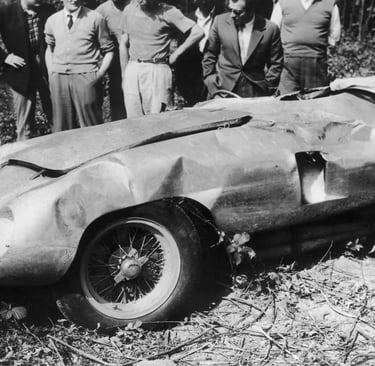
Four days later, Ascari unexpectedly appeared at a Ferrari test at Monza where his friend Eugenio Castellotti was running a sports car. He had not brought his own racing overalls or his beloved blue helmet, so he borrowed Castellotti’s white helmet instead. After only a few laps, he crashed fatally at the Vialone corner, now renamed in his memory.
The exact cause of the accident has never been conclusively established. A list of possibilities were discussed at the time: a blackout, a gust of wind, a tyre blowout, or even a person suddenly crossing the track.
Italy reacted with collective grief. Magazines describe a silent Milan during his funeral procession, with thousands of mourners dressed in black, fifteen funeral cars needed for the wreaths, and Ascari laid to rest beside his father, his blue helmet placed atop the coffin.
Ascari’s Legacy in Ferrari and Formula 1 History
Alberto Ascari’s place in history is secure on several levels at once. He was Ferrari’s first Formula 1 world champion, the first driver to win consecutive world titles, and the man who helped define what a dominant championship campaign looked like. The only Italian driver to have won two Formula One world titles, both with the Scuderia.
He also remains the last Italian world champion in Formula 1, which gives his career continuing national significance. In a country so deeply tied to Grand Prix racing, with Ferrari at the center of its motorsport identity, that fact ensures Ascari is never merely a historical footnote. He remains a reference point, a benchmark, and a symbol of a particular kind of Italian excellence: elegant, disciplined, proud, and touched by tragedy.
Yet his legacy cannot be reduced to numbers alone. Plenty of champions are remembered for statistics; only a few are remembered as fully formed characters. Ascari endures because the facts of his life fit together with unusual dramatic force: the heroic father, the childhood loss, the rise through Ferrari, the meticulous style, the superstitious rituals, the blue helmet, the back-to-back titles, the Monaco escape, the Monza death, and the almost unbearable parallels to Antonio.
Ascari reminds us that racing greatness is not always loud. Some champions dominate through force of personality and visible aggression. Ascari’s greatness was quieter. It lived in rhythm, in balance, in the refusal to make unnecessary mistakes, and in the calm authority with which he controlled races once he found the front.
At the same time, his vulnerability is part of his power as a historical figure. He was not a machine. He was a man shaped by fear, memory, affection, obligation, and ritual. That emotional complexity makes him more impressive. He was methodical precisely because he understood danger so well.
In the end, Alberto Ascari stands as one of the essential figures of early Formula 1, his career was brief, but its impact has lasted for generations.
Without Ascari, Ferrari’s rise would have looked different, Formula 1’s early record book would have looked different, and the mythology of motor racing would be missing one of its most haunting and unforgettable heroes.
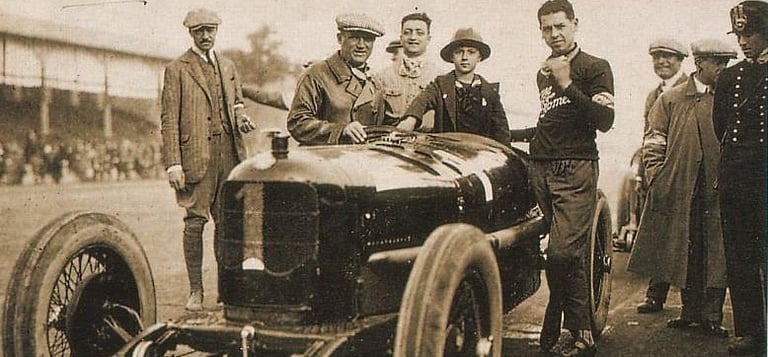
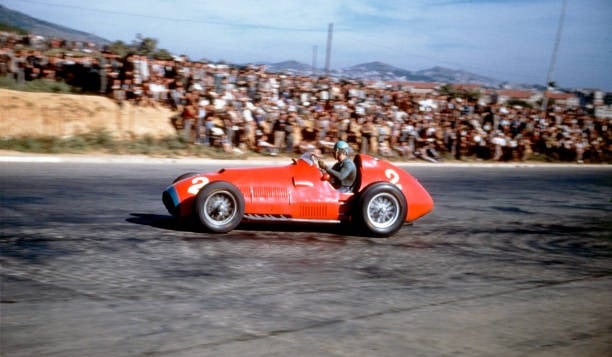
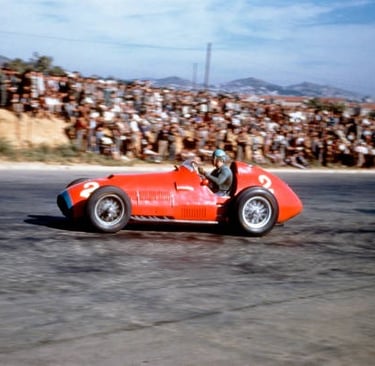
Historic photograph featuring Antonio Ascari, Enzo Ferrari, and a young Alberto Ascari as a child.
Ascari Driving his Ferrari 375 to Victory in Monza 1951
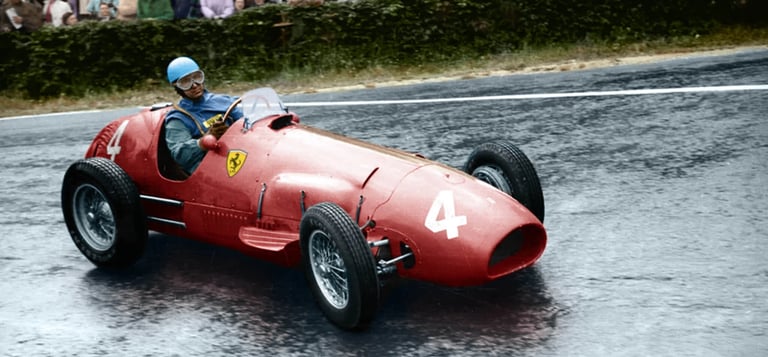
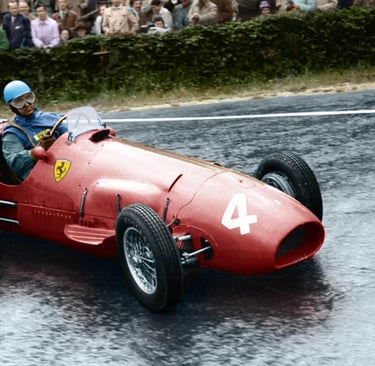
Alberto Ascari and his Ferrari 500 F2 during the 1952 Belgian Grand Prix.
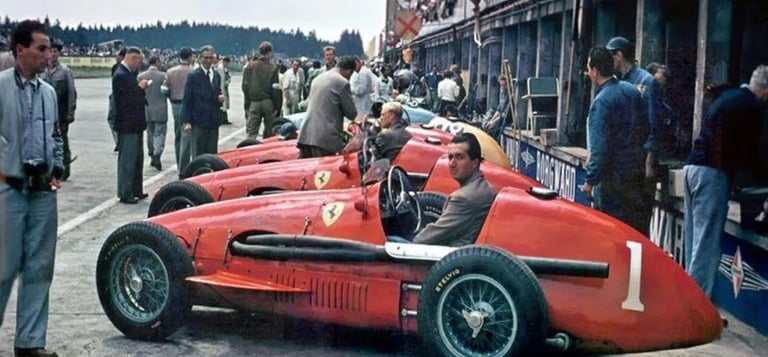
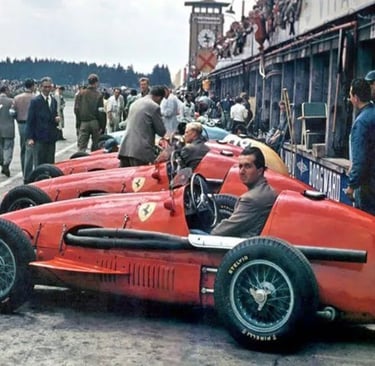
Alberto Ascari in the pit lane during the 1953 German Grand Prix.
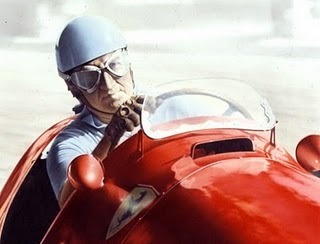
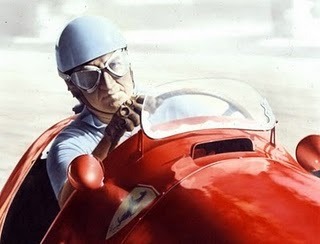
Alberto Ascari wearing his iconic blue helmet.