Rear-Engine Revolution: How the Cooper T51 Changed Grand Prix Racing in 1959
The Cooper T51 was powered by a four-cylinder engine at a time when every serious competitor fielded a six or more, and carried that engine bolted behind the driver when the entire establishment of motorsport considered the front the only logical place for it.
CLASSIC MOTORSPORT
5/7/20267 min read
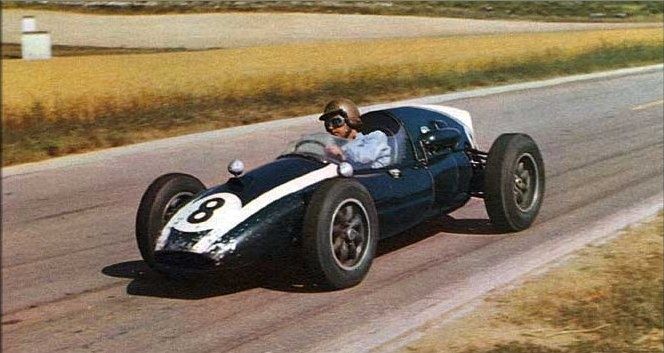
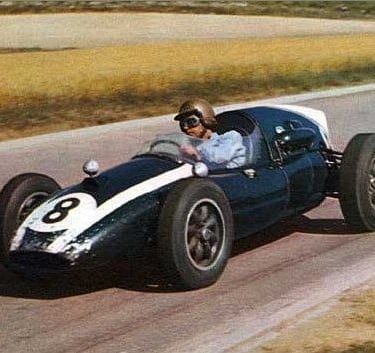
In 1959, the Cooper T51 looked like it had been assembled in a backyard workshop — because it essentially had been. The Cooper T51 was powered by a four-cylinder engine at a time when every serious competitor fielded a six or more, and carried that engine bolted behind the driver when the entire establishment of motorsport considered the front the only logical place for it. The establishment laughed. Then the Cooper T51 won everything — the Drivers' Championship, the Constructors' Championship — and triggered one of the most sweeping technical revolutions in the history of motorsport.
From a Fiat and a Motorcycle Engine: The Cooper Origin Story
The Cooper Car Company did not begin with some grand engineering vision drafted by white-coated technicians in a gleaming facility. It started with a father, a son, a limited budget, and a problem to solve.
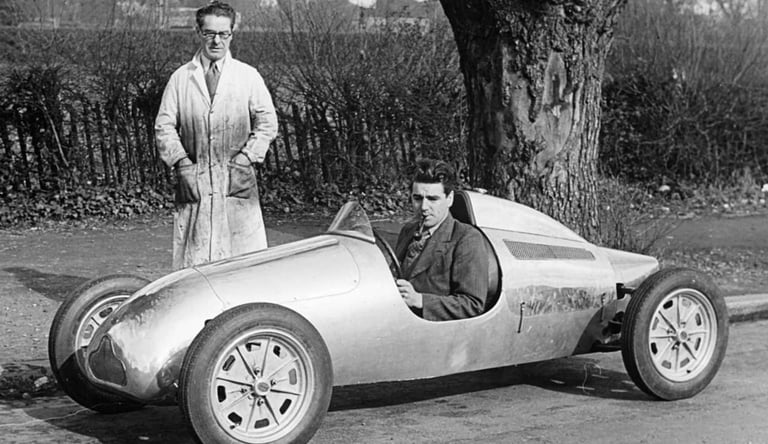
Charles Cooper had been a racing mechanic between the wars — most notably working for racing driver Kaye Don in the 1930s. His son John wanted to go racing, but the family could not afford a proper car. So in 1946, working in their small garage, they built the first prototype by joining the front suspension assemblies of two Fiat Topolinos and fitting a 500cc JAP motorcycle engine behind the driver. The engine went in the back for one entirely practical reason: it was chain-driven, and chain drive works best when the engine sits close to the rear wheels. There were no aerodynamic calculations, no weight-distribution theories, no team of engineers poring over telemetry data. It was just a father and son making do with what they had.
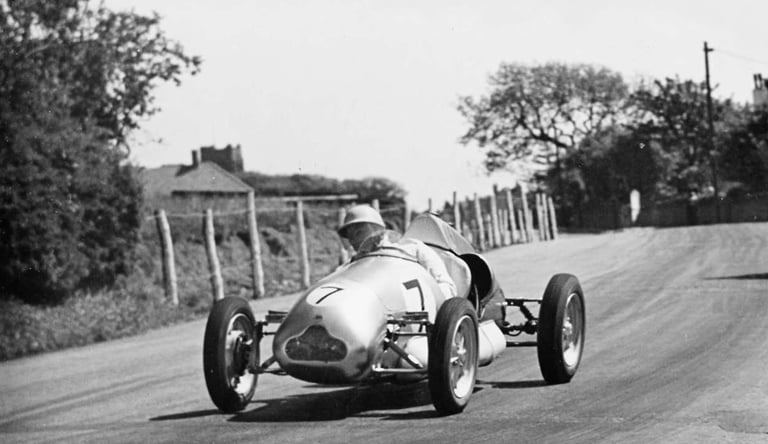
That first car competed in hill climbs in 1946. When the first-ever 500cc circuit race in Britain was held at Gransden Lodge in 1947, Eric Brandon won it in a Cooper. Orders began flooding in almost immediately. Cooper kept building rear-engined cars because it was cheap, practical, and it kept winning. Through the late 1940s and throughout the 1950s, the company steadily climbed through the lower racing formulae. The Cooper 500 series, from the Mk I through the Mk IX, made the company the most prolific manufacturer of racing cars in the post-war world, giving early starts to drivers including Stirling Moss, Jack Brabham, Bernie Ecclestone (Believe it or not, Ecclestone was actually a racing driver in the 1950s), Ken Tyrrell, and Peter Collins.
The Garagistes: Ferrari's Contempt and What It Missed
While Cooper was quietly ascending through junior categories, Enzo Ferrari watched from Maranello with unconcealed contempt. He coined a dismissive term for teams like Cooper: garagistes — garage owners, assemblers. The label was designed to sting.
In Ferrari's world, a real racing team designed and manufactured everything in-house: its own engines, its own gearboxes, its own chassis. These little British operations, by contrast, were buying Coventry Climax engines off the shelf, bolting them into lightweight frames welded together in a shed, and showing up to race against teams with decades of factory infrastructure behind them. Ferrari saw it as an affront to proper engineering. What he failed to see — or refused to see — was that these so-called garage mechanics were about to render his entire approach to car design obsolete.
An Almost Absurdly Affordable Championship Car
The Cooper T51 was not just cheaper than a Ferrari — it was almost comically cheap. When the Yeoman Credit Racing team purchased T51 chassis in 1959–1960, the price per rolling chassis was under £1,000. Cooper was, above all else, running a business. By 1958, Coopers of various types made up a substantial portion of the grid at major British events, having become the largest manufacturer of racing cars in the post-war world, building cars that club racers and privateer teams could actually afford to buy and campaign independently. Over its racing lifetime, 38 different drivers raced T51 chassis in Grand Prix events, a staggering number that underscores how thoroughly the design had penetrated the sport.
The Engineering Logic Behind the Rear Engine
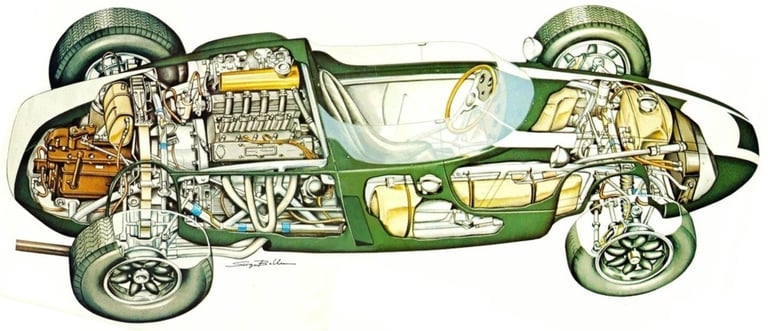
Under the T51's rear bodywork sat a 2.5-litre four-cylinder Coventry Climax FPF engine producing around 240 horsepower. Ferrari's Dino 246, by comparison, ran a V6 producing closer to 290 horsepower. On raw numbers, the Cooper should have been embarrassed on every straight. What the figures did not capture was what the rear-engine layout did for the rest of the car.
With the engine behind the driver rather than in front, the T51 had a dramatically smaller frontal area, reducing aerodynamic drag at speed. It eliminated the long propeller shaft that ran under the cockpit of every front-engined car, saving weight and mechanical complexity. Perhaps most importantly, the fuel tanks sat on either side of the cockpit rather than at the rear, meaning the car handled with remarkable consistency whether the tanks were full at the start of a race or nearly empty at the end. The combination of lower weight, better balance, and reduced drag allowed the T51 to compensate for its horsepower deficit in every braking zone and every change of direction.
The Curved Tube Chassis and the Road Car Gearbox
The T51's chassis was an act of deliberate pragmatism. Designer Owen Maddock — known within the team as "Whiskers" — created a space frame where many of the structural tubes were curved rather than straight. Classical structural engineering would favour straight tubes under load; Maddock's approach relied on the overall geometry of the frame compensating for the individual characteristics of each member, producing a chassis that was light, reasonably rigid, and fast to manufacture.
Finding a suitable gearbox for a rear-engined Formula 1 car in 1959 was a genuine engineering headache. Cooper's solution was ingenious in its crudeness: they used a Citroën Traction Avant gearbox, reversed and adapted to mate with the Climax engine. The unit suffered from chronic oil loss through the breather during racing, meaning internals had to be stripped and replaced after virtually every event.
Stirling Moss and the Warning Shot of 1958
Before the T51 even existed, Stirling Moss had already handed the racing world a clear warning of what the rear-engine concept was capable of. At the 1958 Argentine Grand Prix, Moss drove a Cooper T43 fitted with a Climax engine enlarged to approximately 1,960cc, against factory Ferraris running 2.4-litre V6s. He was outgunned on horsepower by a significant margin. Moss ran the entire race without a single pit stop — on tyres so worn that the canvas was showing through the rear rubber by the closing laps — and won. It was the first victory by a rear-engined car in World Championship Formula 1 history.
Jack Brabham: The Driver Who Was Also an Engineer
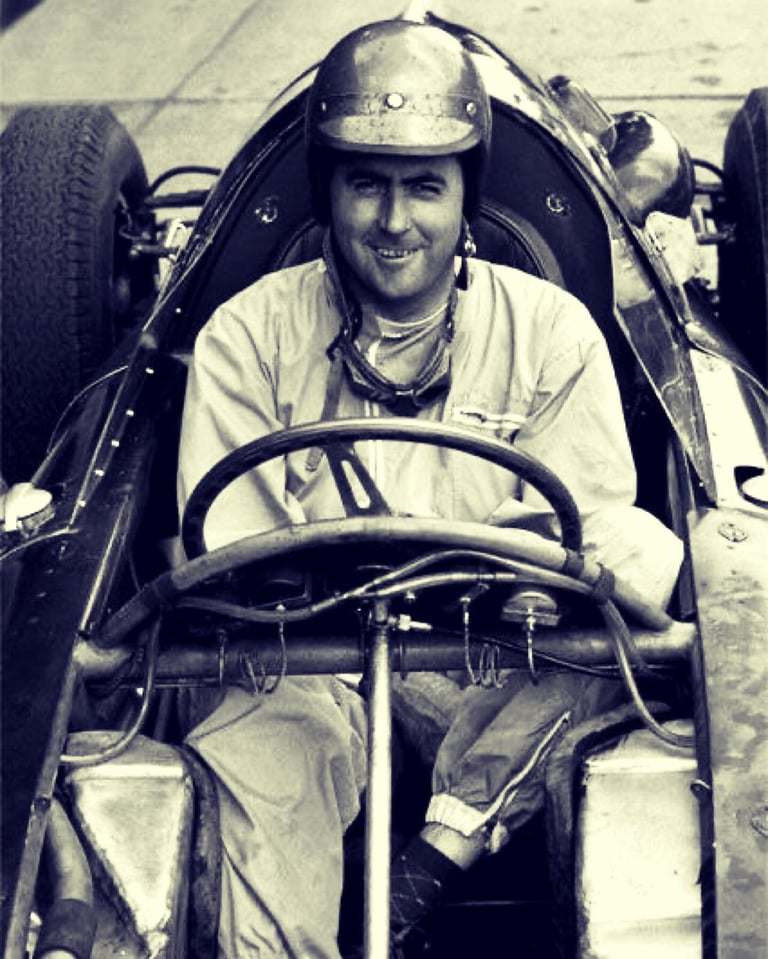
Jack Brabham was not simply a fast driver. He was a trained mechanical engineer who had initially come to the Cooper factory in Surrey to source spare parts for his own racing programme in Australia, and gradually became an integral part of the operation.
Brabham's most critical contribution beyond the cockpit was his hands-on development of the T51's gearbox. Working with his Australian engineering associate Ron Tauranac, he developed modifications to the chronically unreliable Citroën-based units that significantly improved their durability. The improved specification went into the works Cooper cars, while the many privateer teams running T51s continued to deal with the standard units. Brabham's engineering knowledge — and not merely his driving speed — was a decisive factor in the 1959 championship campaign.
Sebring 1959: The Most Dramatic Championship Finale
The final race of the 1959 season was the United States Grand Prix, held at Sebring, Florida — a bumpy former wartime airfield. Brabham arrived leading the championship. Stirling Moss and Ferrari's Tony Brooks were both within striking distance. All three men could still win the title that afternoon.
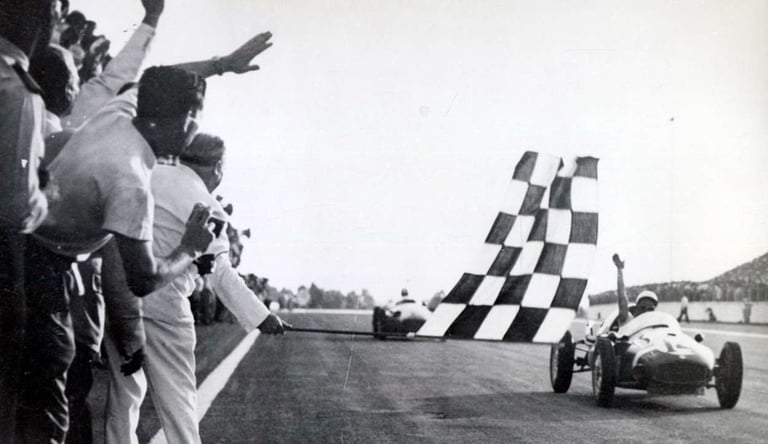
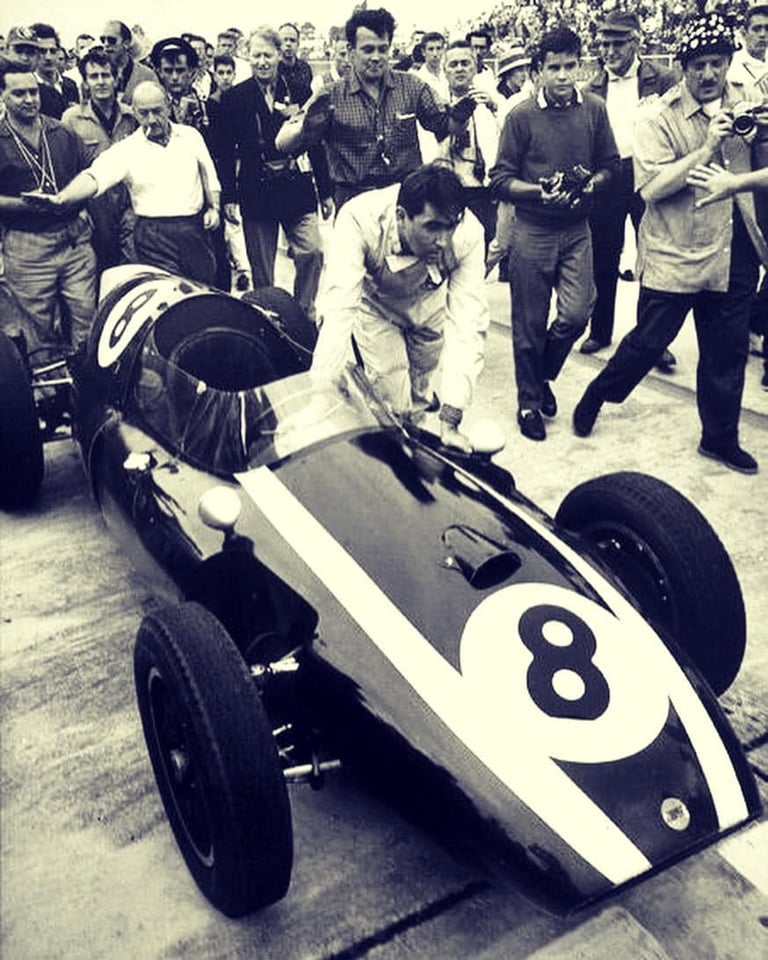
Moss took pole position and built an early lead. Then his gearbox failed. Brooks was involved in an incident at the start involving Wolfgang von Trips that compromised his race. Brabham led from there, nursing his Cooper through the Florida heat. Then, on the final lap, within sight of the finish line, the Climax engine sputtered and died — out of fuel. Brabham climbed out of the cockpit and pushed. The regulations required him to finish without outside assistance, so he shoved the Cooper toward the chequered flag while Bruce McLaren, Maurice Trintignant, and Tony Brooks swept past him in succession. He crossed the line in fourth place, then collapsed from exhaustion.
Fourth place was enough. Jack Brabham became the first Australian World Champion in Formula 1 history. The Cooper T51 became the first rear-engined car to win both the Drivers' and Constructors' Championships. Bruce McLaren, aged 22, became at the time the youngest Grand Prix winner in history that day.
The Revolution That Followed
When The Cooper T51 won the championship, it killed an entire philosophy of car design practically overnight. In 1960, Brabham in the updated Cooper T53 won five consecutive Grands Prix, and Colin Chapman's Lotus 18 — directly inspired by Cooper's rear-engine layout — was already winning races. By 1961, every single car on the Formula 1 grid had its engine mounted behind the driver.
Ferrari — the team that had openly mocked Cooper as garagistes — was the last major constructor to make the switch, finally committing to the rear-engined Ferrari 156 for the 1961 season. After 1960, no front-engined car ever won a World Championship Grand Prix again.
Every Formula 1 car built since, every IndyCar, every Le Mans prototype, every serious single-seater racing machine produced in the decades that followed uses the fundamental packaging layout that Charles and John Cooper arrived at in 1946 because they could not afford to put a motorcycle engine anywhere other than behind the driver of a Fiat-based chassis. The most consequential car in Grand Prix history was designed by necessity, built on a budget, and driven to its greatest moment by a man who had to climb out and push it across the finish line.
Ferrari had called them garagistes. History called them visionaries.