Senna at the Nürburgring: The Day a Rookie Announced Himself to the World
CLASSIC MOTORSPORT
4/23/20267 min read
A Race Born From Celebration
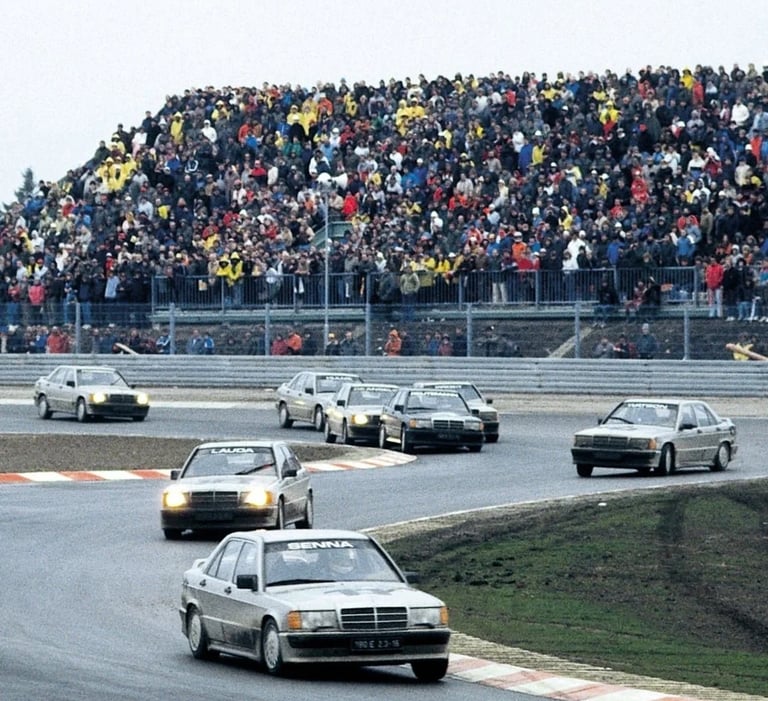
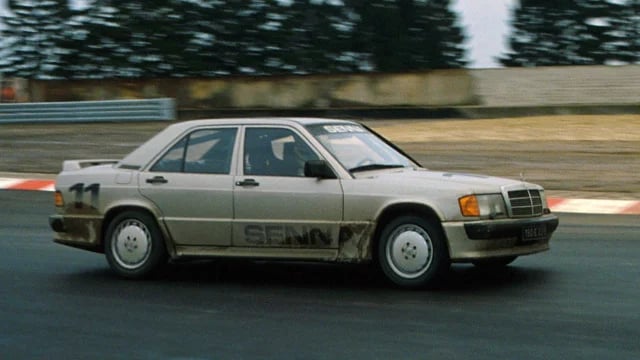
May 12, 1984. The new Nürburgring Grand Prix circuit is officially open, and Mercedes-Benz has chosen to mark the occasion in style. A proper race, with proper drivers, proper competition, and the kind of tension that only motor racing can produce. The event is called the Race of Champions, and it is built around one of the most elegant concepts in motorsport history: take twenty identical Mercedes-Benz 190 E 2.3-16 cars, hand one to each driver, and let the best man win.
The idea carries a certain purity that is rare in a sport defined by technological warfare. In Formula 1, the machine always shares credit with the driver. At Nürburgring in May 1984, there would be no such ambiguity. Every car is identical — same engine, same chassis, same tyres, same setup. Whatever happens on the track happens because of the driver alone. For a company launching a new performance saloon and a circuit announcing its rebirth after years of controversy following the 1976 accident that nearly killed Niki Lauda, it is the perfect promotional vehicle.
The Car: Mercedes-Benz 190 E 2.3-16
The Mercedes-Benz 190 E 2.3-16 — is no ordinary road car dressed in racing clothes. Developed in partnership with Cosworth, which engineered the 16-valve cylinder head, the car produces around 185 horsepower from a 2.3-litre engine, and it represents the sporting ambition of a company that had largely stayed away from front-line racing for decades. Small, rear-wheel drive, beautifully balanced and precise.
For Formula 1 drivers accustomed to machinery generating multiple times that power, it is a novelty. But the best among them understand immediately that the equal machinery format simply removes the excuse of a slower car. What remains is the driver — nothing else.
The Grid: Champions and Legends
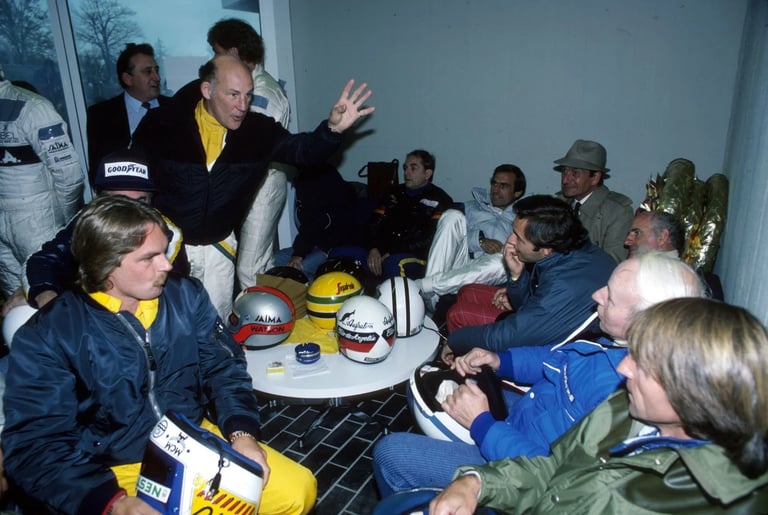
The entry list for the 1984 Nürburgring Race of Champions reads like a page torn from the history of Grand Prix racing. Mercedes-Benz and the event organisers have assembled a grid that spans generations: multiple world champions, Grand Prix winners, and celebrated names whose careers define the sport across the late 1960s, the 1970s, and the early years of the turbocharged 1980s era.
Among those present are Niki Lauda, the double world champion who almost died at this very venue eight years earlier and who has recently returned from retirement to add a third title with McLaren. Alain Prost is there too — the precise, calculating Frenchman who is at this moment one of the most feared drivers in Formula 1, a points-scoring machine whose measured intelligence behind the wheel has earned him the nickname "The Professor." Keke Rosberg, the 1982 World Champion, arrives with his trademark flamboyance. Carlos Reutemann, Jack Brabham, Denny Hulme, Stirling Moss, John Surtees, Alan Jones, James Hunt — the list encompasses decades of motorsport achievement and creates a grid unlike anything seen outside of a Grand Prix itself.
These are competitive people for whom winning is an instinct that cannot be switched off, and each one understands that finishing behind a teammate or rival in identical machinery carries no excuses whatsoever. The Race of Champions is, in every sense that matters, a genuine test.
The Substitute Who Wasn't Supposed to Be There
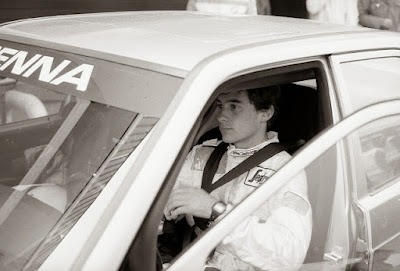
Into this constellation of champions walks a young man who is not, strictly speaking, supposed to be there at all. Ayrton Senna da Silva, twenty-four years old, in his first full season of Formula 1 with the Toleman team, is present at Nürburgring because someone else could not make it.
That someone is Emerson Fittipaldi, the Brazilian double Formula 1 world champion who had accepted the invitation to race at Nürburgring but found himself unable to attend. The reason is straightforward: Fittipaldi is committed to the Indianapolis 500, the legendary American oval race that demands its participants' full attention and presence in the week leading up to the event. With his seat suddenly vacant, Fittipaldi does not leave the organisers to scramble. He has a recommendation ready: the young Brazilian who is already making noise in Formula 1, the driver everyone who has worked with him says possesses something extraordinary.
Senna arrives at Nürburgring not as a headline act but as a late addition, a name that many of the older drivers on the grid may barely know. He is a rookie in Formula 1, driving for a team — Toleman — that operates far from the front of the grid. He has shown flashes of exceptional talent, but he has not yet won a Formula 1 race. He has not yet won anything that these champions would consider meaningful.
What he has, though, cannot be measured by results alone. In the Mercedes 190 E 2.3-16, on a new circuit, in an event that carries the weight of an entire paddock's attention, his talent is about to be demonstrated to an audience who will remember it for decades.
List Of Drivers by Number
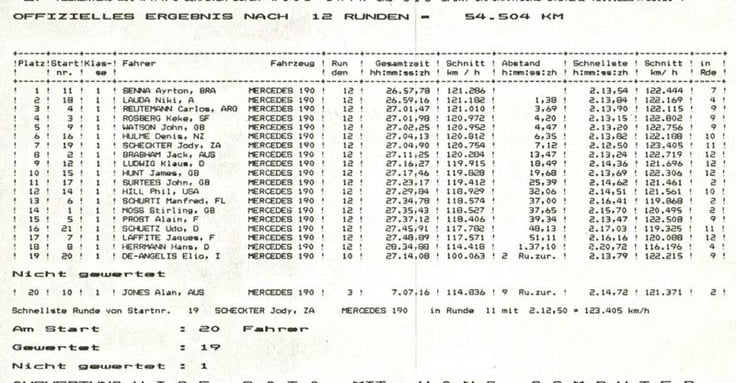
1 - Stirling Moss
2 - Jack Brabham
3 - Keke Rosberg
4 - Carlos Reutemann
5 - Alain Prost
6 - Manfred Schurti
7 - Jacques Laffite
8 - Hans Herrmann
9 - John Watson
10 - Alan Jones
11 - Ayrton Senna
12 - Klaus Ludwig
14 - Phil Hill
15 - James Hunt
16 - Denny Hulme
17 - John Surtees
18 - Niki Lauda
19 - Jody Scheckter
20 - Elio De Angelis
21 - Udo Schuetz
The Race: From Third to the Front
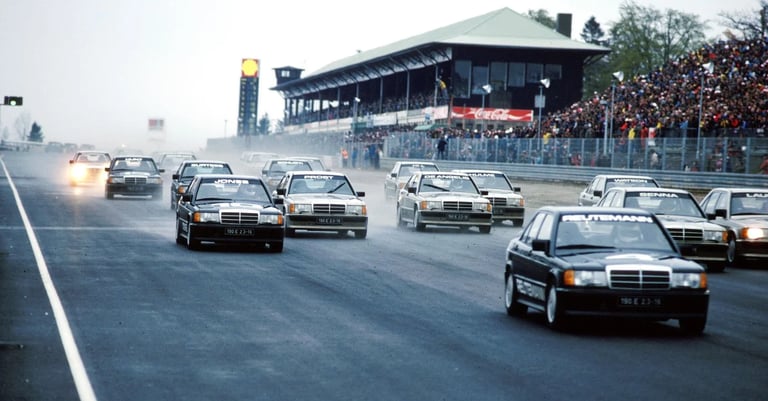
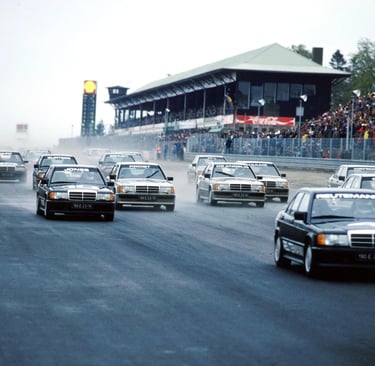
Senna qualifies in third position on the grid — after Prost and Reutemann. When the lights go out and the twenty Mercedes-Benz 190 E 2.3-16 cars accelerate away from the grid in a chorus of identical four-cylinder engines, the initial order holds. Senna is third, patient for the moment, watching, calculating. The circuit is new and demanding, requiring the respect and intelligence that separate the best drivers from the merely fast ones.
Alain Prost made a strong getaway from pole position, with Senna running third behind Carlos Reutemann. The official broadcast missed the critical opening moments due to an extended pre-race speech that ran overtime, but detailed eyewitness accounts confirm exactly what happened next.
On the first lap, Senna executed a decisive maneuver against Prost, forcing the Frenchman to take a wide line off the ideal racing trajectory and seizing the lead. Prost, attempting to recover positions, became involved in minor contact with Elio de Angelis moments later. This incident required a brief pit stop and dropped him to 15th place — the position in which he ultimately finished the race.
This sequence of events allowed Senna to take the lead right from the start and hold it for all 12 remaining laps, demonstrating both calculated aggression and unflinching consistency under pressure.
Leading the Race: Smooth, Precise, Relentless
Once at the front, Senna reveals the second dimension of his genius. The aggression of the overtake on Prost is only half the story. What follows is a masterclass in precision driving that demonstrates a quality even more difficult to teach than outright speed: the ability to maintain absolute commitment to the limit of the car, lap after lap, without ever crossing it.
The Mercedes-Benz 190 E 2.3-16 is a sensitive car, one that communicates its grip levels through the steering wheel and chassis with great honesty. Senna drives it as though he has spent a season in the car: smooth inputs, clean lines, braking with surgical precision, carrying exactly the right amount of speed through each corner to maximize exit acceleration.
This is the Senna signature that engineers and teammates will describe for the rest of his career — the capacity to drive at the very limit of grip in a way that looks unhurried, almost easy, from the outside, while actually extracting every tenth of a second the machinery can offer. Lap after lap.
The Result and Its Echo
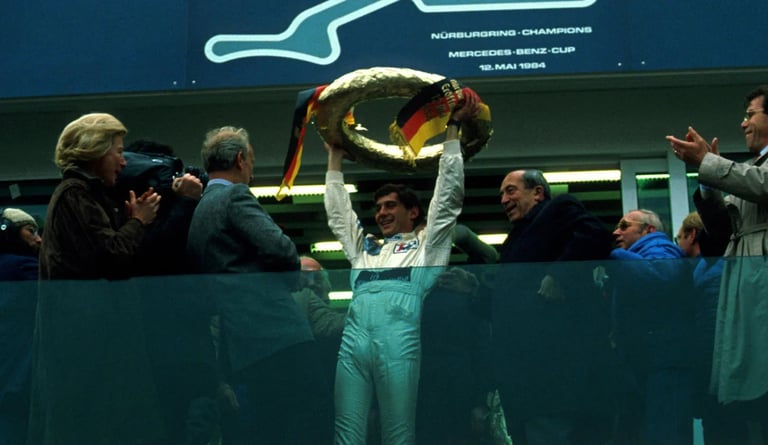
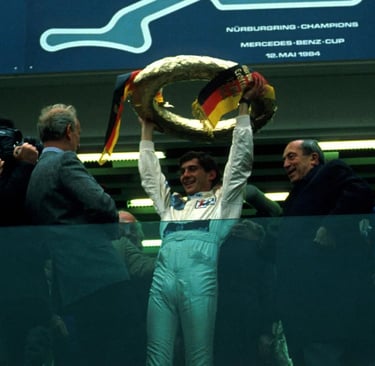
When the chequered flag falls, Ayrton Senna wins the 1984 Nürburgring Race of Champions. He crosses the line ahead of a field that includes a double (future three) world champion in Niki Lauda, a future four-time champion in Alain Prost, a reigning world champion in Keke Rosberg, and a pantheon of Grand Prix winners whose combined career achievements span generations.
Watch this incredible race by clicking the link below
The victory makes immediate noise inside the paddock. For the senior engineers, team principals, and motor racing journalists who witness it, the result is not easily dismissed as an anomaly. The identical-car format eliminates the possibility of a lucky machinery advantage. Senna has won because he drove better — faster, smarter, and more precisely than every champion in that field.
Team principals from the leading Formula 1 outfits — McLaren, Ferrari, Williams — begin to sharpen their interest in a driver who, until this afternoon, was considered a promising rookie at a midfield team.
Senna's position in the hierarchy of Formula 1 shifts that afternoon at Nürburgring. He arrived as a substitute and leaves as something entirely different: the driver who beat nine Formula 1 world champions in equal machinery, who overtook Alain Prost as though the move had been planned days in advance, and who then led the race with a smoothness and precision that belonged to a much more experienced competitor.
The Beginning of a Legend
Looking back across the decades, the 1984 Nürburgring Race of Champions occupies a special place in the story of Ayrton Senna — not because it was his most important victory, nor because it came against the strongest possible competition, but because of what it revealed at the earliest stage of his career.
It showed a driver who could be composed under pressure in unfamiliar machinery. A driver who attacked world champions without hesitation and without error. A driver who, once at the front, raised his own level to match the demands of the lead rather than managing his advantage conservatively. In short, it showed everything that Ayrton Senna would become over the following decade of Formula 1 history — announced clearly and unmistakably, on a sunny afternoon in Germany, while driving a road car at a circuit that was opening its gates to the world for the very first time.
The paddock noticed. The world of motor racing would never quite look at Ayrton Senna the same way again.