The Brabham BT55: Gordon Murray's Radical Gamble That Changed Formula 1 Forever
The 1986 Brabham BT55 was Gordon Murray’s radical "skateboard" F1 car—designed for aerodynamic dominance but doomed by failure, scoring only two points and tragically killing Elio de Angelis when its rear wing failed at Paul Ricard.
CLASSIC MOTORSPORT
6/12/202611 min read
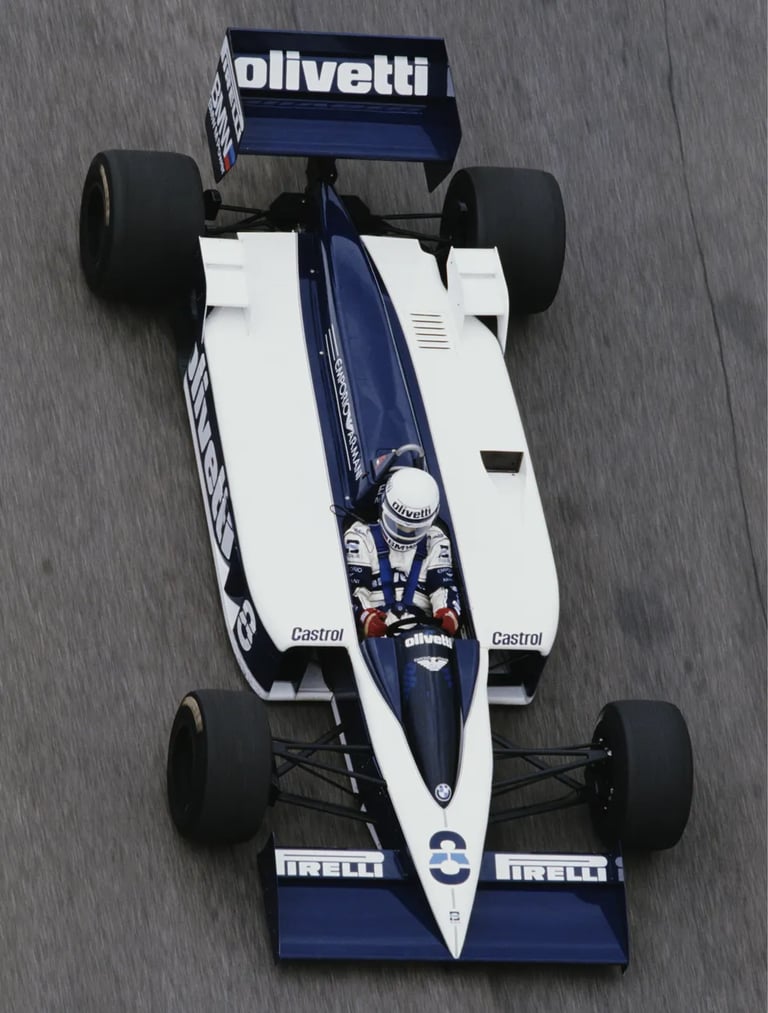
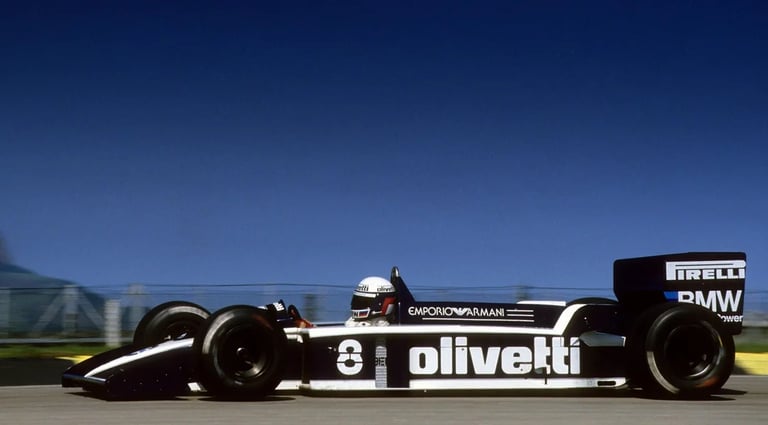
In the annals of Formula 1 history, few cars have generated as much fascination, controversy, and heartbreak as the Brabham BT55. Unveiled at the start of the 1986 season, the BT55 was the most radical Formula 1 car of its era — a low-slung, almost flat machine that looked unlike anything the sport had ever seen. Designed by the brilliant South African engineer Gordon Murray, it was a concept born from pure aerodynamic ambition. Its nickname — the "skateboard" — said everything about how different it looked from the competition. But behind the striking visual identity lay a deeply troubled machine, one that would score just two championship points across an entire season, and more tragically, claim the life of one of the most beloved drivers of the decade.
To understand the BT55, you have to understand the context in which it was created. You have to understand Gordon Murray, the Brabham team, the turbocharged era of Formula 1, and the relentless pursuit of aerodynamic advantage that defined the sport in the 1980s. And you have to understand why a car that was, on paper, a work of engineering genius became, in practice, one of the biggest failures in the history of the sport.
Gordon Murray and the Brabham Legacy
Gordon Murray joined Brabham in 1969 and quickly established himself as one of the most innovative designers in Formula 1. Throughout the 1970s and into the 1980s, his cars were known for their originality and lateral thinking. The BT46B — the infamous "fan car" — had been banned after just one race in 1978 because it was simply too effective. The BT52, which won Nelson Piquet the 1983 World Championship, was widely regarded as one of the most elegant and purposeful machines of its generation.
By the mid-1980s, however, the Brabham team was struggling. After the triumph of 1983, the subsequent seasons had been disappointing. The BT53 and BT54 were competitive but not championship-winning cars. The sport had moved on, and teams like McLaren, Williams, and Ferrari were fielding massively well-resourced operations that Brabham — despite being owned by Bernie Ecclestone, the commercial rights holder of F1 itself — could not quite match. Murray knew that incremental development would not be enough. To compete at the very front of the grid, Brabham needed a revolution. And so, in his characteristic fashion, Gordon Murray decided to tear up the rulebook and start from scratch.
The Concept: Thinking Flat
The core idea behind the BT55 was deceptively simple, but its execution required an almost total reinvention of what a Formula 1 car could be. Murray's starting point was aerodynamics — specifically, the rear wing.
By the mid-1980s, the rear wing had become the single most important aerodynamic element on a Formula 1 car. It generated the majority of the downforce that kept the car glued to the track at high speed, and the quality of the airflow feeding it determined how effective it was. The problem, as Murray saw it, was that the conventional layout of a Formula 1 car — with the driver sitting upright and a tall turbocharged engine behind him — created a massive aerodynamic obstacle. All of that turbulent air arriving at the rear wing was dirty, disturbed, and far less effective than it could be.
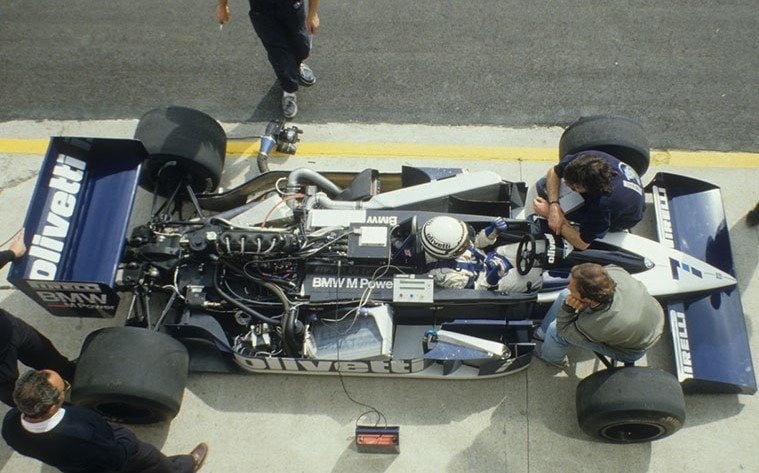
Murray's solution was breathtakingly audacious: make the entire car as flat as possible. By dramatically lowering the profile of the car, he could feed clean, undisturbed air directly to the rear wing, massively increasing its aerodynamic efficiency. Downforce would increase, drag would decrease, and the car would be faster. The concept was elegant and, from a pure aerodynamic standpoint, theoretically sound.
But to achieve this, two fundamental compromises had to be made. First, the driver would have to be reclined — lying at an angle of approximately 30 degrees from the horizontal rather than sitting in a conventional upright position. Second, and even more challenging, the engine itself would have to be tilted on its side.
The BMW Engine: An Engineering Marvel Pushed Too Far
The engine at the heart of the BT55 was the BMW M12/13 — the same four-cylinder turbocharged unit that had powered Brabham to victory in 1983. In standard configuration, the M12/13 was already a remarkable piece of engineering. In qualifying trim, it was capable of producing over 1,350 horsepower from just 1,499cc, making it one of the most powerful engines ever seen in Formula 1. In race specification, output was typically around 900 horsepower — still enormous by any standard.
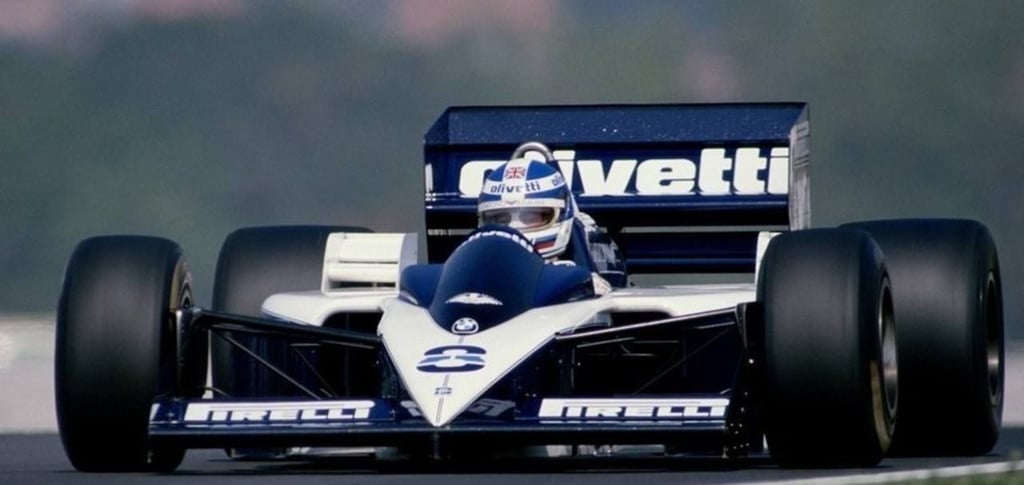
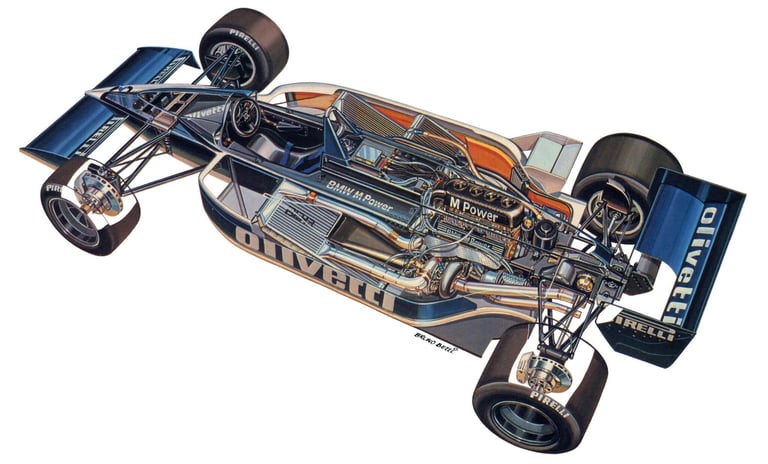
For the BT55, BMW was asked to do something that had never been attempted in Formula 1: tilt the engine over on its side. Specifically, the cylinder axis was inclined at 72 degrees. This allowed the entire engine installation to be dramatically lower, which in turn allowed Murray to create his flat, skateboard-like car with the remarkably low height of just 88 centimeters.
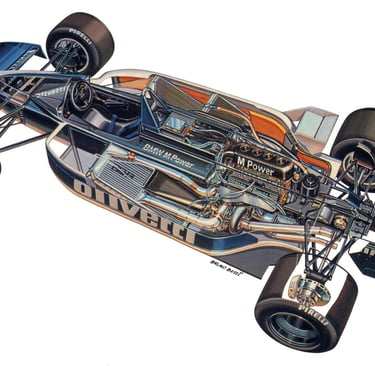
The tilted engine was a tremendous feat of engineering. BMW's technicians had to redesign the lubrication system to work at such an extreme angle, reroute the cooling circuits, and ensure that the turbocharger — which relied on gravity and oil pressure in ways that were now fundamentally altered — could still function reliably. The gearbox was also redesigned specifically for this installation, using a new longitudinal layout that complemented the low profile of the car.
On paper, the package was extraordinary. The BT55 was not only dramatically lower than any competitor — it was also lighter and theoretically more aerodynamically efficient. When it was unveiled, it caused a sensation in the paddock. Rival teams immediately began studying the concept, and several — most notably McLaren, with their MP4/4 — would later incorporate elements of Murray's thinking (Murray himself would move to McLaren after Brabham folded and design the MP4/4, one of the greatest F1 cars of all time).
The Car: Beauty and Dysfunction
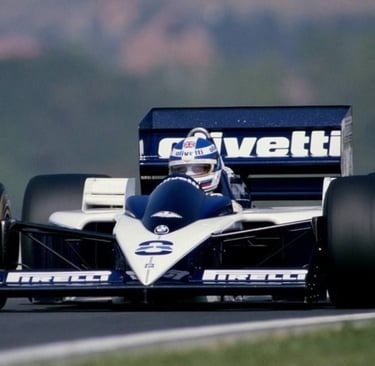
The Brabham BT55 was, visually, one of the most striking cars of the turbo era. Its flat, wide body — wide at the nose and tapering dramatically toward the rear — gave it an almost predatory appearance. The cockpit was elongated and reclined, the sidepods were shallow and sculpted, and the overall impression was of a machine that had been compressed under enormous pressure until it became something entirely new.
The drivers assigned to the BT55 for the 1986 season were Riccardo Patrese and the newest member of the Brabham lineup: Elio de Angelis, the charming, cultured Italian pianist who had spent the previous years at Lotus. De Angelis was considered one of the most complete and intelligent drivers of his generation — a man of genuine sensitivity and precision who was ideally suited to the development work that a new and complex car would require. Derek Warwick was also involved as a test driver and later became a race substitute.
From the moment the BT55 turned a wheel in anger, however, it became clear that something was deeply wrong. The problems were multiple, inter-related, and almost impossible to solve quickly. The engine, tilted so far from its intended orientation, suffered chronic reliability issues. The lubrication system, despite BMW's best efforts, was not fully suited to sustained running at the extreme angle required. Overheating was a constant problem. The gearbox — newly designed and therefore unproven — was fragile and prone to failure.
The aerodynamic gains Murray had predicted did exist, but they came with an unexpected penalty: the flat underbody created unpredictable ground-effect behavior, particularly at the rear of the car, which made the BT55 nervous and difficult to balance. The tires overheated on circuits that demanded sustained high-speed cornering. And the reclined driving position, while innovative, made it harder for drivers to physically manage the car under the enormous lateral G-forces of a fast corner.
A Season of Failure
The 1986 Formula 1 season began in Brazil, at Jacarepaguá, and the BT55 was immediately in trouble. Patrese qualified 14th and retired from the race. The pattern would repeat itself throughout the year. The car was simply not competitive, and more worryingly, it was unreliable in the most fundamental ways — engines failing, gearboxes breaking, the car shedding components that should never have come loose.
By mid-season, it was apparent that the 1986 championship was a battle between the Williams-Hondas of Nigel Mansell and Nelson Piquet, the McLaren-TAGs, and the Ferraris. Brabham was nowhere near that fight. Patrese and de Angelis — and later Warwick, who replaced de Angelis after his death from the Canadian Grand Prix onward — simply tried to keep the car on the road long enough to score points, and in almost every race, they failed to do so.
By the end of the season, the BT55 had scored just two championship points — both credited to Patrese from two separate races, where he finished sixth in both the San Marino Grand Prix and the Detroit Grand Prix — leaving Brabham ninth in the Constructors' Championship. It was a catastrophic result for a team that, just three years earlier, had been world champions.
The BT55 participated in only a handful of Grands Prix in any meaningful competitive sense. The list of mechanical retirements was staggering. Engine failures accounted for the majority of them, followed by gearbox problems and various other mechanical failures that stemmed directly from the compromises inherent in the car's radical design.
The Shadow Over Paul Ricard: The Death of Elio de Angelis
But the most devastating moment associated with the BT55 had nothing to do with championship points or race retirements. It occurred on the morning of May 14th, 1986, at the Circuit Paul Ricard in Le Castellet, in the south of France.
Elio de Angelis was 28 years old. He had already accumulated a record of genuine achievement in Formula 1 — 108 Grands Prix started, two victories, a reputation as one of the most graceful and complete drivers of his era. He was a man of broad culture and intelligence, a concert-level pianist, a person whose presence elevated the paddock. And on that May morning, he was doing what all Formula 1 drivers did routinely — lapping a familiar circuit in a private test session, gathering data, providing feedback, trying to understand the car beneath him.
At approximately 11:00 AM, as de Angelis approached the high-speed S-shaped "La Verrière" curves at around 180 mph (approximately 290 km/h), the rear wing of the BT55/3 failed catastrophically. The rear wing detachment — witnessed by other people at the circuit including former F1 World Champion Alan Jones, who was also testing that day — immediately robbed the car of its rear downforce. The BT55 became instantly unsteerable, pitching violently and entering a series of brutal somersaults before vaulting the guardrail on the right-hand side of the track and coming to rest upside down approximately 100 yards from the initial point of impact.
The violence of the crash was extreme. Yet — and this is the cruel irony that still haunts the story of Elio de Angelis — the impact itself was not what killed him. Investigators and witnesses established that de Angelis had survived the accident with, remarkably, a broken collarbone and some burns on his back. He was alive. He was conscious. He needed help.
And help did not come.
This was a private test session, not a Grand Prix. The Circuit Paul Ricard in 1986, under these conditions, was not required to maintain the same level of marshaling, safety equipment, and emergency response that a race weekend demanded. There was no rescue helicopter on standby. The marshals present at the circuit were not equipped to deal effectively with a serious accident involving a burning Formula 1 car. Alan Jones stopped his own car and ran to help, joined by fellow F1 drivers Alain Prost and Nigel Mansell, but could do little against the growing fire that had engulfed the inverted BT55.
Elio de Angelis remained trapped in the car for approximately 10 minutes before he was extracted. The fire had already engulfed the cockpit. The heat was intense. When help finally arrived, it was already too late. De Angelis had suffered severe smoke inhalation and oxygen deprivation. He was airlifted to the Timone Hospital in Marseille, where surgeons found that he had sustained massive brain damage. The official medical assessment left no room for hope.
Elio de Angelis died on May 15th, 1986 — the day after the accident. The official cause of death was recorded as serious head and chest injuries, but the broader truth was undeniable: he had survived the crash and been killed by the failure of the safety infrastructure around him.
The Formula 1 community was devastated. His Brabham teammate Riccardo Patrese was among those most deeply affected. The paddock mourned not just a driver but a person — a musician, an intellectual, a man who had brought something irreplaceable to the sport. His death at just 28 years old, in the cockpit of a car that was already known to be deeply problematic, cast a long shadow over the rest of the 1986 season.
The Legacy: Safety, Failure, and Murray's Genius Redirected
The death of Elio de Angelis was not without consequence for the sport of Formula 1. In the immediate aftermath, drivers — led by some of the most prominent names in the paddock — made clear to the FIA that the safety standards applied to private test sessions were wholly inadequate. As a direct result of the Paul Ricard accident, the FIA imposed new regulations requiring that test sessions adhere to the same safety standards as race weekends: trained marshals, firefighting equipment, and — most critically — a rescue helicopter on standby at all times.
It was a reform that came at the worst possible price, but it was a reform that undoubtedly saved lives in the years that followed. In this sense, the tragedy of Elio de Angelis left a permanent mark on the sport — not just as a moment of grief, but as a catalyst for change.
As for the BT55, the car was effectively abandoned after the 1986 season. Brabham attempted a recovery with the BT56 in 1987, but the team never regained its former competitiveness. Bernie Ecclestone sold the team in 1987, and although the Brabham name lingered for a few more years under new ownership, it never again competed at the front of the Formula 1 grid. The team that had won constructors' titles and produced world champions simply ceased to be relevant, and the BT55 — the car that was supposed to be its renaissance — was the beginning of its end.
Gordon Murray himself moved to McLaren, where he channeled his genius into the MP4/4 — a car that won 15 of 16 races in 1988 and is widely considered the greatest Formula 1 car ever built. The low-line concept he had pioneered with the BT55, though it had failed in that specific application, influenced the direction of Formula 1 car design for years afterward. Other teams studied the BT55 carefully, taking note of what had worked and what had not. The idea of lowering the car's center of gravity, reducing its profile, and optimizing the airflow to the rear wing became orthodoxies of modern F1 design — even if the extreme solution Murray had pursued in 1986 proved unworkable.
The Brabham BT55 occupies a unique and painful place in Formula 1 history. It was a car that demanded too much — from its engine, from its designers, from its drivers, and ultimately from the safety infrastructure of the sport itself. It was a vision of what Formula 1 could be, executed before the technology and the supporting systems were ready to make it work.
Gordon Murray was not wrong to think the way he thought. He was, as always, years ahead of the consensus. But in 1986, the gap between his vision and the reality of what could be reliably built and raced was simply too large to bridge. The BT55 scored two points and broke the hearts of everyone who worked on it and drove it.
And somewhere in the smoke above Paul Ricard on that May morning, the sport lost one of its most beautiful souls — a man who deserved far better than to be remembered as the driver who died in the worst car of his generation. Elio de Angelis was so much more than that. And so, in its way, was the Brabham BT55 — a tragic monument to the danger and the glory of the pursuit of perfection.