The Day Ferrari Ended 11 Years of Hurt: The 1975 Italian Grand Prix at Monza
CLASSIC MOTORSPORT
3/23/20268 min read
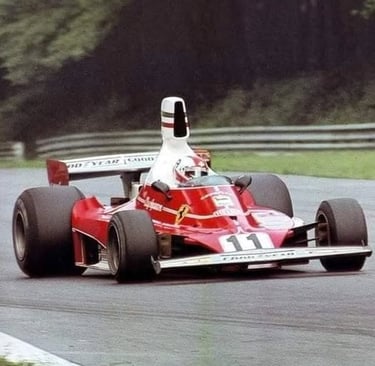
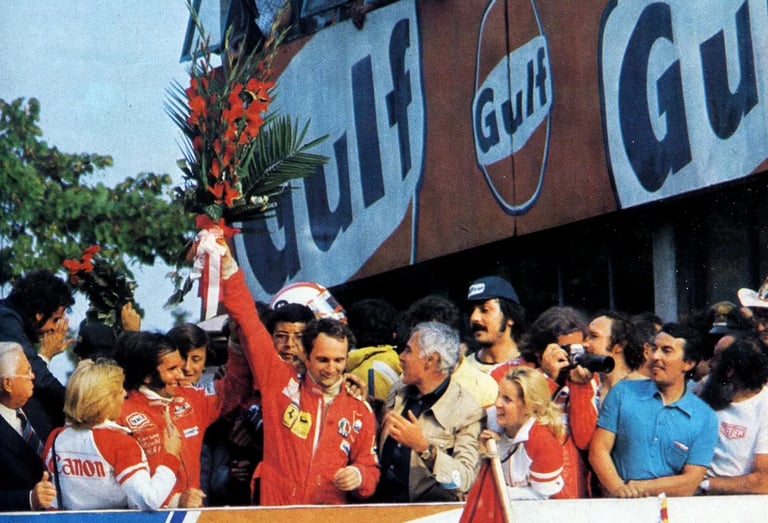
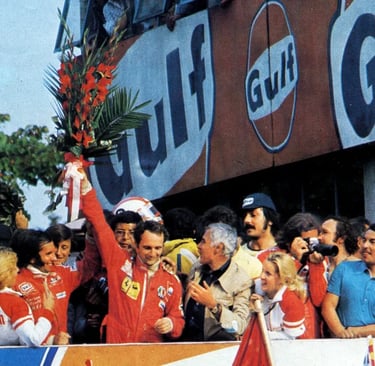
There are moments in Formula 1 history that transcend the sport itself — moments when decades of passion, heartbreak, and relentless engineering ambition converge into a single afternoon of racing glory. September 7, 1975, at the legendary Autodromo Nazionale di Monza was one of those moments. On that Sunday, in front of a sea of red-clad tifosi, Scuderia Ferrari did not merely win a Grand Prix. They reclaimed a dynasty. After eleven long, agonizing years without a World Championship — either for their drivers or for their constructor — Ferrari finally returned to the top of the sport. And they did it at home.
Ferrari's 11-Year Championship Drought
To understand the emotional weight of September 7, 1975, you need to understand what the years between 1964 and 1975 meant to Ferrari. The last time the Prancing Horse had conquered both the Drivers' and Constructors' World Championships was in 1964, when the brilliant John Surtees crossed the finish line in Mexico City to claim the drivers' crown. That triumph also delivered the Constructors' title — but it would prove to be the last taste of glory for a long and painful decade.
Through the late 1960s and into the early 1970s, Ferrari watched rivals like Lotus, Tyrrell, McLaren, and Brabham dominate. The British constructors with their nimble, Cosworth-powered machines seemed untouchable on most circuits. Ferrari's flat-12 engine was powerful but the cars struggled with handling, weight distribution, and aerodynamic efficiency. There were flashes of brilliance — individual race wins, podiums, near-misses — but the championship remained an elusive dream. The tifosi grew restless. The pressure on the Maranello factory was immense.
Then came Mauro Forghieri's masterpiece.
The Ferrari 312T: A Machine Built to Win Everything
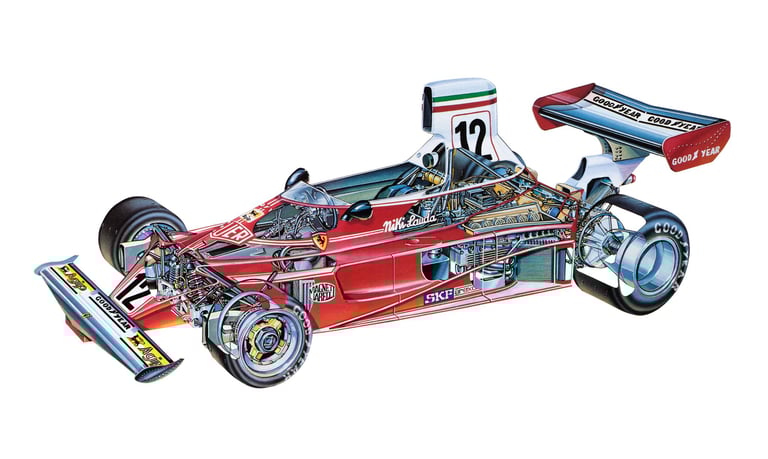
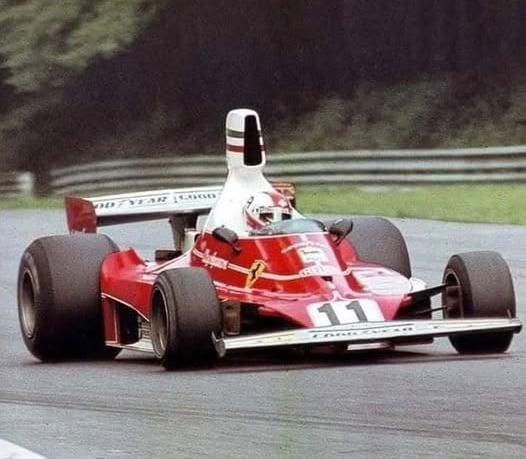
The Ferrari 312T — the "T" standing for trasversale (transverse) — arrived in 1975 as the result of years of refinement and revolutionary thinking. Forghieri, Ferrari's legendary chief engineer, repositioned the five-speed gearbox transversally behind the engine, dramatically lowering the car's center of gravity and transforming its handling. Combined with the thunderous 3.0-litre flat-12 engine, which produced around 490 horsepower, the 312T was a weapon unlike anything Ferrari had fielded in years.
The partnership of Niki Lauda and Clay Regazzoni gave Ferrari the ideal driver lineup. Lauda, the meticulous Austrian perfectionist, was obsessive about car setup and technical feedback. Regazzoni, the fearless Swiss veteran, was the perfect complement — fast, experienced, and capable of delivering on the biggest stages. By the time the Italian Grand Prix arrived on the calendar, the 312T had already secured five victories in the season. Lauda alone had won five races. The championship was not a matter of if — it was a matter of when.
Monza 1975: The Stage is Set
Monza in September is a cathedral of motorsport. The ancient parkland north of Milan hosts one of the fastest circuits in Formula 1, a track where slipstreaming and braking bravery define the racing. In 1975, the circuit measured 5 kilometres in length and would be run over 52 laps for a total race distance of 300 kilometres. The crowd expected a coronation. They got chaos, drama, and then exactly that.
With only two races remaining in the 1975 season — Italy and the United States — Niki Lauda sat atop the Drivers' Championship with a commanding points lead. His only realistic rival was Carlos Reutemann, who needed to win both remaining races and have Lauda finish outside the points in both. As Motor Sport Magazine noted at the time, "the chances of Lauda and Ferrari being beaten for their respective World Championships were so remote as to be non-existent." The air at Monza that weekend was one of inevitability — but Formula 1 rarely surrenders to inevitability without a fight.
Qualifying: The Ferraris Lock Out the Front Row
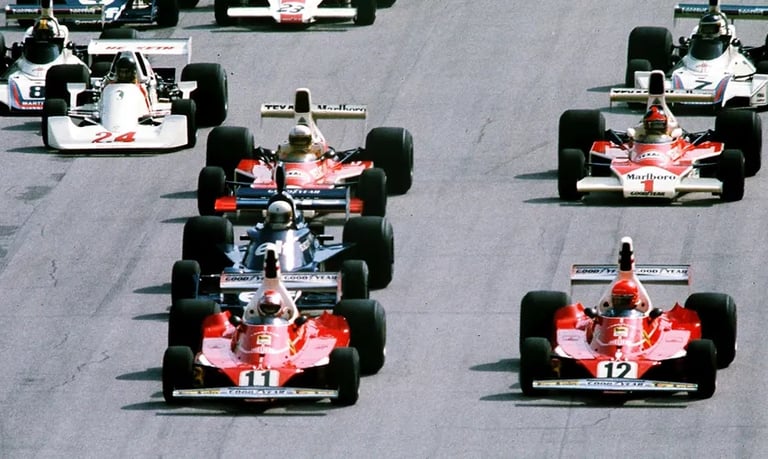
Saturday qualifying only deepened the sense of Ferrari destiny. Niki Lauda stormed to pole position with a lap of 1:32.24 — over half a second clear of his nearest rival. Clay Regazzoni completed a Ferrari front-row lockout with 1:32.75. Emerson Fittipaldi's McLaren M23 was third on 1:33.08, with Jody Scheckter's Tyrrell and Jochen Mass's McLaren completing the top five.
What was remarkable was not merely the gap between the Ferraris and the rest — it was the size of the gap. As Motor Sport Magazine reported, Lauda had "a dominating lead of more than 1.5 seconds over the nearest Cosworth V8 car by the time the first practice session had finished." The Cosworth-powered teams were not sandbagging. They were simply in the presence of something superior. James Hunt qualified eighth, Tom Pryce fourteenth, and Tony Brise a notable sixth for Graham Hill's team — a result that delighted the British constructor on what would prove to be one of his final weekends in Formula 1.
Race Day: Storms, Carnage, and a Moment of History
Sunday morning brought unexpected drama before a single car had turned a wheel in anger. A violent cloudburst swept across Monza, threatening to delay or even cancel the race. For a time, the future of the entire event was in jeopardy. But the storm subsided with roughly an hour to spare before the scheduled start, the track dried rapidly in the Italian sunshine, and the tifosi packed the grandstands, waving their scarlet Ferrari banners.
When the lights went out, Clay Regazzoni immediately asserted himself at the front, leading from his grid position ahead of Lauda and Scheckter.
The opening lap, however, degenerated into chaos at the chicane that had been inserted into the Monza layout for safety reasons. Scheckter was forced to take the escape road as Jochen Mass struck the kerbing and damaged his car's suspension. Ronnie Peterson collided with another car and jammed his throttle open. Mario Andretti and Rolf Stommelen retired with accident damage. Tony Brise spun across the chicane. Harald Ertl's car launched over the top of Hans-Joachim Stuck's machine, damaging the suspension uprights of both. In the space of a single lap, seven competitive cars were either eliminated or mortally wounded. It was the kind of first-lap carnage that only Monza's high-speed nature could produce.
Regazzoni's Masterclass in Ferrari Red
Once the dust settled, the race told a far simpler story. Clay Regazzoni was imperious. He carved out a lead that he never genuinely relinquished, driving with the kind of calm authority that comes from a seasoned champion in a superior machine. Behind him, Niki Lauda slotted into second — content to manage his race and collect the points that mattered.
On lap six, Carlos Pace retired from fourth place with a broken throttle link, further simplifying the midfield picture. By lap fourteen, Emerson Fittipaldi had passed Carlos Reutemann for third, effectively ending Reutemann's slim championship hopes. Reutemann could now only finish fourth, and with Lauda still circulating safely in second, the title equation was rapidly closing.
The narrative of the second half of the race shifted to Fittipaldi's pursuit of the Ferraris. The reigning world champion from Brazil, defending his 1974 crown, was not willing to surrender without a fight. He drove brilliantly, cutting into what had been a ten-second gap to Lauda with considerable urgency. With just six laps remaining, Fittipaldi managed to pass Lauda for second place — a small but meaningful defiance from the McLaren camp. James Hunt and Tom Pryce engaged in a spirited battle for fifth and sixth, adding additional interest behind the leading trio.
Words can only do so much justice to what unfolded at Monza on September 7, 1975. The chaos at the chicane, Regazzoni's commanding lead, Lauda's calculated drive to the title, and the tifosi flooding the track in a sea of red — it all has to be seen to be truly felt. Watch the best moments of this historic race in the video below and experience firsthand why Monza 1975 remains one of the most emotional afternoons in Formula 1 history:
Lauda Seals the Crown: 55.5 Points and a Legend is Born
When Clay Regazzoni swept across the finish line after 52 laps and 1 hour, 22 minutes, and 42.6 seconds of racing, the crowd erupted. It was Regazzoni's third Formula 1 win. It was Ferrari's fifth win of the 1975 season. But the numbers that mattered most were those in the championship table.
Emerson Fittipaldi crossed the line 16.6 seconds behind in second place. Niki Lauda finished third, 23.2 seconds off the lead. Carlos Reutemann was fourth, James Hunt fifth, and Tom Pryce sixth. Those positions meant everything. Lauda's third-place finish gave him enough points to accumulate 55.5 points in the Drivers' Championship — a lead of 16.5 points over Fittipaldi's 39 that was mathematically insurmountable with only one race remaining. Niki Lauda was the 1975 Formula 1 World Champion.
And with Regazzoni adding nine points and Lauda contributing four, Ferrari secured 13 championship points between their two drivers on that single afternoon. Combined with their dominant season haul of 63.5 points, it was enough to also clinch the International Cup for Formula One Manufacturers — the Constructors' Championship — for the first time since 1964. Eleven years of waiting. Eleven years of defeats, near-misses, and engineering revolutions. All of it distilled into one golden afternoon at Monza.
The Tifosi and the Weight of History
The scenes that followed the checkered flag were unlike anything Monza had witnessed in over a decade. Thousands of fans poured onto the circuit — a Monza tradition — but this time carrying the extra weight of eleven years of emotion. Ferrari had not merely won a race on home soil. They had delivered the championship to Italy, back to Maranello, and back to the people who had never stopped believing.
Niki Lauda, ever the pragmatist, was characteristically measured in his celebrations. He had approached the title with the same clinical efficiency he had applied to every race weekend of 1975 — meticulous, fast, and always aware of the bigger picture. In a season where he set the standard for how a modern Formula 1 world championship campaign should be run, Monza was his proof of concept. You didn't need to win every race. You needed to be the best, consistently, week after week.
Clay Regazzoni, meanwhile, earned the adulation he deserved. His victory drive had been flawless — controlled under pressure, aggressive when required, and worthy of a champion. For a man who had been alongside Ferrari through much of the lean years, there was a poetic justice to being the one who stood on the top step of the podium on the day the drought ended.
The 1975 Ferrari 312T's Legacy in Formula 1 History
The 1975 season stands as one of the most dominant single-constructor performances in Formula 1 history up to that point. The Ferrari 312T won six of the season's fourteen races, with Lauda claiming five of those victories. The car's transverse gearbox concept was so effective that Ferrari would continue developing the 312T platform through subsequent seasons — producing variants like the 312T2, T3, and T4 — securing further titles in 1976, 1977, 1979, and beyond.
Mauro Forghieri's engineering genius, the smooth partnership between Lauda and Regazzoni, and the institutional willpower of Enzo Ferrari himself had produced something greater than the sum of its parts. After years of watching British teams dictate the terms of Formula 1, Ferrari had reasserted themselves not just as competitors, but as the sport's definitive superpower.
Fifty years on, the 1975 Italian Grand Prix remains one of the defining chapters in Formula 1's rich history. It was the race that confirmed a new era, the moment that vindicated years of Ferrari's suffering, and the afternoon when a young Austrian named Niki Lauda announced himself to the world as one of the greatest drivers the sport had ever seen.
It was also a reminder of what makes Formula 1 unique among all sports: the convergence of human skill, mechanical engineering, national passion, and historic circumstance into 52 laps of breathtaking competition. Monza delivered all of that on September 7, 1975 — and the echoes of that day still resonate every single time the red cars of Ferrari return to the Temple of Speed.