The Greatest Comeback in Formula 1 History: Niki Lauda at Monza, 1976
In August 1976, doctors didn't expect Niki Lauda to survive. Six weeks later, he was racing at Monza — and finished fourth. The full story of the day a champion defied death, the paddock, and every limit of human endurance.
CLASSIC MOTORSPORT
5/14/202612 min read
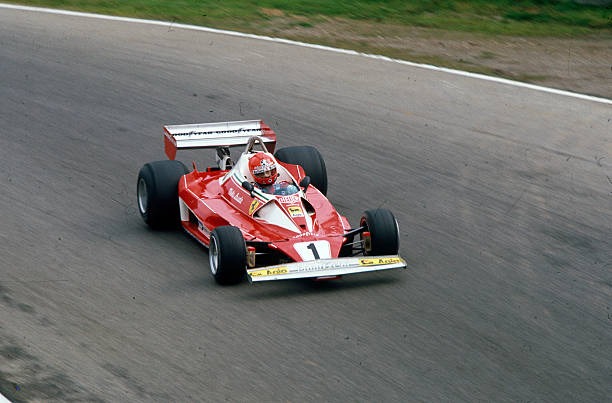
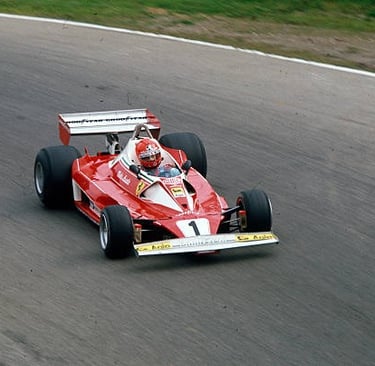
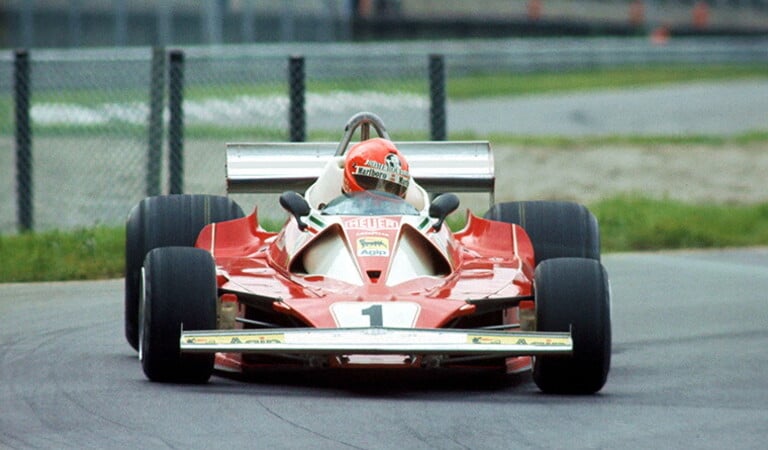
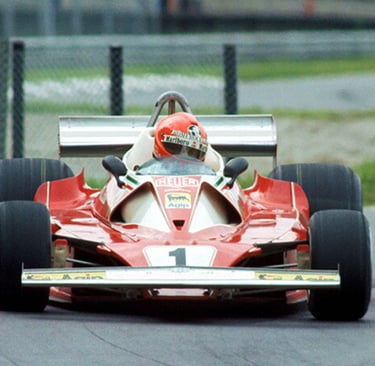
There are moments in sport that transcend competition. Moments that stop being about points, championships, or records, and become something far more fundamental — a statement about the human will to survive, to fight, and to refuse the verdict of fate. The 1976 Italian Grand Prix at Monza was one of those moments. It was the day Niki Lauda, a man who had been administered the last rites just forty-two days earlier, climbed back into a Ferrari cockpit and raced against the best drivers in the world.
What happened that weekend at the Autodromo Nazionale di Monza was, without question, the greatest comeback the sport has ever witnessed — and likely will ever witness. This is the full story of how it happened.
The Tragedy That Should Have Ended Everything
To understand Monza, you must first understand the Nürburgring.
August 1st, 1976. The German Grand Prix was approaching its second lap when Lauda's Ferrari 312T2 inexplicably lost control at the Bergwerk section of the legendary Nordschleife. The car hit the barriers, bounced back into the middle of the track, and erupted into flames. Lauda was trapped inside the inferno for nearly a minute before fellow drivers Arturo Merzario, Guy Edwards, Harald Ertl, and Brett Lunger risked their own lives to pull him free.
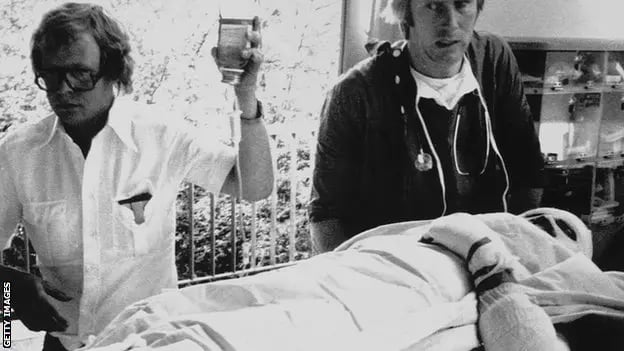
The images that emerged were horrifying. Lauda's helmet had come off during the crash, leaving his face and scalp exposed to direct flame. He suffered severe burns to his face, head, and hands. Far more dangerous, however, was the toxic smoke he had inhaled — the fumes scarred his lungs and airways, and the resulting internal damage was catastrophic. By the time he arrived at hospital, Niki Lauda was fighting for his life. Doctors gave him little chance of survival. A priest was called to administer the last rites.
In a story that would become legendary, Lauda later said that hearing the priest performing those final rites was what sparked his will to survive — a kind of defiant internal response to the formal announcement of his death. He chose to fight.
42 Days: A Recovery No Doctor Could Explain
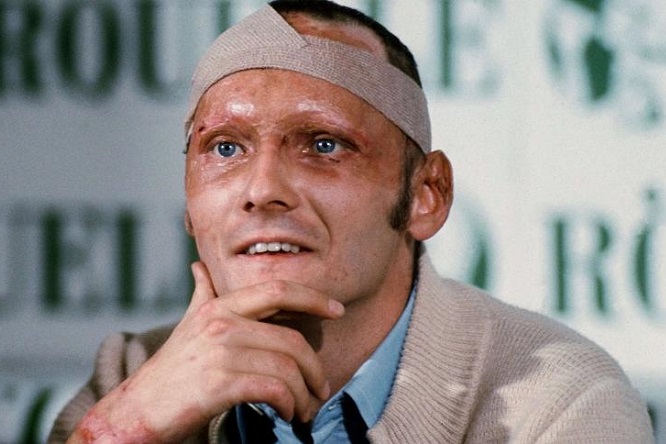
What followed the accident was an extraordinary medical battle. Lauda underwent multiple surgeries. His face was disfigured by the burns — his right ear was almost completely destroyed, his eyelids were damaged to the point that he could no longer fully close his eyes, and the scarring across his scalp and cheekbones would remain visible for the rest of his life. The burns were raw, open, and agonizing. Doctors who treated him were astonished he survived the first 48 hours.
Yet within weeks, Lauda was demanding discharge papers.
The Formula 1 world had moved on with a mixture of grief and pragmatism. Ferrari's team manager Daniele Audetto later recalled being ordered by the team almost immediately after the accident to find a replacement driver. Carlos Reutemann, who was racing for Brabham but deeply unhappy with its Alfa Romeo engines, was contacted. The Argentine bought himself out of his Brabham contract and signed with Ferrari to partner Clay Regazzoni for the remainder of the season.
For most people, the case was closed. Niki Lauda's racing career was over.
But Lauda had other ideas.
The Fiorano Test: Convincing Enzo Ferrari
By early September — barely five weeks after the accident — Lauda had walked out of hospital against medical advice. He had lost more than 10 kilograms. His overalls hung from his frame like a costume. His face, still wrapped in bandages and covered in raw scar tissue, was a shocking sight. Yet he arrived at Ferrari's private Fiorano test circuit with one singular intention: to prove he was fit to race at Monza.
Daniele Audetto, who had witnessed Lauda being loaded unconscious into a helicopter at the Nürburgring while thinking he would never see the Austrian alive again, described that moment at Fiorano in extraordinary detail years later. "When he arrived, that is a vision that I can never forget in my life: Niki arrived in Fiorano with his plane that he apparently flew himself to come to Bologna. He was so pale, plenty of scars, he lost hair, he could not close his eyes — he was like a ghost," Audetto recalled.
Lauda went straight to the office, picked up a set of overalls — oversized now, given his dramatic weight loss — and walked to the car.
His first laps were slow. Tentative, even. Those watching could see a man relearning the language of speed, testing the limits of a body that had been through the unimaginable. But then something shifted. After stopping to adjust his seatbelts — which had been loose, allowing the car's lateral forces to throw his damaged body around — Lauda returned to the track and proceeded to complete 60 laps. By the end of the session, he had nearly broken the Fiorano lap record.
The times were presented to Enzo Ferrari.
Ferrari's relationship with Lauda had never been warm. Il Commendatore was not a sentimental man. He was a builder of champions, not a caretaker of them. When Lauda had been absent, Ferrari had moved forward with ruthless efficiency. Now faced with Lauda's return, he was, according to those present, more skeptical than admiring — concerned not just about Lauda's physical state, but about his mental readiness to race again so soon after such a trauma.
But the lap times were undeniable. Ferrari gave the order: prepare a third car. Reutemann, Regazzoni, and Lauda would all race at Monza.
The Championship Context
The significance of what was happening extended well beyond one race weekend. In 1976, Niki Lauda had been dominant. After winning the World Championship in 1975 with Ferrari, he had started 1976 as the clear favorite, and by mid-season his lead in the drivers' standings was commanding. The Nürburgring crash had changed everything — not just physically, but mathematically.
While Lauda lay in hospital, James Hunt had been racing. The charismatic, fast, and occasionally reckless Englishman driving for McLaren had seized the opportunity presented by Lauda's absence, winning race after race and clawing back points. By the time the Italian GP arrived, Lauda was still ahead in the championship, but Hunt had closed the gap to just 14 points.
A championship that had seemed inevitable now hung in the balance. And the man who had built that lead was still covered in bandages.
Arrival at Monza: The Paddock Falls Silent
The Autodromo Nazionale di Monza had itself been modified for 1976. Two new chicanes had been added — one before the Curva Grande and another before the Lesmo corners — significantly altering the flow of a circuit that had been largely unchanged for decades. The paddock atmosphere that weekend was already heightened by the political and technical drama surrounding several teams.
But when Niki Lauda walked through the gates at Monza, everything else stopped.
Mechanics, journalists, rival drivers, officials — everyone who saw him had the same reaction: shock. This was not a man who had suffered minor burns and taken some time to recover. This was a man whose face still bore the raw, unhealed marks of catastrophic burns. His eyelids were damaged and swollen. Every time he put on or removed his racing helmet, the friction against his healing skin caused pain that, by his own account, was nearly unbearable. His vision was slightly impaired due to the damage to his eyelids — he could not fully close his eyes, meaning that dust, debris, and even wind created additional discomfort at racing speeds.
The medical staff at Monza required him to undergo a second physical examination before he would be permitted to race. Lauda was furious. In his view, the fact that he was standing there, having driven a Ferrari to near-record times at Fiorano just days earlier, was examination enough. He passed the medical, but the resentment lingered.
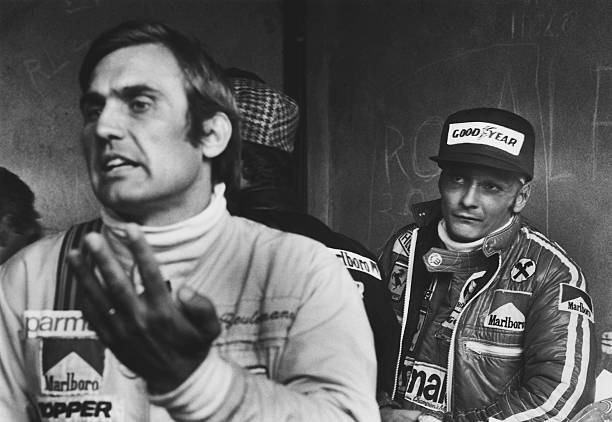
The other drivers said little publicly, but privately the reaction was unanimous astonishment. Many had attended what they had believed was effectively a farewell to Lauda's career. Some had expected to never see him on a racetrack again. And yet here he was, in his red Ferrari overalls, preparing to qualify.
Friday Qualifying: Fear Returns
The first qualifying session on Friday was held in wet conditions — a circumstance that immediately amplified the psychological difficulty of Lauda's situation.
Wet racing in Formula 1 demands a level of physical and mental commitment that even the most seasoned drivers find demanding under normal circumstances. For Lauda, whose burns were still healing, whose body was still physically depleted, and whose memory of what a sliding car had done to him barely six weeks earlier was entirely fresh, the conditions were a direct confrontation with his deepest fears.
He later admitted, with characteristic candor, that he was scared. The sensation of the Ferrari moving beneath him on the wet asphalt triggered an instinctive fear response — something foreign to a driver who had built his entire reputation on cold, calculated, emotionless precision. "It was like a pilot reacting to every air pocket," he said. "Not the way you should feel."
That evening, alone in his hotel room, Lauda conducted what can only be described as a private psychological audit. He examined every aspect of his emotional state with the same analytical rigor he applied to car setup and race strategy. He broke down his fear into its components, assessed each one rationally, and reconstructed his mental architecture from the ground up. He was, at his core, a man who trusted logic above emotion — and logic told him he could still drive a Formula 1 car fast.
He went to bed determined. The next morning, a different man arrived at the circuit.
Saturday Qualifying: Point Proven
The Saturday session was dry, and the grid that emerged told a story of its own.
Pole position went to Jacques Laffite in the Ligier-Matra JS5 — a genuinely competitive car that season. Second was Jody Scheckter in the distinctive six-wheel Tyrrell P34. Carlos Pace occupied third in the Brabham-Alfa Romeo, and Patrick Depailler was fourth in the second Tyrrell.
Fifth was Niki Lauda. Ferrari number one.
The significance of that position cannot be overstated. Reutemann — the man Ferrari had hired specifically to replace Lauda, a highly capable and experienced Grand Prix driver — qualified seventh, two positions behind his teammate. Regazzoni, the other Ferrari, was ninth. Lauda, in a body still recovering from burns, driving with painful eyelids and impaired vision, had out-qualified both of his Ferrari teammates.
Meanwhile, the session had been turned upside down by a fuel controversy. Post-qualifying samples from the McLaren and Penske teams revealed that Hunt, Jochen Mass, and John Watson had been running fuel above the maximum permitted 101-octane limit. All three were stripped of their Saturday qualifying times. Since Friday's wet session had been essentially useless for setting representative times, this effectively meant they had not qualified.
The situation was resolved through a series of negotiations — Guy Edwards agreed to withdraw his Hesketh entry to allow Hunt, Watson, and Mass to race — but it confirmed the frenetic, almost chaotic nature of a weekend that had already been dominated by one man's presence.
Race Day: The World Watching
Race day at Monza that September brought the kind of expectation that transcends normal sporting tension. The Italian crowd, the tifosi, were passionate about Ferrari above all else, and the sight of Lauda in the number one car carried enormous emotional weight. These were the people who had mourned his accident, who had followed every bulletin from the hospital, who had prayed for his survival. Now he was here.
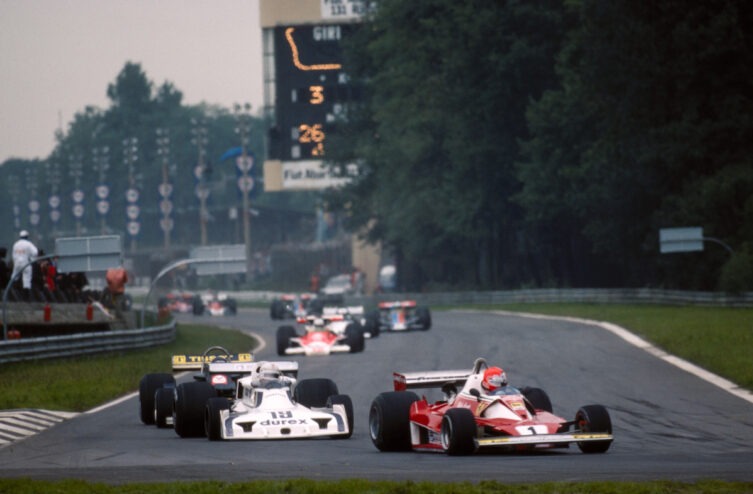
At the start, the race order quickly reshuffled. Scheckter pushed ahead of Laffite through the first chicane, with the field bunching and jostling in the way that Monza always produces. Lauda, cautious and measured as he always was in the opening laps, found himself slipping back — as far as 12th by the end of the first lap.
For those watching from the grandstands and from around the world, the early laps raised uncomfortable questions. Was it too soon? Was Lauda's presence on the track a danger to himself and others? Some commentators voiced precisely this concern — that a man in his condition, however extraordinary his determination, could not be expected to race competitively.
What happened next proved them entirely wrong.
Before we get to the race itself, here's something special, two videos, the first one is the full 1976 Italian Grand Prix, exactly as it happened. Every lap, every overtake, every second of Niki Lauda's return to the track, preserved in its entirety. And the second, is a incredible documentary behind the scenes of this legendary moment.
Hit play, and watch a man who had no business being there outrace drivers who were supposed to be in a different league. Some things are better seen than described.
▶ Watch these historic moments at the links below:
The Race: Methodical, Courageous, Magnificent
As the laps accumulated, Lauda's pace steadied and then began to improve. The early caution gave way to the controlled aggression that had made him a world champion. He began picking off cars one by one, not with the spectacular flourishes of a Hunt or a Peterson, but with the precise, unhurried efficiency that was entirely and unmistakably his own.
At the front, Ronnie Peterson had taken the lead for March. Behind him, Regazzoni had worked his way up to second, with Laffite third. The Ferrari team was having a strong race — but the most important Ferrari story was unfolding further back in the field.
On lap 11, James Hunt's McLaren spun out and retired from the race — a result that had direct consequences for the championship standings.
Lauda, meanwhile, was hunting. He passed Scheckter. He closed in on the two Tyrrells. And then came the moment that the Autodromo would never forget: he overtook Carlos Reutemann.
It was a statement of the most profound kind. The man who had been hired to replace Lauda — the man whose seat at Ferrari existed because Lauda was supposed to be finished — found the number one Ferrari in his mirrors and then past him on the road. Reutemann would finish ninth. Lauda would finish fourth.
When Patrick Depailler's Tyrrell suffered engine failure on lap 46 and dropped back to sixth, the final order crystallized: Peterson won for March, Regazzoni was second for Ferrari, Laffite was third in the Ligier, and Niki Lauda — forty-two days after the fire — was fourth.
The time gap to the winner was 19.4 seconds. The gap to Reutemann behind him was 38.1 seconds.
Fourth Place Felt Like a Victory
When Lauda crossed the finish line, the reaction at Monza was not the measured acknowledgment of a solid points finish. The Autodromo roared. The tifosi understood precisely what they had witnessed — something rare and precious: a man who had come back from the edge of death to prove that neither fire, nor pain, nor the consensus of an entire paddock could define the limits of his will.
Daniele Audetto, who had watched from the pit wall, was overcome. "It was something that you have to live this moment to understand how good, how determined, how strong, was Niki Lauda," he said years later. "He was not only a champion — of course he won three world championships — but he was an incredible man. He was controlling inside him not only the emotion but the strength because you can imagine — 40 days before… I saw him in the helicopter, and I was thinking 'I'll never see you alive'. He was racing in Monza and finishing fourth? That's unbelievable."
Three championship points. On paper, a modest return. In reality, one of the most significant results in the history of motor racing.
The Legacy of That Sunday Afternoon
The story, of course, did not end at Monza. The 1976 championship would be decided at the final race of the season, the Japanese Grand Prix at Fuji, in torrential rain. Lauda — his burned eyelids still causing him pain, his vision still compromised — pulled into the pits after two laps and withdrew. He could not see properly, he said, and in those conditions, to continue would have been suicidal. It was the most honest, and perhaps the bravest, decision of his career. Hunt finished third that day, taking the title by a single point.
But the championship of 1976, in all its drama, is remembered today not primarily for who won it. It is remembered for the man who came back from the dead to compete for it.
In 1977, Lauda won the World Championship again. In 1984, driving for McLaren, he won a third title. He became a successful airline entrepreneur, a television commentator, and one of the most respected voices in motorsport until his death in May 2019.
Yet of all the chapters in his extraordinary life, none carries more weight than those 42 days in the summer of 1976 — from a burning Ferrari at the Nürburgring to a fourth-place finish at Monza, achieved in a body that the medical world had declared unlikely to survive, in a car that had been prepared to race without him, in front of a crowd that had never expected to see him again.
Niki Lauda did not win the 1976 Italian Grand Prix. But no one who was there — no driver, no mechanic, no tifoso in the grandstands — has ever forgotten what he did that day.
And no one ever will.