"We Want Hunt": The Day 70,000 Fans Forced Formula 1 to Back Down - British GP 1976
Brands Hatch, 1976. The stewards said no. The crowd said otherwise. And Formula 1 had no choice but to listen.
CLASSIC MOTORSPORT
4/30/20267 min read
A Season on a Knife's Edge
To understand what happened on that sweltering Sunday in Brands Hatch, you must first understand the weight of the 1976 Formula One season. It was not simply a championship battle — it was a clash of worlds. In one corner stood Niki Lauda, the meticulous, calculating Austrian genius driving for Ferrari, already the reigning world champion and a man who treated racing like a science experiment. In the other corner: James Hunt.
Hunt was everything Lauda was not — reckless and charismatic, a man who partied as hard as he raced, who wore his emotions on his fire-resistant sleeve, and who had spent years clawing his way back to the top after financial disaster. By the time the Formula One circus arrived in Britain for the ninth round of the season, Lauda sat comfortably atop the standings with 52 points. Hunt had just 35. The gap was not yet insurmountable, but it felt enormous.
For the British crowd, however, none of that arithmetic mattered. What mattered was their man — racing on home soil, at Brands Hatch, a circuit carved into the English countryside. The last time a British driver had won the British Grand Prix was 18 years earlier.
Saturday: The Stage is Set
Qualifying at Brands Hatch unfolded under blazing heat that would define the entire weekend. It was Niki Lauda who claimed pole position, setting a blistering lap of 1 minute 19.35 seconds in his Ferrari 312 T2 — a time that left the rest of the field scrambling. Hunt pushed hard but could manage only 1:19.41, a mere six hundredths of a second behind. It was enough for second on the grid, and it sent the partisan British crowd into thunderous approval for their man.
Third on the grid went to Mario Andretti, showing the improving pace of the Lotus 77. Clay Regazzoni placed his Ferrari in fourth, and Patrick Depailler was fifth in his Tyrrell. The front row, however, belonged to the two central protagonists of the season — Lauda on the left, Hunt on the right — a visual summary of the championship battle that was consuming Formula One in 1976.
The McLaren team knew the car was quick, but also knew it was fragile. After the chaos of earlier rounds — Hunt had already had wins awarded and then stripped from him that season — the mechanics worked through the night on car number 11, trying to ensure nothing would go wrong. Hunt barely slept. He rarely did before a race he cared about, and there was no race he cared about more than this one.
Lap Zero: Carnage at Paddock Hill Bend
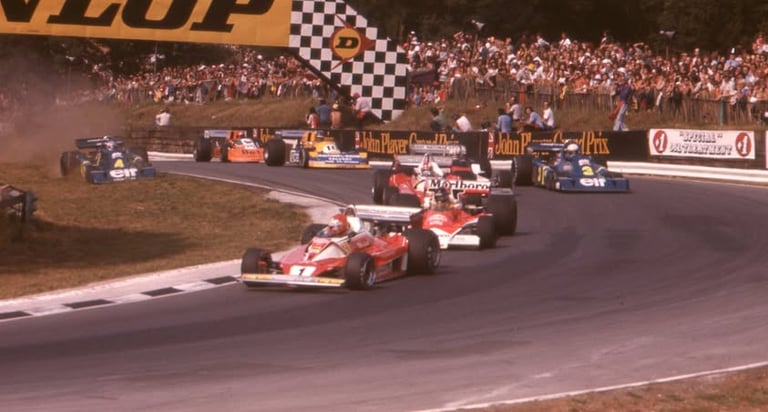
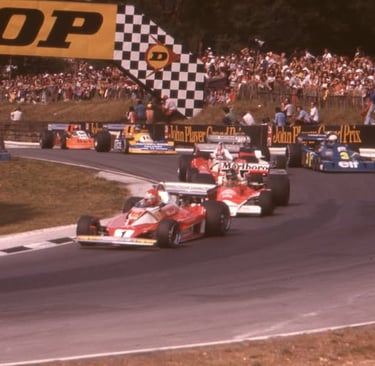
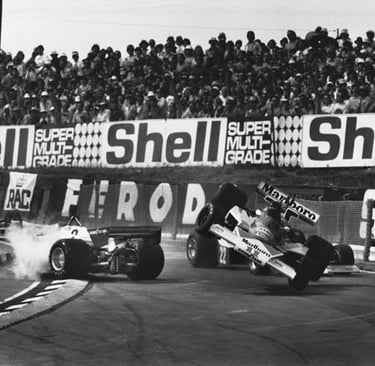
The red lights went out at 2:00 pm. Twenty-six cars launched toward the first corner in a thundering pack, but it was at Paddock Hill Bend — the sweeping, downhill right-hander that demands both courage and precision — that the afternoon's first act of chaos was written.
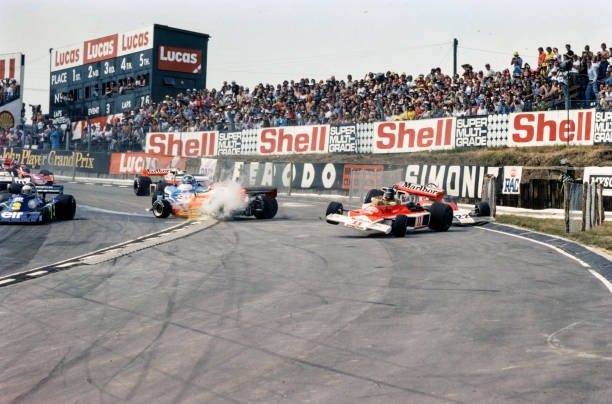
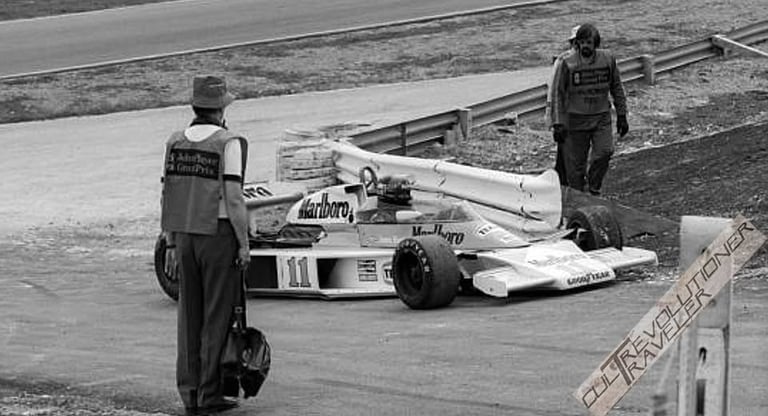
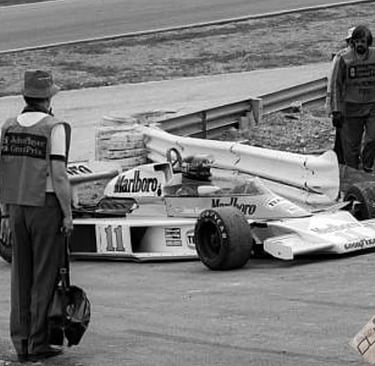
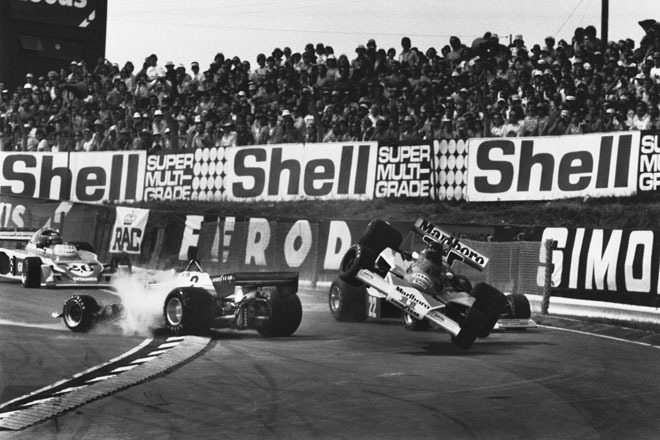
Fighting aggressively for the lead off the line, Regazzoni's Ferrari made contact with Lauda's car as the two Prancing Horses battled for position into the corner. The impact sent Regazzoni spinning violently across the track, his Ferrari slewing sideways directly into the path of the onrushing field. Hunt, following closely behind, had nowhere to go. His McLaren's right rear wheel slammed into Regazzoni's stricken car, launching car number 11 into the air. Several other drivers were also caught in the carnage, the incident unfolding too fast and in too confined a space for anyone to react in time. The red flags came out before the pack had completed the first lap.
Hunt managed to keep his stricken McLaren running — barely — and instead of bringing it around via the full circuit, he took a shortcut through an escape road, rejoining the track and making his way back to the pits. That decision, made in a split second by a driver desperate to save his race car, would haunt him two months later. The McLaren was a mess — bodywork torn away, suspension geometry uncertain, the nose a crumpled testament to the violence of the impact. Hunt climbed out, nursing an injured right hand, as the McLaren mechanics began what looked like an impossible race against the clock.
"He Cannot Start" — The Decision That Ignited a Fire
The regulations in 1976 were, to put it diplomatically, open to interpretation. The crux of the issue was this: Hunt had taken the escape road rather than completing the first lap. Under a strict reading of the regulations, he should not be allowed to take the restart in a repaired car.
The stewards made their decision: James Hunt would not be permitted to take the restart.
This announcement rippled through Brands Hatch like a stone thrown into still water. The moment the word spread across the grandstands, the circuit transformed. What had been a partisan but good-natured crowd became something altogether more volatile.
The first sounds were boos — a chorus of disapproval that grew in volume until it became a roar. Then came the chants, simple and rhythmic, tens of thousands of voices unified: "WE WANT HUNT! WE WANT HUNT! WE WANT HUNT!"*
It wasn't just noise. Bottles, cans, programmes — anything the fans had in their hands — began raining down onto the circuit. The track needed to be clear for the restart, but the fans kept throwing. The situation was deteriorating rapidly from angry protest to something that genuinely threatened public safety.
The Mechanics Work, The Crowd Fights
Inside the McLaren garage, the next thirty minutes were a masterpiece of organised chaos. Every mechanic had a specific task, hands moving at the speed of urgency, pulling off damaged bodywork, assessing the suspension geometry, patching what could be patched. There was no time for neatness. There was only time for function.
"This took half an hour to do all this stuff — arguing," Hunt later recalled, referring to both the bureaucratic battle being fought by team manager Alastair Caldwell in the stewards' room and the mechanical battle being fought in the pits. The two battles were inseparable: every minute the officials spent arguing was another minute for the mechanics to work.
Caldwell fought the decision with every legal argument he could muster, demanding to know exactly which regulation prohibited Hunt from restarting, challenging interpretations, demanding clarity. Outside, the crowd grew louder. Bottles clattered on the tarmac. Marshals formed lines to clear the debris, but it was a losing battle against the will of 70,000 people who felt their hero was being robbed.
The circuit officials began to receive a very clear message: if they did not let Hunt race, there might not be a race at all.
Fearing a Riot: The Reversal That Changed The Officials Decision
The officials blinked.
Faced with the very real prospect of a full-scale crowd riot — debris on the track, fans threatening to breach the barriers, the restart indefinitely delayed — the stewards reversed their decision. Fearing a riot, the organisers felt they had no choice but to let it race.
The announcement over the public address system triggered scenes those present never forgot. The roar from the grandstands was enormous. Flags waved in every direction. People embraced strangers. The crowd had done something unprecedented: they had changed the course of a Formula One race through sheer force of will.
Hunt jogged from the McLaren garage toward his car, pulling on his helmet. Mechanics pushed car number 11 down the pit lane and onto the grid. It wasn't perfect — but it was going to race. Hunt was going to race.
The Race: Fury Transformed Into Speed
When the lights went out for the restart, Hunt launched like a man possessed. Lauda led initially, the Ferrari smooth and authoritative. For 45 laps, the Austrian held position, his precise driving style keeping Hunt at bay. The McLaren was not in perfect shape — it pulled slightly, the steering felt odd — but Hunt pushed through it.
Then Lauda's gearbox began to betray him. The Ferrari started jumping out of gear, robbing him of momentum at critical moments. Hunt sensed the weakness immediately. He moved into attack mode, closing the gap corner by corner until he swept past Lauda in a move that brought the entire circuit to its feet.
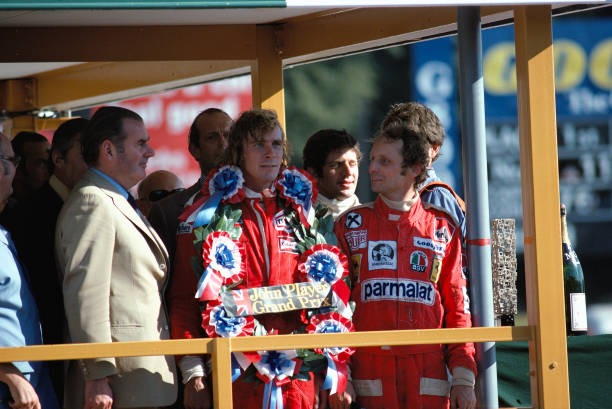
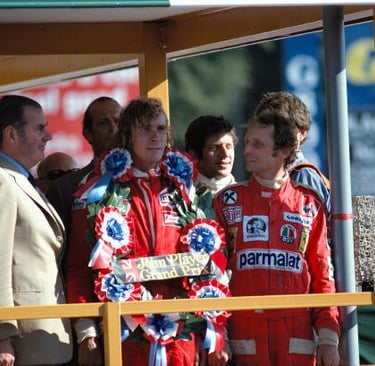
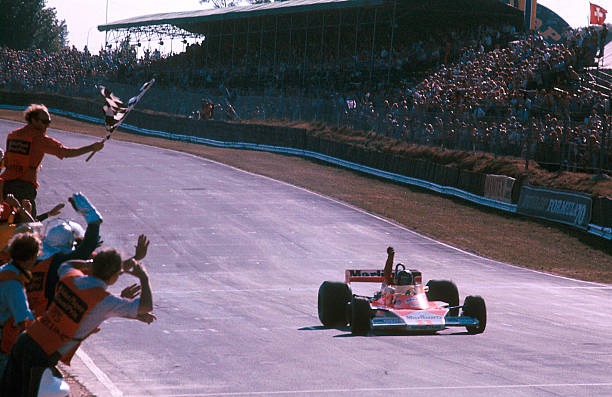
From that moment, Hunt didn't look back. He built his lead methodically, his McLaren — improbably repaired, improbably fast — eating up the laps toward victory. Lauda nursed his ailing Ferrari home in second. When Hunt crossed the finish line, it was a collective triumph.
See the 1976 British Grand Prix at Brands Hatch in full detail — including the infamous restart controversy that nearly ended Hunt's race before it began:
The Aftermath: Victory Given and Taken Away
The post-race joy lasted exactly as long as it took Ferrari, Tyrrell and the Copersucar team to file their official protests. Their argument was the same used earlier: Hunt had not completed the first lap and therefore should not have been allowed to restart. The stewards dismissed the protests in a three-hour meeting held immediately after the flag dropped.
But Ferrari were not finished. Two months later — with three races remaining and Hunt having clawed to within five points of Lauda in the standings — the Italian team escalated their protest to the FIA's Court of Appeal in Paris. The court ruled in Ferrari's favour. Hunt was disqualified. The victory was struck from the record. The nine points became zero.
The championship arithmetic shifted brutally: Hunt, who had been within reach of Lauda, now found himself 17 points behind with 3 races to go. He discovered the verdict during the Canadian Grand Prix weekend at Mosport Park. Furious beyond words, he went out and won the Canadian Grand Prix. He eventually won the world championship by a single point in Japan — a title born, in no small part, from the rage and love of 70,000 British fans on a blazing Sunday afternoon in Kent.
A Race That Became Legend
James Hunt did not win the 1976 British Grand Prix. The record books say so. But ask anyone who was there — anyone who felt the electricity of that afternoon in Kent — and they will tell you a different story. On that day, on that track, under that merciless July sun, Hunt won. The crowd made sure of it.
And then the crowd made sure everyone would remember.