Why the Tyrrell P34 Was Built, Why It Was Abandoned, and What It Could Have Become
The Rise and Fall of the Formula 1’s Most Radical Car
CLASSIC MOTORSPORT
5/12/20268 min read
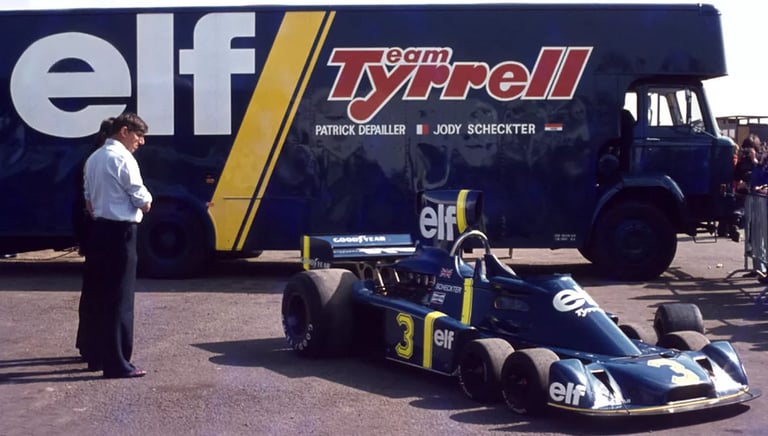
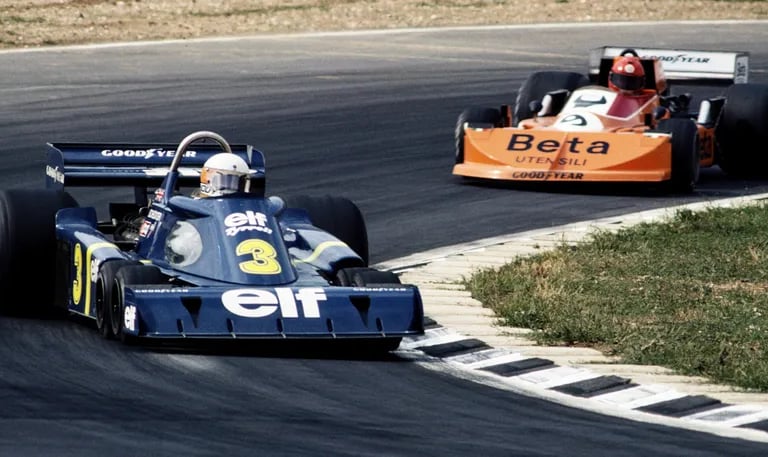
The Tyrrell P34 remains one of the boldest engineering experiments in Formula 1 history because it was not built as a gimmick. It was a serious attempt to solve a real aerodynamic problem in the regulations of the mid-1970s, and for a brief period it worked well enough to become the only six-wheeled car ever to win a Formula 1 Grand Prix. Its short life also makes it a revealing case study in the limits of innovation: the idea was clever, the first results were promising, but the concept depended on a chain of technical and commercial conditions that Formula 1 could not sustain for long.
Why the P34 was conceived
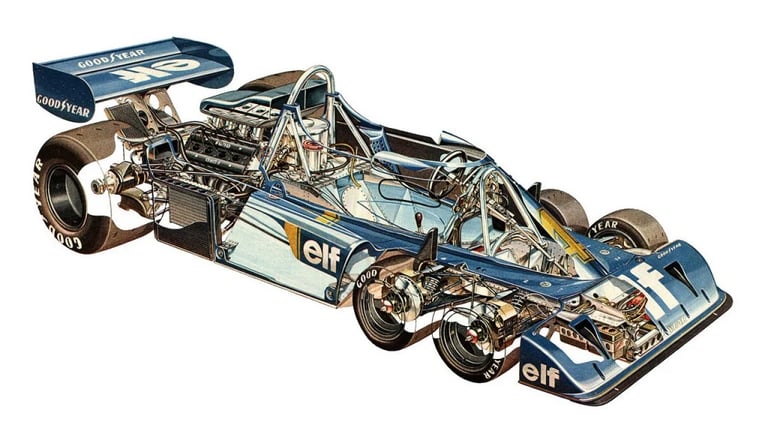
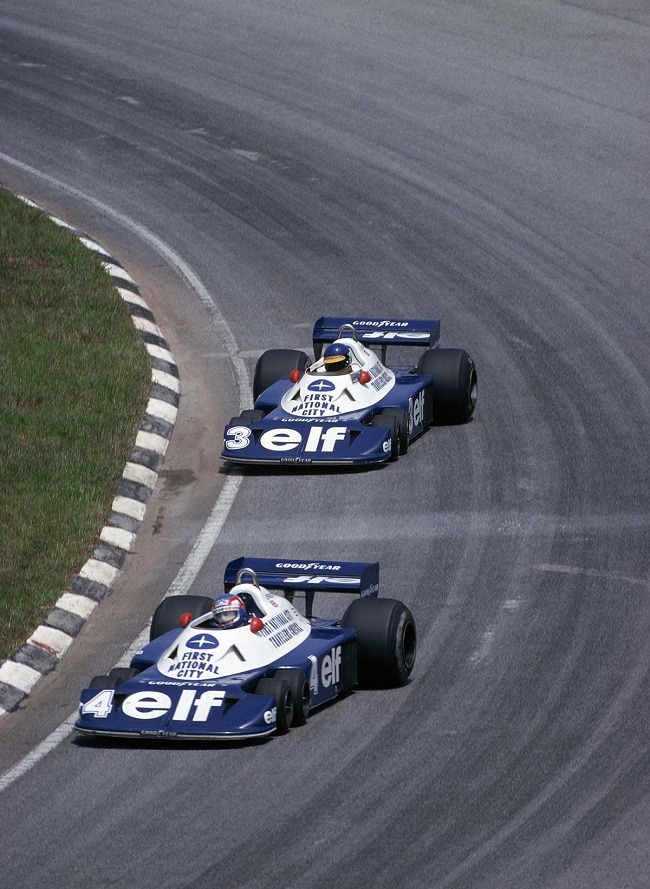
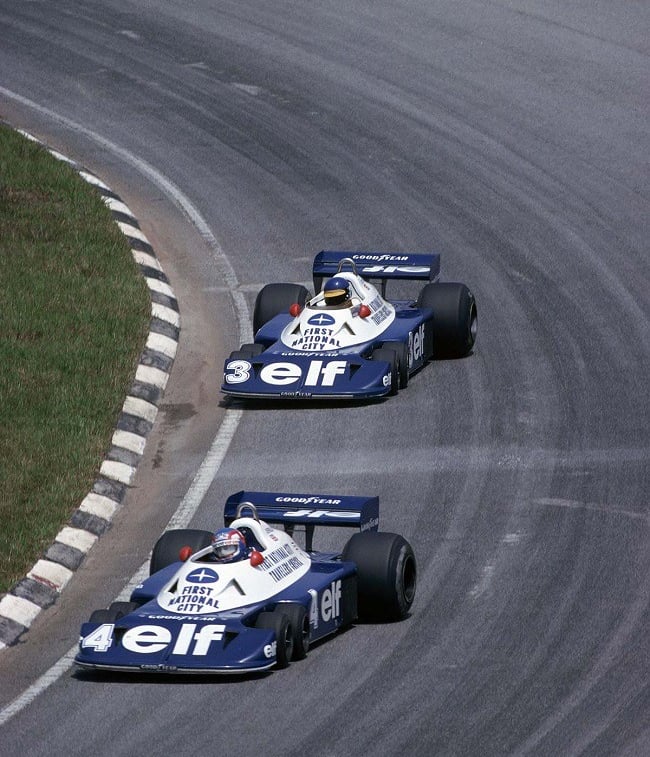
To understand why Tyrrell created the P34, it is necessary to return to the aerodynamic logic of Formula 1 in the 1970s. Regulations limited the width of the front wing to 1.5 metres, which meant the front tyres sat outside the protected airflow of the wing and disturbed the air as it moved around the car. Derek Gardner, Tyrrell’s chief designer, saw that as an opportunity. If the front wheels could be made much smaller, they could be hidden behind the front wing, reducing drag and improving airflow without breaking the rules.
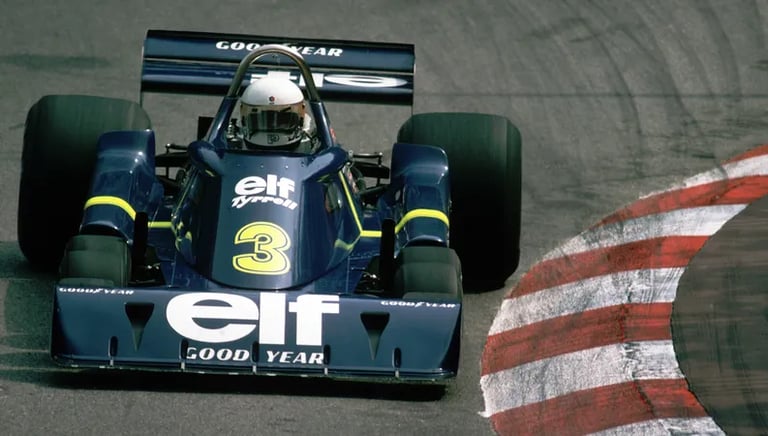
That apparently simple idea immediately created a second problem: tiny front tyres would reduce the contact patch and therefore compromise grip and braking. Gardner’s answer was to use four small front wheels instead of two conventional ones, preserving front-end grip while keeping the frontal area lower than a normal Formula 1 car. In theory, the design offered several benefits at once. It promised cleaner aerodynamics, strong front-end traction, and improved braking capacity.
The car was therefore born from regulation exploitation rather than eccentricity. Gardner himself presented the early version as a research concept at the end of 1975, but testing soon suggested it was more than a laboratory curiosity. Tyrrell compared the P34 with the established 007 during development, and Gardner later said that on any circuit and with either driver, the P34 was quicker.
There were practical side effects too, some of them unexpectedly positive, the design produced greatly reduced brake pad wear and better brake cooling because the small front wheels rotated at higher speeds. Those gains help explain why Tyrrell committed to a complex and expensive architecture instead of abandoning it at the first sign of difficulty.
Why the concept looked so promising in 1976
The P34’s competitive debut reinforced the feeling that Tyrrell had found something special. The car first raced in long-wheelbase form at the 1976 Spanish Grand Prix, where Patrick Depailler qualified strongly, immediately showing that the six-wheeler could be fast against the best cars of its time.
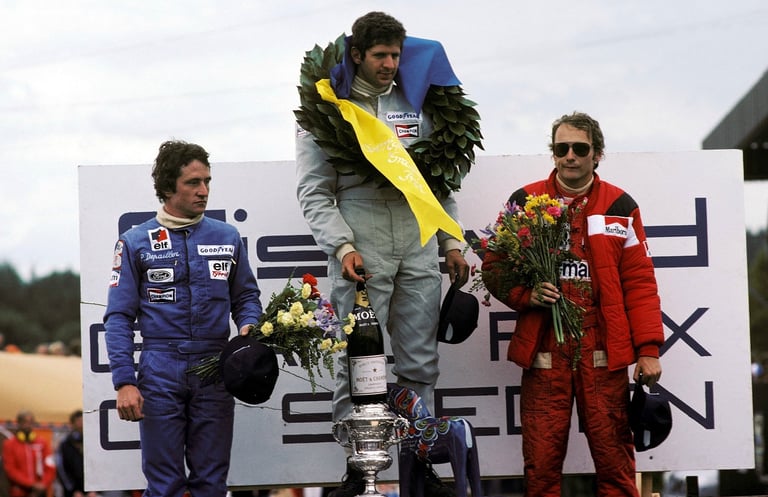
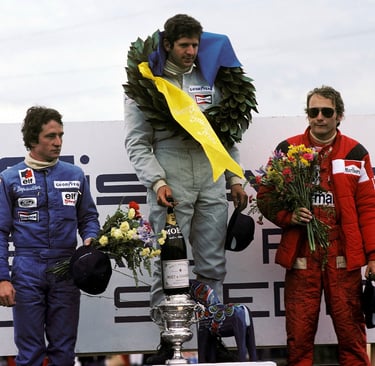
Three races later in Sweden, the project reached its historical peak: Jody Scheckter won and Depailler finished second, giving Tyrrell a one-two finish and making the P34 the only six-wheeled Formula 1 car to win a world championship Grand Prix.
That result was not a fluke in the narrow sense of pure luck. The P34 also placed both cars on the podium one race before in Monaco, while its drivers later finished third and fourth in the Drivers’ Championship and Tyrrell ended the season third in the Constructors’ table. Even critics of the concept must admit that those results place the P34 well above the category of failed experiment.
Part of the promise came from the tracks where the concept could exploit its strengths. The car performed best on circuits with long straights and fast corners, where its reduced drag and enhanced mechanical grip at the front could be translated into lap time. In those conditions, the four small front wheels were part of a coherent performance philosophy.
The project was abandoned after only two seasons
The most direct reason the project died is that its technical problems became harder to solve than its advantages were worth. The P34 was fast, but it was also mechanically and dynamically complicated. The braking system had to balance not just front to rear, but also between two separate front axles, and if one axle locked before the other it could effectively alter the car’s wheelbase during braking, producing unstable handling. That was not a minor tuning issue; it was a fundamental dynamic vulnerability built into the concept.
Drivers felt those problems differently, and their opinions tell an important part of the story. Patrick Depailler appreciated the car’s sharp front end, but Jody Scheckter, despite winning in Sweden, was openly hostile to the concept and later dismissed it as a poor car that only really worked on very smooth circuits. His criticism was especially damaging because Scheckter was both quick and technically sensitive, so his judgment carried weight inside and outside the team.
Track surfaces also exposed the design’s fragility. On bumpy circuits the four front wheels could experience oscillating grip levels, making the car inconsistent and difficult to predict. A concept that depends on smooth surfaces is always vulnerable in a championship that visits many different circuits, because competitive range matters almost as much as peak performance.
The tyre issue was even more decisive. The P34 depended on uniquely small 10-inch front tyres supplied by Goodyear, and those tyres needed constant development if the concept was to remain balanced against the evolving rear tyres used by the rest of the field. While development of regular tyres continued, Tyrrell’s special small front tyres stagnated, creating a worsening grip imbalance between the front and rear as the 1977 season unfolded. In Formula 1, a radical concept cannot survive if its tyre partner is no longer motivated to invest in a niche solution for one team alone.
That problem became more visible when Tyrrell introduced the wider and heavier P34B for 1977. Instead of refining the elegance of the original idea, the team chased mechanical grip by widening the track, which pushed the front tyres out into the airflow and partially destroyed the very aerodynamic advantage that had inspired the six-wheel design in the first place. Once the small front wheels were no longer neatly hidden behind the front wing, the concept started to lose its philosophical and technical coherence.
Results reflected that decline. After a strong 1976, the 1977 P34B struggled with braking and cornering grip, and Tyrrell’s drivers finished far lower in the championship than the year before. At that point the project was no longer a clever alternative path to the future; it had become an expensive development trap.
There was also a broader historical reason for the abandonment. Formula 1 in the late 1970s was moving rapidly toward the next wave of aerodynamic innovation, especially ground effect. A team of Tyrrell’s size had limited resources, and investing those resources in rescuing a tyre-dependent six-wheel concept may have looked less rational than returning to a conventional platform better suited to the direction the sport was taking. Even if six-wheelers were not yet fully shut out by regulation, the strategic momentum of Formula 1 had begun to move elsewhere.
Could six-wheel Formula 1 cars have succeeded with better development conditions?
This is the most intriguing question because the honest answer is yes, but only under a narrow set of conditions. The P34 already proved that a six-wheeled Formula 1 car could be competitive enough to win, score podiums, and finish high in both championships. That alone means the concept should not be treated as a dead end from the moment of its birth.
If the conditions had been more favorable, the project likely had greater development potential than its short life suggests. The first requirement would have been sustained tyre development. A six-wheel front-end architecture depended on tire technology evolving specifically for its needs, and without that support the concept was effectively frozen while conventional rivals improved every month. Had Goodyear treated the P34’s front tyres as a strategic programme rather than a specialist obligation, Tyrrell might have solved some of the balance problems that undermined the 1977 season.
The second requirement would have been a longer and more consistent engineering runway. Radical concepts often need several iterations before their weaknesses are understood and designed out, and the P34 moved from breakthrough to decline before that process was complete. Better simulation tools, more exhaustive testing, and stronger material and suspension development could plausibly have improved the braking consistency, steering geometry, and front-axle interaction that made the car unpredictable.
The third requirement concerns the circuits themselves. Scheckter’s complaint that the car worked best on smooth tracks was not trivial, because ride quality and contact-patch stability matter enormously when two front axles must share load under braking and cornering. In a championship calendar with smoother surfaces and fewer bumps, the six-wheel layout might have converted more of its theoretical advantage into repeatable race performance.
Even under better conditions, however, the concept would probably still have faced structural limits. The complexity of packaging, steering linkages, suspension geometry, and brake balance was inherently greater than on a four-wheel car, and every extra component introduced weight, friction, cost, and setup sensitivity. A successful six-wheeler therefore needed its aerodynamic and mechanical benefits to exceed a very high threshold before it could dominate the conventional alternative.
There is another important caveat. The success ceiling of the P34 must be judged against the direction Formula 1 actually took. Once ground effect became central, teams discovered a much larger performance frontier through underbody aerodynamics, sidepod design, and sealing airflow beneath the car. In that environment, even a more mature six-wheel project might have been overtaken by technologies that promised greater gains with fewer tyre-specific compromises.
So the fairest conclusion is that the six-wheel idea had real but limited potential. It could probably have been developed into a more reliable and more consistently competitive car than the 1977 P34B became, especially with better tyres and more focused support. But it is harder to argue that it would have transformed Formula 1 for a decade or permanently replaced the four-wheel template, because the concept’s benefits were genuine yet conditional, while its difficulties were persistent and expensive.
Legacy of the P34
The Tyrrell P34 deserves to be remembered as one of Formula 1’s clearest examples of intelligent rule interpretation meeting real-world limits. It showed that a six-wheel car could be fast enough to win at the highest level, and it also showed that innovation in motorsport depends not only on a brilliant idea, but on supply chains, tyres, track conditions, driver confidence, and the broader technological direction of the sport.
That is why the P34 still fascinates nearly fifty years later. It succeeded enough to prove its legitimacy, failed enough to remain mysterious, and vanished early enough to leave behind one of Formula 1’s most compelling unanswered questions: not whether the six-wheeler worked, because it clearly did at times, but how far it might have gone if the world around it had been ready to help it evolve.